What do red giants turn helium into?
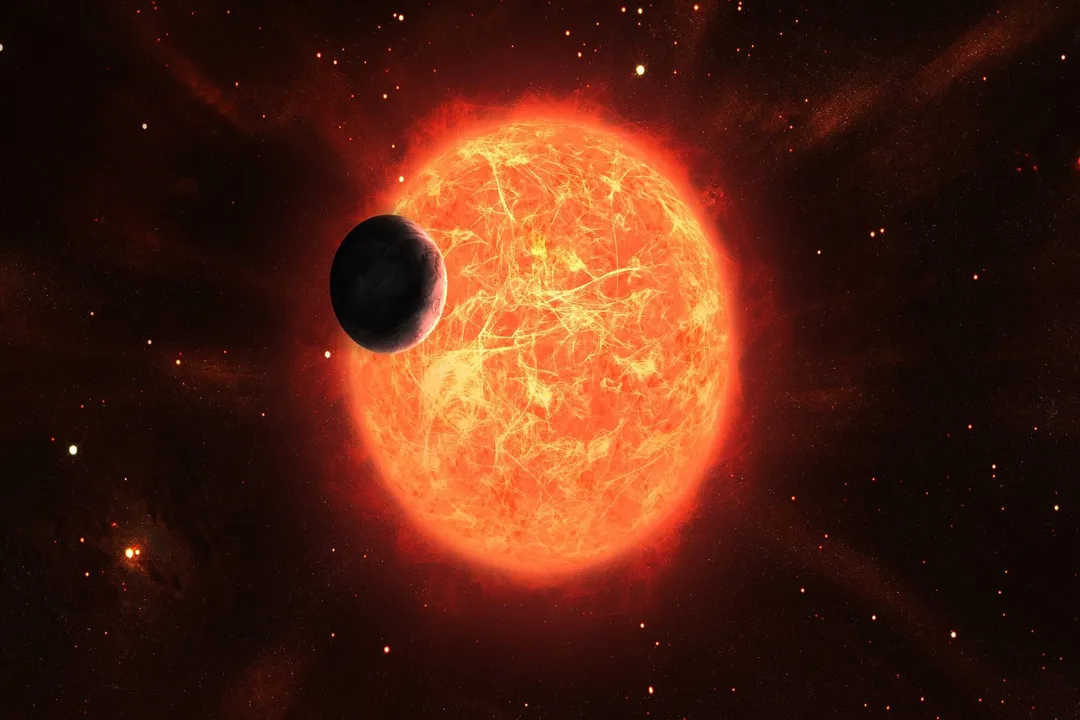
The transformation of a star like our Sun into a red giant marks one of the most dramatic shifts in its long life, a phase dictated entirely by the exhaustion of its primary fuel. When a star has burned through the hydrogen in its core, converting it into helium, the internal dynamics change completely. Gravity begins to win the long-standing battle against thermal pressure, causing the core to contract and heat up immensely. [6][9] This contraction doesn't happen indefinitely; it stops when the core temperature reaches a critical threshold necessary to ignite the next stage of nuclear burning. [3][6]
# Stellar Shift
Stars spend the vast majority of their lives on the Main Sequence, fusing hydrogen into helium in their cores. [6] For a star similar in mass to the Sun, this period lasts about ten billion years. [2] Once the central hydrogen supply is depleted, the core is left primarily filled with inert helium ash, and fusion ceases there temporarily. [9] Without the outward pressure from core fusion, the core contracts under its own weight. [6] This compression, however, has a secondary effect: it heats up the layers of hydrogen just outside the core, causing a shell of hydrogen surrounding the core to begin fusing furiously. [6] This shell burning generates far more energy than core burning did, causing the outer layers of the star to swell outward dramatically and cool down, resulting in the star becoming a luminous, enormous red giant. [1][5] Our own Sun is expected to follow this path. [2][3]
# Ignition Threshold
The fate of the helium core hinges on temperature. For fusion to commence again, the core must achieve temperatures exceeding $100$ million Kelvin ($10^8$ K). [3][5] This temperature is necessary to overcome the powerful electrostatic repulsion between the positively charged helium nuclei, allowing them to get close enough for the strong nuclear force to bind them. [7] It is fascinating to consider that while the Sun’s current core hovers around $15$ million Kelvin to sustain hydrogen fusion, the jump to $100$ million Kelvin represents an almost seven-fold increase in kinetic energy required just to initiate the next stable burning phase. [3] This massive temperature requirement explains why the helium fusion process is not continuous with the hydrogen burning phase but waits until the contraction forces the matter to extreme densities and temperatures.
# Triple Alpha
Once this high temperature is reached, the star begins the process of fusing helium into heavier elements. This specific reaction sequence is known as the triple-alpha process. [4][7] In this process, three helium nuclei, which are also called alpha particles (composed of two protons and two neutrons), are combined. [4]
The reaction occurs in two rapid steps:
- Two helium nuclei () collide to form an isotope of beryllium, specifically beryllium-8 (). [4][7] Beryllium-8 is extremely unstable and has a fleeting existence, typically decaying back into two helium nuclei almost instantly. [4]
- Crucially, before the newly formed can decay, it must successfully capture a third helium nucleus. [4][7] This collision results in the formation of a stable nucleus of carbon-12 (). [4][7]
The entire efficiency of this entire stage of stellar life rests on the near-simultaneous success of that second capture event. If the density and temperature aren't precisely right, the energy produced is insufficient to overcome the repulsive forces for long enough to build the carbon nucleus, halting the process prematurely. [7]
# Elemental Outcome
The primary product created when red giants fuse helium is carbon. [4][7] While the process starts with helium and builds up, the resulting stable element is carbon, which marks a significant step up the periodic table from the star's previous fuel source. [7]
However, the story doesn't necessarily end with carbon. If the star is massive enough and its core continues to contract and heat after the helium has been converted to carbon, a secondary fusion process can begin where carbon nuclei fuse with another helium nucleus. [4]
When a carbon nucleus () captures an alpha particle (), it results in the formation of oxygen-16 (). [4]
Therefore, the helium burning phase in a red giant generates a mixture of carbon and oxygen in the core. [4][7] The relative abundance of these two elements depends heavily on the mass of the star and how long the helium-burning phase lasts. Less massive red giants, like the eventual fate of our Sun, will primarily transition to a stage where the core is composed of this carbon-oxygen mixture, which will eventually become the remnant White Dwarf. [6][8] More massive stars, however, can continue this process, fusing carbon and oxygen further to create elements like neon, magnesium, and silicon, eventually leading up to iron. [4]
# Stellar Legacy
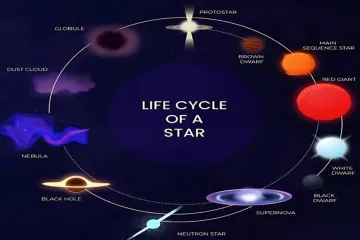
The elements forged in the hearts of these expansive stars are the building blocks for the rest of the cosmos. For stars like the Sun, the helium fusion phase is relatively short, lasting only about a hundred million years—a fraction of its main sequence lifetime. [2] Once the helium is exhausted, the star enters a new phase, often characterized by an inert carbon-oxygen core surrounded by a shell of helium fusion, which itself is surrounded by a hydrogen-fusing shell. [6]
An interesting consequence of this rapid, high-temperature fusion, especially in lower-mass stars, is the event known as the helium flash. [3] In stars like the Sun, the helium core is initially supported by electron degeneracy pressure rather than thermal pressure, meaning the temperature can rise without the volume expanding significantly to cool things down. This leads to a runaway fusion event—the helium flash—which rapidly burns the core's helium until enough thermal pressure builds to overcome degeneracy, allowing the star to settle into a stable, albeit temporary, phase of core carbon/oxygen burning. [3] This delicate balance determines whether the star has enough thermal energy remaining to initiate the fusion of the newly created carbon and oxygen into heavier elements, or if the core simply settles as a white dwarf composed primarily of the products of the triple-alpha reaction. [7] In essence, the efficiency and duration of the helium flash dictate the final composition of the stellar corpse that will eventually cool into a white dwarf, leaving behind a legacy of carbon and oxygen dispersed into the galaxy later on through planetary nebula ejection. [8]
#Videos
Why Do Red Giants Expand? - YouTube
Related Questions
#Citations
Red Giant - ESA/Hubble
and helium-burning red giant stars - NASA ADS
The Sun's core will fuse helium when it becomes a red giant? - Reddit
Why Do Red Giants Expand? - YouTube
Red giant stars: Facts, definition & the future of the sun - Space
Evolution from the Main Sequence to Red Giants | Astronomy
why do red giant stars fuse helium into carbon and oxygen? why ...
Red Giants and White Dwarfs | CK-12 Foundation
Why do stars become red giants? - Astronomy Stack Exchange