How do stars burn helium?
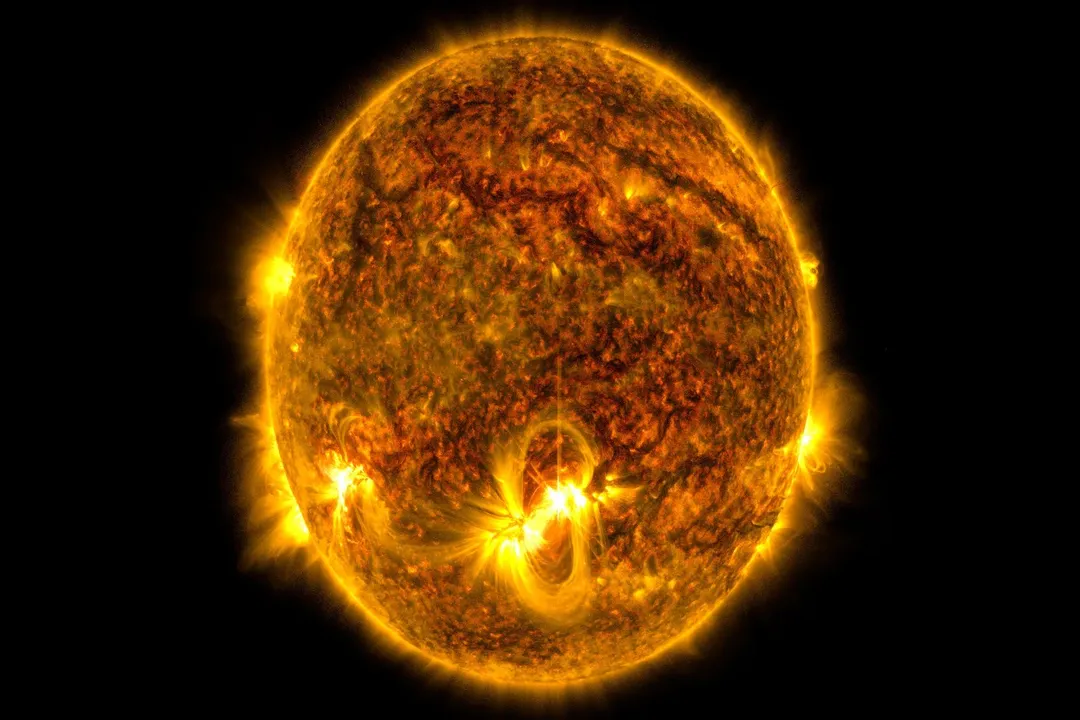
The transition for a star from its long, stable youth burning hydrogen to its more dramatic middle age where it tackles helium fusion marks one of the most significant structural changes in its entire lifespan. For billions of years, a star like our Sun maintains equilibrium through the relentless conversion of hydrogen into helium deep within its core. This thermonuclear furnace generates the outward pressure that perfectly balances the inward crush of gravity, keeping the star in hydrostatic equilibrium. [2] But what happens when the primary fuel, hydrogen, is finally exhausted in the very center? The star doesn't simply go dark; instead, a period of intense structural readjustment begins, eventually leading to the ignition of helium.
# Core Contraction
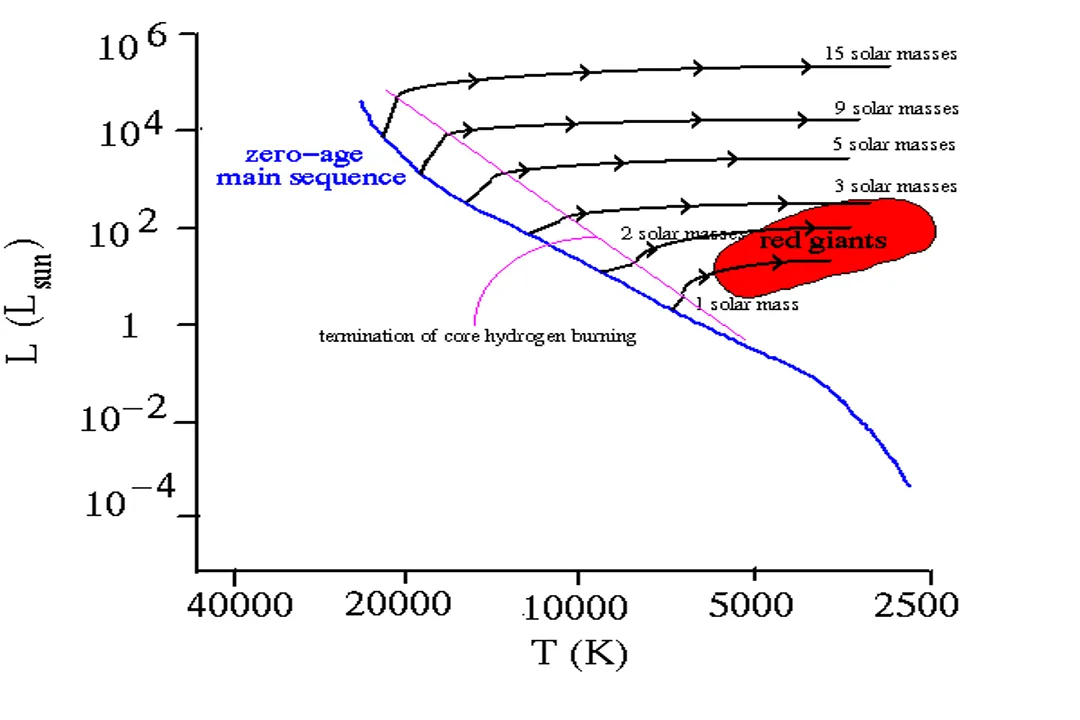
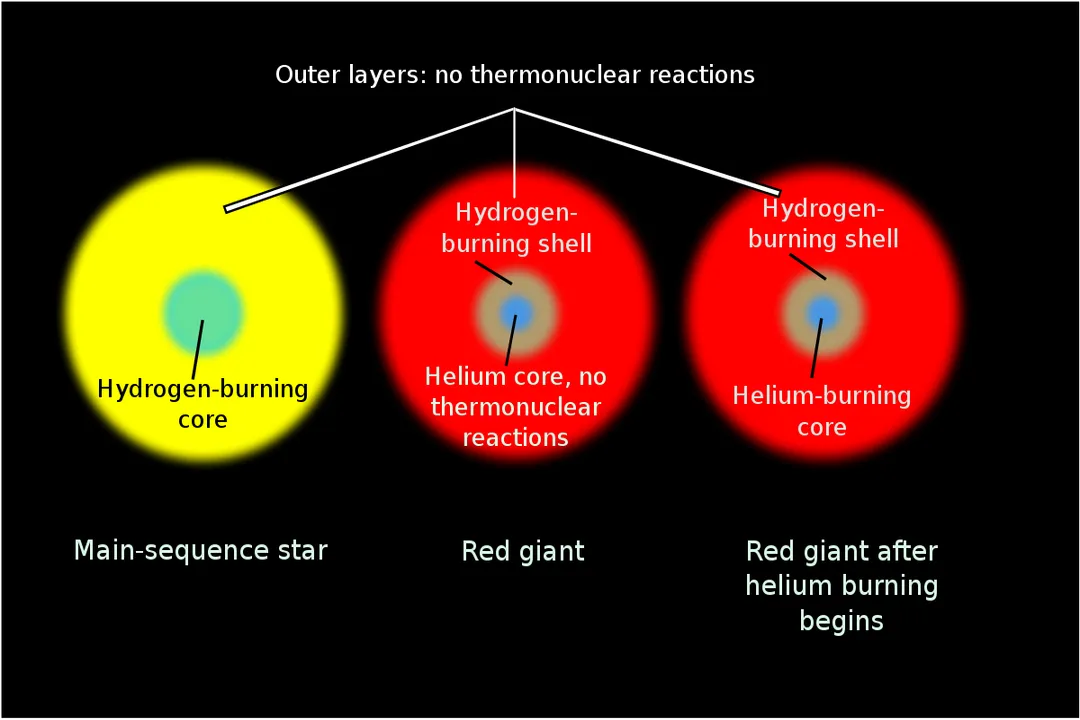
When the hydrogen fuel in the stellar core is depleted, the fusion process stops there. Without the outward thermal pressure supplied by hydrogen burning, gravity immediately wins the local tug-of-war. The inert helium "ash" in the core begins to contract under its own immense weight. [3][4] This gravitational collapse is a runaway process: as the core shrinks, the gas within it is compressed, causing its temperature and density to soar dramatically. [4]
This intense contraction only happens in the core because the outer layers, still rich in hydrogen, begin to fall inward. The material just outside the contracting helium core gets squeezed so tightly that it heats up sufficiently to begin fusing hydrogen in a shell surrounding the now-inert core. [3] This shell burning is highly exothermic—it generates more energy than the core burning did previously. This new, powerful energy source causes the star's outer envelope to swell dramatically, cooling its surface and causing it to transition into a Red Giant. [4]
# Ignition Threshold
The fundamental difference between a star living its main-sequence life and one beginning to burn helium lies in the required temperature. Hydrogen fusion, as seen in main-sequence stars, can occur at relatively lower core temperatures, around $15$ million Kelvin (). [7] However, the process of fusing helium requires significantly more kinetic energy to overcome the stronger electrostatic repulsion between the positively charged helium nuclei.
For helium fusion to commence in the core, the temperature must climb substantially higher, typically reaching about $100$ million Kelvin (). [7] This necessity dictates the star's fate. Only stars with sufficient mass—those significantly more massive than the Sun—can generate enough gravitational pressure during the core contraction phase to reach this extreme temperature threshold in their centers while the core remains gaseous, allowing for a smooth transition to helium burning. [1]
# Triple Alpha
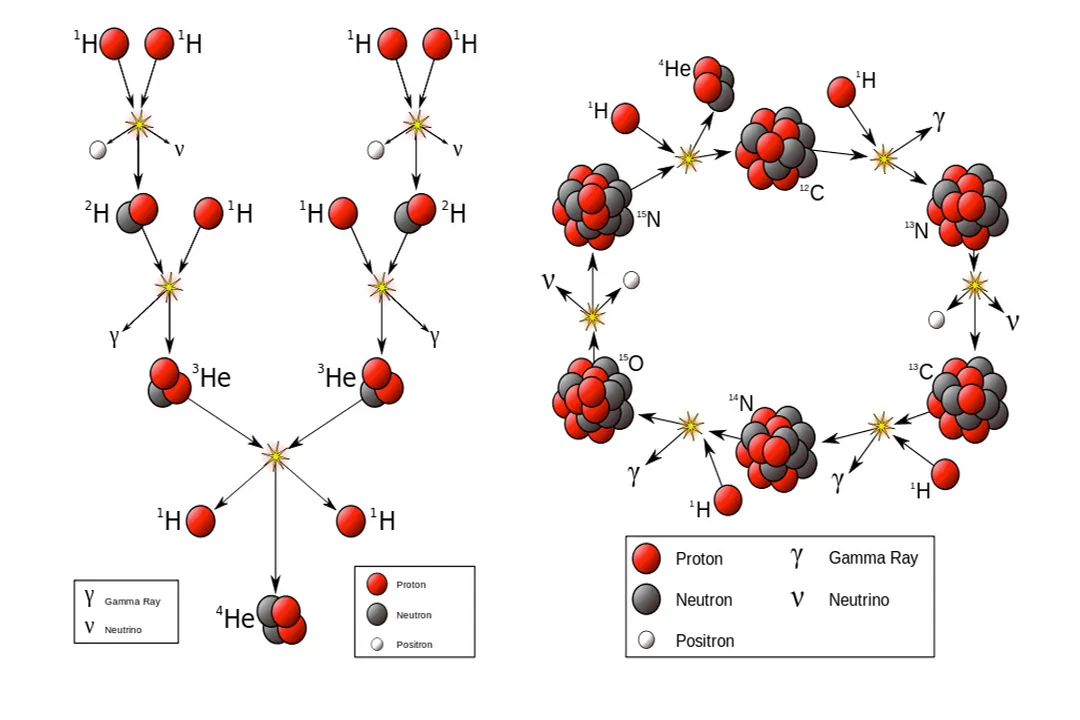
Once the core temperature crosses the mark, the dominant mechanism for consuming helium begins: the Triple-Alpha Process. [6] This is the primary way stars synthesize heavier elements from the primary product of the first stage of stellar life. The term "alpha" refers to the helium nucleus itself, which is identical to a carbon-12 nucleus minus six protons and six neutrons, or more simply, a nucleus. [6]
The process does not occur in a single step because the required collision of three helium nuclei simultaneously is statistically improbable. Instead, it proceeds in two rapid stages. [6][7] First, two helium nuclei collide to form an unstable isotope of beryllium, Beryllium-8 (). [7] This isotope has an extremely short half-life, decaying back into two alpha particles almost immediately. However, if a third helium nucleus encounters the before it decays—which is made possible by the extreme density and temperature in the core—it can fuse with it. [7] This second step forms a stable isotope of carbon, Carbon-12 (). [6][7]
This sequence is crucial because it is the stellar mechanism responsible for creating the first stable carbon atoms in the universe, laying the groundwork for all subsequent carbon-based chemistry and life. [6]
# Degenerate Ignition
The manner in which the Triple-Alpha Process ignites depends critically on the star's mass, specifically whether the core is supported by thermal pressure or electron degeneracy pressure. [1][8]
For stars like the Sun (lower mass stars, roughly $0.5$ to $2$ solar masses), the core contracts so intensely that the helium atoms become packed incredibly close together. At this point, the core matter is degenerate; the outward pressure supporting the core is no longer dependent on temperature but on the quantum mechanical principle that prevents electrons from occupying the same energy state. [1][8]
When the temperature finally hits the mark in this degenerate environment, the Triple-Alpha Process begins. Because the pressure is independent of temperature, the fusion starts explosively. A sudden, massive surge in energy production occurs without an immediate corresponding expansion to cool the core down and regulate the reaction. This runaway event is known as the Helium Flash. [1] For a Sun-like star, the flash can release as much energy in a matter of minutes or hours as the star did during its entire main-sequence hydrogen-burning phase. [1] Although the energy release is immense, the degenerate envelope absorbs and redistributes the heat, meaning the surface of the star does not immediately show dramatic changes. [1] The flash effectively "heats up" the core until the temperature is high enough for thermal pressure to take over, destroying the degeneracy and allowing the star to enter a new, stable phase of core helium burning. [1][8]
In contrast, stars significantly more massive than the Sun ( solar masses) have cores that are hot and pressurized enough that degeneracy pressure is never the dominant force. When their cores reach , the thermal pressure is high enough to absorb the increased energy release immediately through slight expansion and cooling. [1] These massive stars ignite helium burning smoothly, without a dramatic flash, transitioning directly into a new stable equilibrium phase where they fuse helium in their gaseous core. [1]
Here is a comparison of the two ignition pathways:
| Feature | Low-Mass Star (e.g., Sun) | High-Mass Star () |
|---|---|---|
| Core State at Ignition | Electron Degenerate | Gaseous (Thermal Pressure Dominant) |
| Ignition Event | Sudden, explosive Helium Flash [1] | Smooth, stable ignition [1] |
| Energy Regulation | Delayed by thermal runaway | Immediate expansion and cooling |
| Post-Ignition | Stable core burning follows the flash [1] | Stable core burning phase begins [8] |
An interesting point arising from this contrast is how the initial energy release dictates subsequent evolution. The violent, non-thermostatically controlled energy burst during the flash in low-mass stars sets up a very specific configuration for the next stage of life, sometimes leading to thermal pulses later on as the star evolves toward the tip of the red giant branch. [1] High-mass stars, having avoided this initial shock, maintain a more predictable internal structure as they consume their helium.
# Post-Flash Equilibrium
Following the helium flash in a low-mass star, the core's temperature rises sufficiently for thermal pressure to become dominant, effectively dissolving the degeneracy. [1] The star settles into a second, shorter period of stability, now fusing helium into carbon in the core, while the outer layers continue to sustain hydrogen fusion in a shell around the core. [4] This phase is sometimes referred to as the "horizontal branch" phase in stellar evolution diagrams, though the precise terminology depends on the star’s metallicity and mass. [4]
For the more massive stars that experienced a smooth ignition, the core continues to burn helium steadily until most of the central helium is converted into carbon and oxygen. This stable core burning phase lasts significantly shorter than the preceding hydrogen burning phase—perhaps only a few hundred million years for a star several times the Sun's mass. [4]
# Carbon and Oxygen Growth
The Triple-Alpha Process yields carbon, but the stellar engine rarely stops there if the core gets hot enough. If the star is massive enough—even after the initial helium core burning phase—the core temperature can eventually climb high enough to initiate fusion involving the newly created carbon.
When the central helium is mostly gone, the core is now composed primarily of carbon and oxygen nuclei. If the star has enough mass to contract further and heat the core to approximately $600$ million Kelvin (), a new fusion reaction becomes possible: the Carbon-Helium Capture process. [7]
This reaction fuses an existing carbon nucleus with another available alpha particle (helium nucleus) to create Oxygen-16. [7] In lower-mass stars that shed their outer layers during the Asymptotic Giant Branch (AGB) phase, this oxygen production might not be completed in the core before the star ends its life as a planetary nebula and a white dwarf. The resulting white dwarf will be largely a mixture of carbon and oxygen. However, in the most massive stars, this process continues, building up layers of heavier elements in concentric shells—carbon burning, neon burning, oxygen burning, and so on—a process collectively known as stellar nucleosynthesis. [6]
Considering the energy scale involved in these transformations offers some perspective on stellar longevity. The energy released per kilogram of reacting mass is substantially lower for helium fusion compared to hydrogen fusion, approximately th the energy release of the proton-proton chain for the same mass converted to energy. [9] This means that while helium burning is necessary for stellar survival past the main sequence, it is a relatively brief, high-intensity burn phase because the fuel itself releases less energy per reaction, coupled with the fact that the core's supply of helium is far smaller than the initial hydrogen supply. This inherent energy difference is a primary reason why the helium-burning phase is much shorter than the hydrogen-burning phase, typically lasting only about $10$ to $15$ percent of the star's total lifetime. [4]
The ability of a star to transition from hydrogen burning to helium burning, and potentially to subsequent stages, is thus fundamentally determined by its initial mass. This initial mass dictates the core conditions—specifically, whether degeneracy sets in—and sets the temperature ceiling for subsequent fusion stages, ultimately defining the chemical composition of the star's remnants when it finally dies. [2]
#Videos
Chaos in the Cosmos: How Stars Burn Helium and Evolve - YouTube
Ask John: How do stars burn? - YouTube
Related Questions
#Citations
Helium flash - Wikipedia
Star Basics - NASA Science
When a star runs out of hydrogen, it begins using helium as fuel. Is ...
Star Life Cycle - ASPIRE
Chaos in the Cosmos: How Stars Burn Helium and Evolve - YouTube
Stellar Evolution: Main Sequence - University of Oregon
[PDF] Massive Stars through Helium Burning Massive Stars After Helium ...