Do stars convert hydrogen to helium?
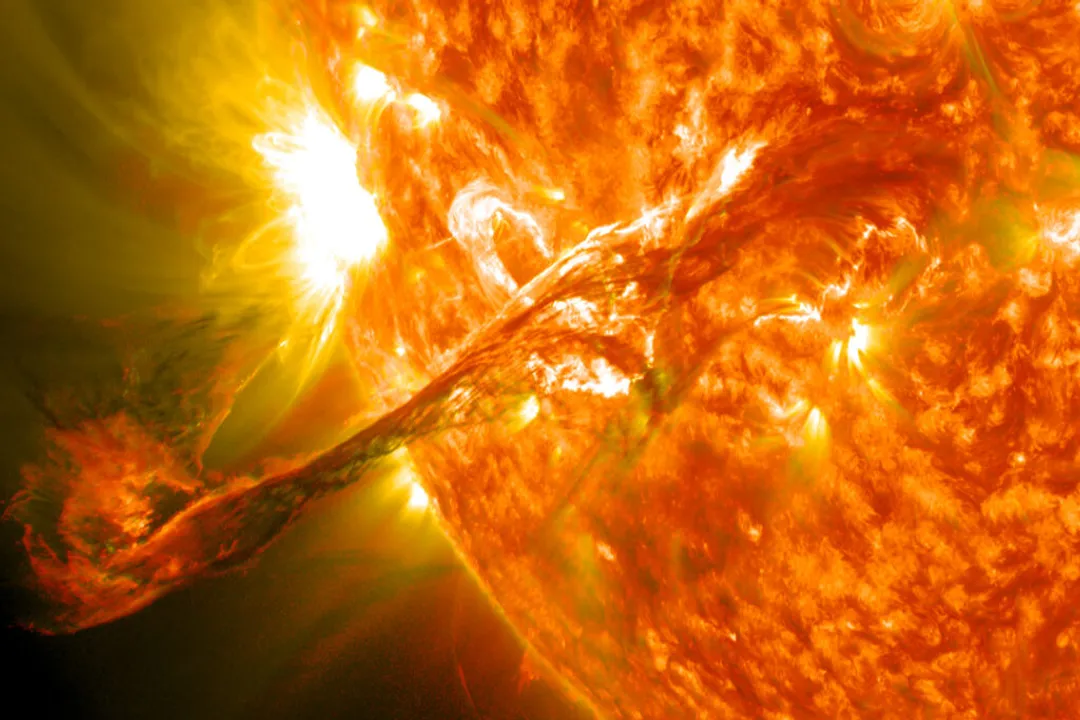
The light that bathes our world, and the glow emanating from countless distant suns, is the direct result of a fundamental cosmic transaction: the conversion of hydrogen into helium deep within stellar cores. [2][8] This process, known as stellar nucleosynthesis, is the engine of the universe, dictating the lifespan and eventual fate of every star. [4] It is not a simple burning, but a complex feat of nuclear engineering orchestrated by gravity, where the lightest element is squeezed until it fuses into the second lightest, releasing the staggering energy that defines a star’s existence. [8]
# Stellar Power Source

Stars are essentially colossal, self-regulating balls of hot gas, predominantly composed of hydrogen, with helium making up a significant fraction, and only trace amounts of everything else. [2][3] The reason for this elemental bias stems from the universe’s earliest moments; Big Bang nucleosynthesis established the initial abundance, producing almost exclusively hydrogen and helium. [6][7] Stars form when gravity causes large molecular clouds of this primordial gas to collapse until the immense pressure and temperature at the center—reaching millions of degrees Celsius—transform the gas into a plasma. [1][8] In this state, electrons are stripped from their nuclei, allowing the positively charged hydrogen nuclei, or protons, to approach one another despite their natural electrostatic repulsion. [1]
The longevity of a star, spanning millions to trillions of years, is a direct testament to the efficiency of this nuclear power generation, which provides the outward thermal pressure necessary to perfectly balance the inward crush of its own gravity. [3][5] The stability seen on the main sequence—the longest phase of a star’s life—is this hydrostatic equilibrium, sustained by the continuous conversion of hydrogen into helium. [2][4]
# Core Ignition
For fusion to take hold, the kinetic energy of the colliding particles must be high enough to overcome the Coulomb barrier, the repulsive electrostatic force between two positively charged nuclei. [4] In a star like our Sun, this process kicks off when the core reaches a staggering temperature of about $15$ million degrees Celsius, or approximately . [1][4] It is this precise temperature threshold that separates a contracting protostar from a true, shining star.
It is interesting to consider the sheer output of this process when contrasted with familiar terrestrial chemistry. When hydrogen fuses into helium in the core, the energy released per conversion is immense. The total energy released for every four hydrogen nuclei turned into one helium nucleus is roughly ten million times greater than the energy produced by the chemical reaction of hydrogen combining with oxygen to form water. [1] This massive energy disparity is why stars can sustain themselves for eons, whereas a chemical fire burns out in moments. While the energy released provides light and heat, a significant portion is carried away by released neutrinos, which escape the star unimpeded. [4]
The process is not always uniform across all stars, however. While our Sun operates primarily using one mechanism, more massive stars utilize a different, faster pathway, leading to vastly different stellar lifecycles.
# Fusion Pathways
The transformation of four individual hydrogen protons () into a single helium nucleus () is not a single reaction but a sequence of steps, known predominantly through two main reaction chains depending on the star's mass and core temperature. [4][8]
# Proton-Proton Chain
In stars with mass up to about the mass of the Sun—the vast majority of stars in the galaxy—the primary mechanism is the proton-proton (p-p) chain reaction. [4] This process generally starts when two protons fuse to form a deuterium nucleus, which is a heavy isotope of hydrogen containing one proton and one neutron, accompanied by the emission of a positron and a neutrino. [1][4] Subsequent steps involve the deuterium nucleus combining with another proton to form helium-3 (two protons, one neutron), and finally, two helium-3 nuclei merge to create a stable helium-4 nucleus, releasing two free protons back into the reaction mix. [1][8]
The p-p chain begins to dominate at temperatures around . [4] For the Sun, which sits near the upper end of where this process is dominant, the complete cycle releases approximately of energy per helium nucleus created. [4]
# CNO Cycle
For stars significantly more massive than the Sun—those exceeding about $1.3$ times the Sun’s mass—the core temperatures climb high enough () for the Carbon-Nitrogen-Oxygen (CNO) cycle to take over as the main energy producer. [4] The CNO cycle is fundamentally different because it is catalytic: carbon, nitrogen, and oxygen nuclei are used as intermediaries to facilitate the fusion of hydrogen into helium, and they are regenerated at the end of the cycle. [4] While the net result is still four protons forming one helium nucleus, the energy released per cycle is slightly lower, around , due to differences in neutrino energy loss. [4]
This difference in temperature dependency between the two chains has major structural consequences for the star. The p-p chain rate scales roughly with temperature to the fourth power (), meaning a small temperature rise leads to a moderate increase in energy production, allowing the fusion zone to extend over a larger volume (up to a third of the star's radius). [4] Conversely, the CNO cycle is extremely sensitive to temperature, with rates proportional to to . [4] This hyper-sensitivity means CNO fusion is intensely concentrated in the very center of the star, often occurring within the inner $15%$ of its mass. [4] This intense energy flux forces the interior structure to adopt a convection zone that efficiently mixes the core material, unlike the more stable radiative zone in lower-mass stars like the Sun, where the CNO cycle contributes only about one percent of the total output. [4] If we were to track the Sun over its main sequence life, we would see its core slowly contracting and heating up slightly, forcing the p-p chain to become marginally more efficient over billions of years just to maintain the required outward pressure against gravity. [5]
# Mass Difference
The entire principle hinges on a discrepancy so small it seems impossible: mass is converted into energy according to Einstein’s famous relation, . [8] When four individual hydrogen nuclei (protons) successfully fuse to form one helium nucleus (), the final helium nucleus is measurably lighter than the sum of its four initial components. [1][8] This missing mass () is precisely the amount converted directly into the radiant energy that powers the star. [8] While this mass deficit is small—about $0.7%$ of the initial mass—when multiplied by the sheer volume of hydrogen processed every second, it equates to an astronomical energy output. [1]
# Stellar Lifespan
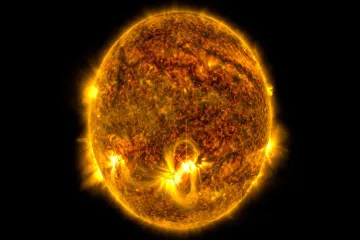
A star’s mass is the ultimate dictator of its life story, primarily because it dictates the rate at which it consumes its hydrogen fuel. [3] Low-mass stars are conservative; they burn cooler and dimmer, allowing their hydrogen supply to last for trillions of years, potentially longer than the current age of the universe. [3] They rely almost entirely on the gentler p-p chain reaction.
High-mass stars, on the other hand, are stellar powerhouses that must burn their fuel at an aggressive rate to counteract their overwhelming gravity. [3] They utilize the highly efficient, temperature-dependent CNO cycle, causing them to exhaust their core hydrogen in a comparatively brief span—sometimes just a few million years. [3][4]
When the core exhausts its hydrogen, the delicate equilibrium breaks. Fusion pressure drops, and gravity wins momentarily, causing the core to contract and heat up until the 'ash'—the newly created helium—reaches the temperature required to ignite its own fusion process. [5][8]
# Beyond Hydrogen
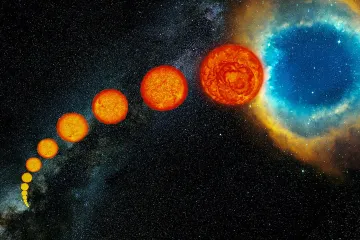
The conversion of hydrogen to helium is just the first chapter in a star's life. [4] Once the helium ignites, it fuses, often via the triple-alpha process, into carbon. [4][8] In stars like the Sun, this leads to helium burning in the core, eventually forming a core rich in carbon and oxygen. [4][8] The Sun will then puff up, shed its outer layers as a planetary nebula, and leave behind a dense, cooling white dwarf. [3]
Massive stars proceed further in their demise. Once helium is spent, their cores compress and heat further, sequentially fusing carbon into oxygen, neon, magnesium, silicon, and eventually, iron. [4] Elements heavier than iron are not produced this way, as fusing iron consumes energy rather than releasing it. [4] This cessation of energy production in the iron core leads to catastrophic collapse, rebound, and the ensuing supernova explosion, which for the most massive stars, scatters all the newly forged elements—from carbon to iron—back into the cosmos, seeding the next generation of stars and planets. [3]
It is worth noting that while we often discuss the heavy elements being created in supernovae, the initial H-to-He conversion, and the subsequent He-to-C, C-to-O, etc., are responsible for building up the bulk of the periodic table found inside stars themselves. [7] The elements that make up terrestrial planets—the heavier stuff—are built up layer by layer, a slow accumulation that only the largest stars complete before their explosive end. [4] A less massive star simply doesn't possess the gravitational weight to achieve the temperatures needed to unlock these subsequent fusion stages, meaning it will live and die utilizing only hydrogen and perhaps a bit of helium fusion. [5]
# Composition Legacy
The fact that stars, including our Sun, are primarily hydrogen and helium is not a preference, but a constraint of cosmic history. [7] The available raw material dictated the outcome. Since the Big Bang left behind a universe overwhelmingly composed of and (about $98%$ by mass), [6][7] any large cloud collapsing under gravity to form a star—even if it contains trace amounts of heavier elements—will inevitably incorporate vast quantities of the lighter components. [6]
Planets, conversely, form from the remaining material that condenses in the protoplanetary disk around the new star. [6] Near the hot center of the disk, only heavier elements (like silicates and metals) can condense into solids to form rocky cores like Earth. [6] The lighter hydrogen and helium remain gaseous and are much more easily lost by the weaker gravity of these smaller, inner bodies, unless the body becomes massive enough to become a gas giant like Jupiter, which successfully hoovers up the abundant gas. [6] Even with this separation, the Sun’s total mass of heavier elements (astronomers often call everything heavier than He "metals") is enormous—that small fraction, $0.014%$ of the Sun's mass being iron, for example, still equates to the mass of roughly 46 Earths made entirely of iron. [6] Thus, the conversion of hydrogen to helium is the primary process that builds the star's energy supply, while the subsequent, higher-temperature fusion stages within massive stars are responsible for the elemental diversity that eventually populates the rocky worlds orbiting them.
#Videos
How Do Stars Convert Hydrogen To Helium? - Physics Frontier
Related Questions
#Citations
Stellar nucleosynthesis - Wikipedia
Star Basics - NASA Science
What causes stars to switch from Hydrogen fusion to using heavier ...
The Elements: Forged in Stars | PBS LearningMedia
How Do Stars Convert Hydrogen To Helium? - Physics Frontier
Why are stars made from hydrogen and helium and not other ...
Fusion on the Sun - EUROfusion
High-Mass Stars | Research Starters - EBSCO