What happens when a star runs out of hydrogen to fuse?
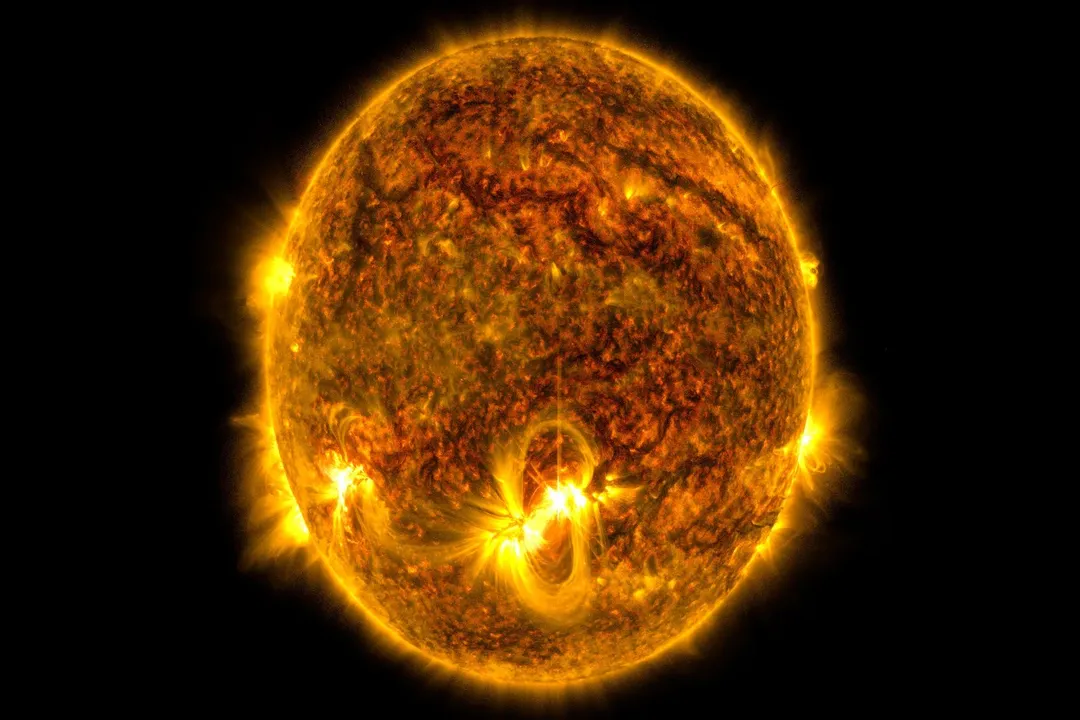
A star spends the vast majority of its active life in a state of remarkable equilibrium, a long, steady burn we call the main sequence. [2][5] During this extended period, the star diligently fuses hydrogen atoms into helium within its fiercely hot core. [2] This continuous nuclear reaction generates an immense outward pressure that perfectly counteracts the relentless, inward crush of the star's own gravity. [2][5] It is this delicate, sustained balance that keeps the star stable, shining predictably for billions of years. [5] However, the hydrogen fuel in the core is finite. When that supply eventually runs out, the fundamental engine powering the star sputters, and the long, dramatic process of stellar death—or transformation—begins. [5][1]
# Core Exhaustion

The immediate consequence of hydrogen depletion in the stellar core is the cessation of fusion in that specific region. [5] Since the outward thermal pressure generated by fusion drops significantly, gravity suddenly gains the upper hand, causing the inert helium core to begin contracting. [1][5] This contraction is not instantaneous; it is a slow, inexorable squeeze driven by immense mass. [1] As the core shrinks, the gravitational energy is converted into heat, causing the temperature within the contracting mass to rise sharply. [5]
What happens next depends entirely on the star's initial mass. For stars like our Sun—those in the low to intermediate mass range—the situation is dramatic but relatively gentle on a cosmic timescale. [5] The contracting helium core never gets hot enough yet to fuse helium, but the immense heat it generates has consequences for the layers surrounding it. [5]
# Shell Burning
The rising temperature from the shrinking helium core heats the layer of fresh hydrogen immediately surrounding it to the point where fusion can ignite there. [5][1] This process is known as hydrogen shell burning. [1] While the core itself is temporarily dormant, this new source of energy in the shell is actually more potent than the star’s previous central fusion rate. [1]
The increased energy output from the shell drives the star's outer layers outward in a massive expansion. [5] As these layers inflate, they move further away from the core’s heat source, causing their surface temperature to drop significantly. [3] When a star swells to many times its original diameter and cools on the surface, it transforms into a Red Giant. [3][5] The star has fundamentally changed its appearance and size, though it is not yet finished evolving. [5]
# Sunlike Expansion
For a star comparable to the Sun, the Red Giant phase marks a significant transition in internal dynamics. As the helium core continues to compress and heat up, the temperature gradient across the star becomes increasingly steep. [5] In stars below about $2.2$ times the Sun’s mass, this core heating leads to a strange event known as the Helium Flash. [5] The core becomes so hot and dense that when helium fusion finally begins—the triple-alpha process, converting helium into carbon and oxygen—it does so in a runaway, explosive manner because the core is degenerate, meaning its pressure doesn't immediately increase with temperature. [5] It's a striking example of a physical system suddenly crossing a critical stability threshold, where a gradual buildup of internal energy leads to an abrupt, powerful reaction that resets the star’s immediate equilibrium. [1][5]
Once the Helium Flash passes (or if the star is massive enough for helium ignition to start gently), the star enters a new stable period burning helium in the core, while potentially still burning hydrogen in an outer shell. [5] This phase is shorter than the main sequence. When the core eventually exhausts its helium, the process repeats: the core contracts again, and if the star is massive enough, it might ignite carbon fusion in a series of concentric shells, creating an "onion-like" structure of fusing elements. [5]
For a Sun-like star, after the core helium is depleted, the outer layers are pushed away completely by stellar winds and pulsations, forming an expanding, glowing shell of gas known as a planetary nebula. [5] Left behind is the hot, dense, exposed core: a white dwarf. [5] This remnant is supported not by thermal pressure, but by electron degeneracy pressure, a quantum mechanical effect that resists further compression. [5] It will spend eons slowly cooling down, eventually becoming a cold, dark black dwarf. [5]
I often reflect on the timescales involved here. A star like the Sun spends about 10 billion years on the main sequence burning hydrogen. [2] Contrast this with the subsequent phases: the Red Giant phase lasts only about 1 billion years, and the subsequent helium-burning phase is often less than 100 million years. [5] This shows that the quiet, predictable life is vastly longer than the frantic, dramatic death throes that follow the exhaustion of the primary fuel source. [2]
# Giant Collapse
Stars significantly more massive than the Sun—those perhaps $8$ times the Sun’s mass or more—face a far more violent end. [5] They have sufficient gravitational force to continue fusing heavier and heavier elements after helium is gone. [5] The core cycles through fusion stages: carbon fuses to neon, neon to oxygen, oxygen to silicon, and finally, silicon fuses into iron. [5]
Iron marks the absolute end of the road for stellar fusion. Unlike lighter elements, fusing iron consumes energy rather than releasing it. [5] Once the core is predominantly iron, it loses its source of outward pressure instantaneously. [2] Gravity wins completely, leading to a catastrophic, freefall collapse that occurs in mere milliseconds. [5]
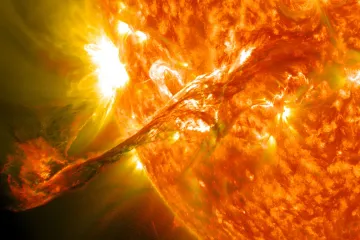
This rapid implosion compresses matter to incredible densities, rebounding off the ultra-dense center and sending a shockwave outward through the star's layers. This unleashes one of the universe’s most spectacular events: a Type II Supernova. [2][5] This explosion briefly outshines entire galaxies and is responsible for forging all elements heavier than iron, which are blasted out into space to seed the next generation of stars and planets. [5]
The remnant left behind depends on the mass of the iron core remaining after the explosion. [5] If the remnant core is between about $1.4$ and $3$ solar masses, the collapse is halted by neutron degeneracy pressure, forming an incredibly dense object called a neutron star. [5] If the remaining core mass exceeds this limit, not even neutron degeneracy pressure can stop the collapse, and it continues indefinitely, creating a black hole. [2][5]
# Final States
The end state of a star is entirely encoded in its birth mass, which dictates how much gravitational pressure it can withstand before fusion ceases. [5]
| Initial Stellar Mass Category | Main Fuel Burn Time | Final Major Transition | Remnant Left Behind |
|---|---|---|---|
| Low/Intermediate (like the Sun) | Billions of years | Red Giant, Planetary Nebula | White Dwarf [5] |
| High Mass | Millions of years | Supernova | Neutron Star or Black Hole [5] |
Understanding these paths illustrates a fundamental principle: the star's entire lifespan is a constant struggle against gravity, and the outcome of running out of hydrogen simply determines which external force—electron degeneracy, neutron degeneracy, or nothing at all—will ultimately prevail against that relentless squeeze. [5] The universe recycles the building blocks of these dead stars into new, complex structures, ensuring that the matter synthesized during these explosive finales becomes part of future cosmic phenomena. [2]
#Videos
What Happens When A Star Runs Out Of Hydrogen? - Physics Frontier
Related Questions
#Citations
When a star runs out of hydrogen, it begins using helium as fuel. Is ...
Star Basics - NASA Science
Red Giant - ESA/Hubble
Star Life Cycle - ASPIRE
Stellar evolution - Wikipedia
What happens when a star runs out of hydrogen? - Quora
What Happens When A Star Runs Out Of Hydrogen? - Physics Frontier
Stars shine due to nuclear fusion - Facebook
Stars - Imagine the Universe! - NASA
What happens when a star's core runs out of hydrogen, and ... - Brainly