What does a star produce from hydrogen?
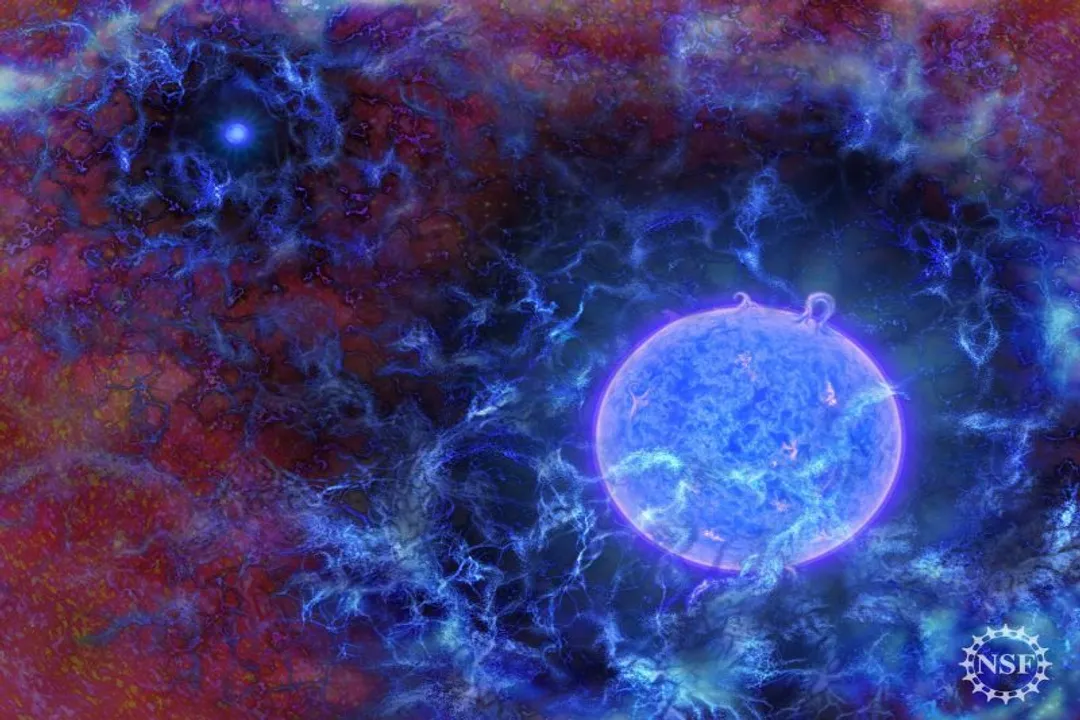
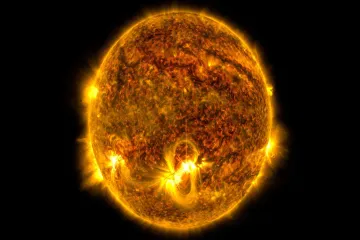
The heart of any star, from the smallest red dwarf to the most colossal blue giant, is a furnace that fundamentally changes its primary ingredient: hydrogen. This transformation is not a simple burning but a process of nuclear fusion occurring under immense gravitational pressure and searing temperatures. [4] The raw material, overwhelmingly composed of hydrogen and the slightly heavier helium left over from the universe's birth, begins a violent conversion in the stellar core, releasing the energy that makes the star visible across light-years. [6][9]
# Hydrogen Fuel
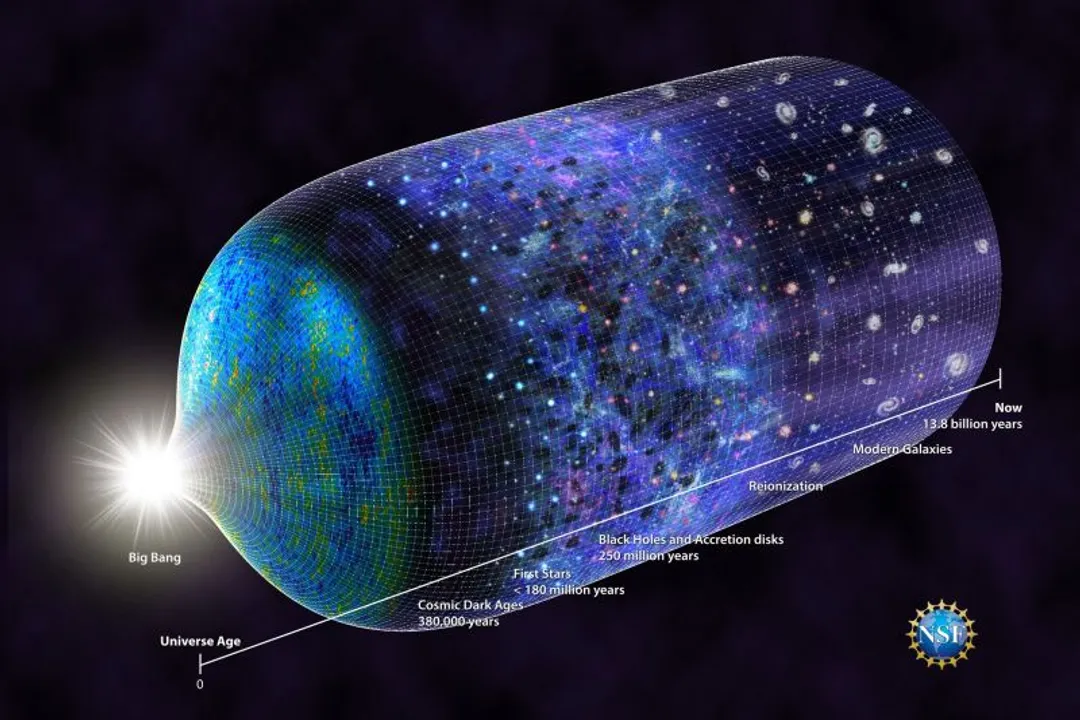
Stars begin their lives primarily composed of hydrogen (about 75%) and helium (about 24%), with trace amounts of heavier elements left over from previous stellar generations or the Big Bang itself. [6][9] This initial composition dictates the entire life narrative of the star. The process that powers the star, what we call stellar nucleosynthesis, relies on overcoming the natural electrostatic repulsion between the positively charged hydrogen nuclei (protons) so they can merge. [1][3] For this to happen, the core temperature must reach millions of degrees Kelvin, creating a state of matter called plasma where atomic nuclei and electrons are stripped apart. [4]
# Fusion Core
The driving mechanism behind a star's luminosity and its resistance to gravitational collapse is the conversion of hydrogen mass into pure energy. [4] When four individual hydrogen nuclei combine to form one helium nucleus, the resulting helium nucleus has slightly less mass than the four separate protons that formed it. [4] This minute discrepancy in mass, according to Einstein's famous equation , is converted into a staggering amount of energy, primarily in the form of gamma rays and neutrinos. [4] It is interesting to consider that for every kilogram of hydrogen fused into helium in the Sun, roughly $0.007$ kilograms of mass disappear, converted entirely into energy. [4] While this fraction seems tiny, when multiplied by the Sun's mass being converted over billions of years, it powers an entire solar system. [4]
# Proton Chain
In stars with masses similar to our Sun or smaller, the dominant pathway for hydrogen fusion is known as the proton-proton (p-p) chain. [1] This reaction sequence is relatively slow, which is why stars like the Sun have such long lifespans, burning their fuel over billions of years. [4] The process is a multi-step affair, beginning when two protons collide to form a deuterium nucleus (one proton and one neutron), a step that requires the weak nuclear force to operate because one proton must transform into a neutron while simultaneously emitting a positron and a neutrino. [1]
The subsequent steps involve:
- Deuterium fusing with another proton to create a light isotope of helium, Helium-3 (), releasing a gamma ray. [1]
- Finally, two Helium-3 nuclei collide to form a stable Helium-4 (), ejecting two excess protons back into the core to restart the chain. [1]
This sequence is highly sensitive to temperature; in cooler stellar cores, the p-p chain proceeds at a moderate, steady pace, guaranteeing longevity. [1]
# CNO Cycle
When a star is substantially more massive than the Sun—about $1.3$ times the mass or greater—its core temperature is significantly higher, often exceeding $15$ million Kelvin. [1] At these extreme thermal conditions, a different, far more efficient fusion pathway takes over: the Carbon-Nitrogen-Oxygen (CNO) Cycle. [1]
Unlike the p-p chain, which builds up from scratch using only hydrogen nuclei, the CNO cycle employs trace amounts of carbon, nitrogen, and oxygen isotopes already present in the star as catalysts. [1] The cycle works like this:
- A proton fuses with a Carbon-12 nucleus, eventually leading through a series of beta decays and proton captures to the creation of a stable Nitrogen-14 nucleus. [1]
- This Nitrogen-14 captures another proton, leading to an Oxygen-15 nucleus. [1]
- The Oxygen-15 decays into a stable Nitrogen-15 nucleus. [1]
- Finally, the Nitrogen-15 nucleus absorbs a final proton and splits, releasing a Helium-4 nucleus and regenerating the original Carbon-12 atom to begin the cycle anew. [1]
The CNO cycle produces energy much faster than the p-p chain. A direct consequence of this more rapid energy generation is a much shorter, hotter life for massive stars, burning through their hydrogen fuel in only millions of years rather than billions. [1][4] This temperature dependency means the physics dictating the core temperature—which is set by the star's initial mass—determines which fusion process is active. [1]
# Element Building
The production of helium from hydrogen is the defining activity of a star's main sequence life, but once the hydrogen in the core is exhausted, the star must adapt or collapse. [4][1] For stars that started their lives with enough mass, the core contracts and heats up further, initiating the next stage of fusion: fusing helium into heavier elements. [1][4]
In these later stages, for sufficiently massive stars, helium atoms begin fusing into carbon, a process known as the triple-alpha process. [1] Carbon can then capture more helium nuclei to create elements like oxygen and neon. [1] This process continues, creating increasingly heavy elements like silicon and sulfur, building up elements layer by layer, until the core produces iron. [3] Iron is the critical stopping point because fusing iron consumes energy rather than releasing it, meaning fusion can no longer support the star against gravity. [1]
| Elements Created | Primary Fusion Stage | Stellar Mass Requirement |
|---|---|---|
| Helium () | Hydrogen Fusion () | All Stars |
| Carbon (), Oxygen () | Helium Fusion () | Stars |
| Neon (), Magnesium () | Carbon Fusion | Massive Stars |
| Silicon (), Sulfur () | Silicon Fusion | Very Massive Stars |
| Iron () | Final Core Product | Very Massive Stars |
The elements that make up everything around us, from the silicon in rocks to the iron in our blood, were forged within the fiery interiors of stars that lived and died long before our solar system existed. [5][3]
# Final Release
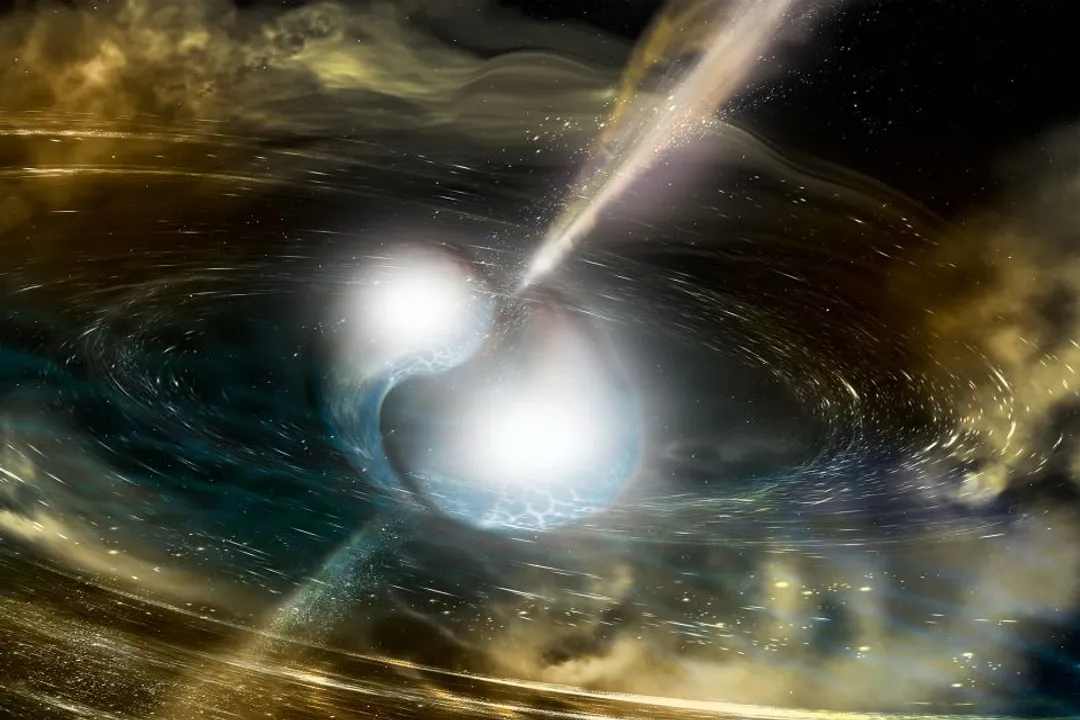
The creation of iron marks the end of viable energy production via fusion within the core. [1] For stars that continue past this point, the final, cataclysmic release of energy occurs, often involving supernova explosions. [3] It is in these explosive deaths, or through the mergers of compact remnants like neutron stars, that elements heavier than iron—such as gold, uranium, and lead—are synthesized through rapid neutron capture processes. [1][3] Thus, the initial hydrogen feedstock ultimately powers the entire periodic table, even if the heavier elements require the star's violent demise to finalize their creation. [1]
Related Questions
#Citations
Stellar nucleosynthesis - Wikipedia
How does the process of nuclear fusion end up producing iron in a ...
DOE Explains...Nucleosynthesis - Department of Energy
How do stars create and release their energy? - Astronomy Magazine
The Elements: Forged in Stars | PBS LearningMedia
Why are stars made from hydrogen and helium and not other ...
The stars within us | NSF - U.S. National Science Foundation
make a star
What are stars made of?