Do stars produce gamma radiation?
Stars absolutely produce gamma radiation, though perhaps not in the way most people imagine routine, everyday stellar output. The answer isn't a simple yes or no; it depends entirely on the energy scale and the astrophysical environment we are considering. [1] When we look at the vastness of the cosmos through the lens of gamma-ray astronomy, we are studying the most violent and energetic phenomena occurring both within stars and in the aftermath of stellar lives. [1]
# Stellar Gamma Production
Gamma rays are the highest-energy form of light in the electromagnetic spectrum, existing at the extreme short-wavelength, high-frequency end. [1] For an object to generate these photons, it needs an environment of incredible heat or immensely powerful physical mechanisms, such as magnetic fields interacting with relativistic particles. [1]
While our own Sun is constantly fusing hydrogen into helium in its core—a process that does create gamma-ray photons—these high-energy particles are almost immediately absorbed and re-emitted many times by the dense plasma surrounding the core. [3] This process, known as the random walk, scatters the photons into lower-energy forms, like X-rays and eventually visible light, which is what reaches Earth centuries later. [3] Therefore, the visible light we see from the Sun is the cooled-down byproduct of internal gamma production, not the direct, observable gamma emission one might associate with the term. [3]
The conceptual limit of energy generation is fascinating. If a star somehow achieved a temperature so high that its output was purely gamma rays, it would mean that every single particle interaction was releasing energy well above the threshold for generating lower-energy radiation like X-rays or visible light, suggesting an environment far exceeding even the hottest normal stellar cores. [5] Such a theoretical state hints at physics closer to accretion disks around black holes or the initial moments of a supernova than stable fusion. [5]
# Core Fusion Gammas
Looking specifically at the thermonuclear furnace inside a star like the Sun, fusion reactions—like the proton-proton chain—release energy primarily in the form of gamma-ray photons. [3] In the Sun's core, with temperatures around 15 million Kelvin, this fusion is ceaseless. [3]
It is worth contrasting the journey of the internal gamma ray with that of a lower-energy photon. The density in the solar core is so extreme that a gamma-ray photon is constantly scattered, perhaps changing direction millions of times, before it has a chance to escape the radiative zone. [3] If one could instantaneously remove the stellar material surrounding the core, the initial gamma rays would rush out unimpeded. However, because the scattering is so effective, the average photon's path from the core to the surface takes an enormous amount of time—hundreds of thousands of years—and by the time it reaches the photosphere, its energy has been drastically reduced. [3] This is a key distinction: the production happens at the gamma level, but the emission we observe is predominantly at much lower energies. [3]
# Remnants and Power
When astronomers detect significant, observable gamma radiation emanating from a star system, they are usually pointing their instruments toward objects far more violent than a stable main-sequence star. [2] The vast majority of the high-energy gamma-ray sky is dominated by objects that are either dead stars or stars in the final, explosive stages of their lives. [2]
Stellar remnants are prolific gamma-ray producers. Pulsars, which are incredibly dense neutron stars left behind after a massive star explodes, possess staggering magnetic fields. [8] These fields can trap charged particles and accelerate them to near the speed of light, causing them to emit beamed radiation across the electromagnetic spectrum, including intense pulses of gamma rays. [8] In some cases, these neutron stars orbit other stars, forming binary systems that create persistent high-energy emissions. [4] For example, the pulsar PSR B1257+12, which orbits white dwarfs, is a confirmed source of such energetic activity. [4]
Furthermore, the death throes of massive stars—supernova remnants—are energetic accelerators for cosmic rays, which in turn produce gamma rays when they interact with surrounding gas. [1] Elizabeth Ferrara notes that observed gamma rays in the universe mostly trace back to these stellar remnants and interactions involving supermassive black holes at galactic centers. [2]
# Active Emissions
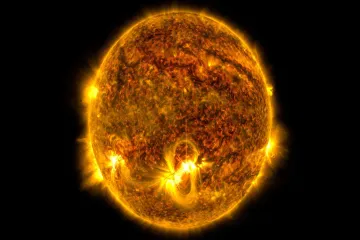
While remnants are major players, it isn't just dead stars generating this radiation. Stars, even relatively modest ones, can experience fits of extreme activity. Evidence has been gathered showing that even low-mass stars, similar to our Sun (G-type stars), are capable of emitting gamma radiation during periods of intense activity. [7] This observational proof indicates that the processes capable of generating gamma rays are present across a broader range of stellar masses than previously thought, provided the star enters a high-energy state. [7]
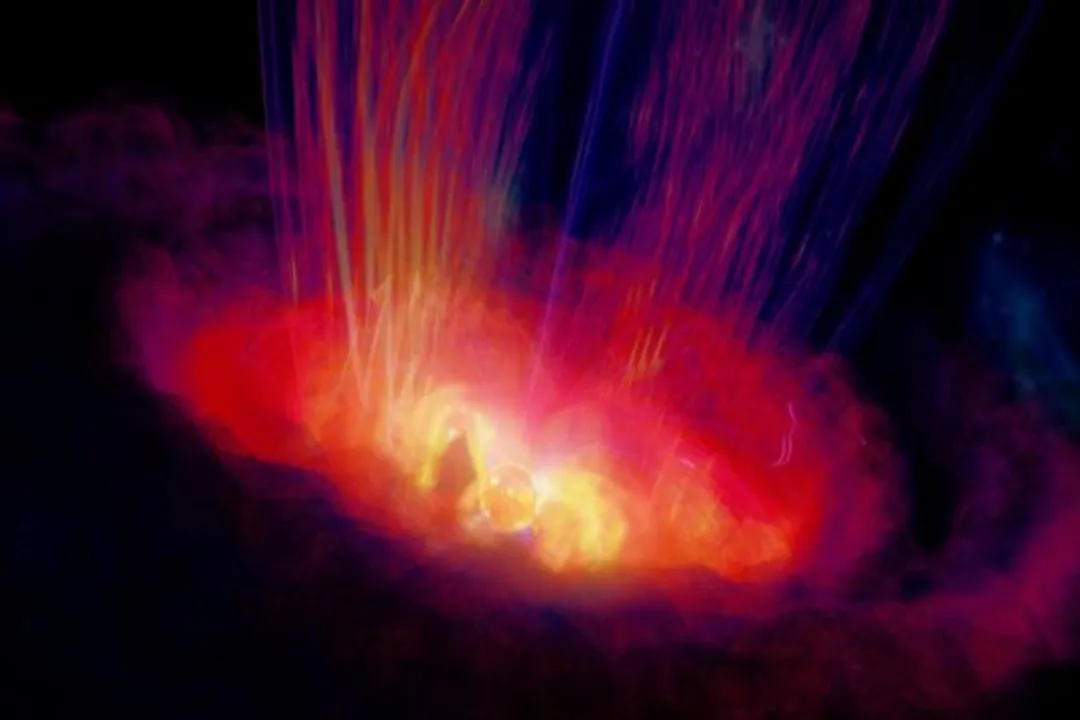
Young stars, still contracting and settling into stability, are known to be temperamental. These developing stars have been observed "tantrum throwing," belting out high-energy gamma radiation for the first time in a measurable way. [6] This early phase of high-energy output is linked to the magnetic turmoil inherent in newly forming stellar systems. [6]
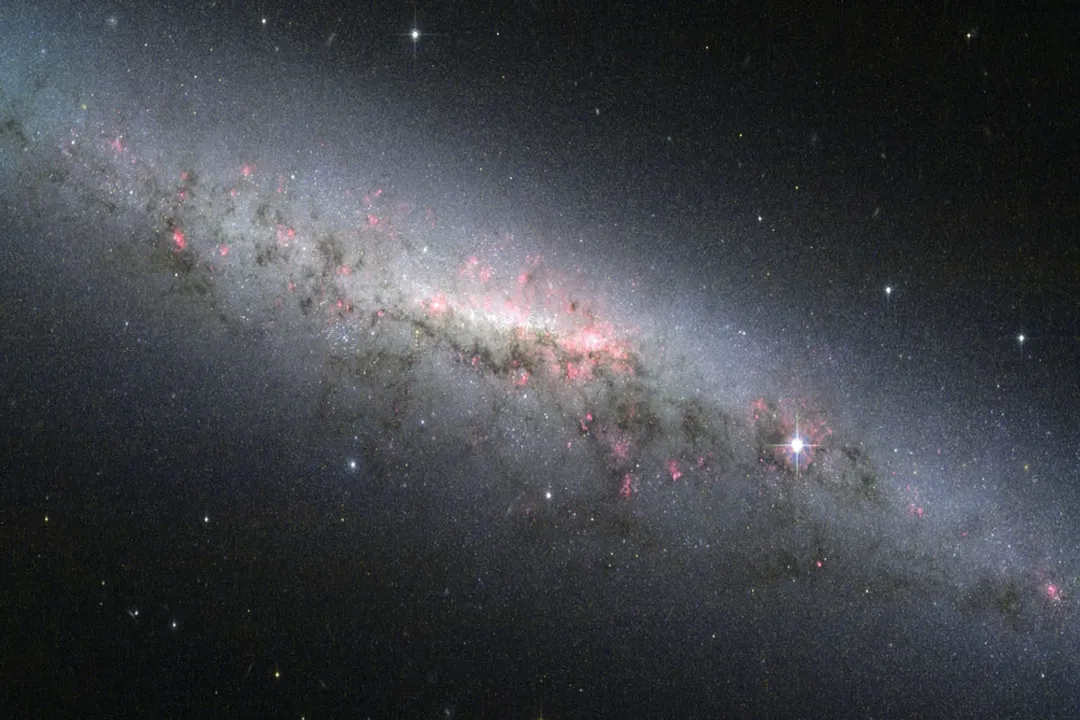
When cataloging the entire gamma-ray sky, star-forming galaxies contribute significantly to the overall background noise detected by instruments. [9] This heavily suggests that the collective output from numerous young, active, and evolving stars within these starburst regions provides a substantial component of the observed diffuse gamma-ray signal across the cosmos. [9]
# The Observational View
The study of these phenomena relies on specialized instruments designed to detect gamma rays, a discipline known as gamma-ray astronomy. [1] Because Earth's atmosphere absorbs nearly all incoming gamma radiation, these observations must be conducted from space. [1] Detectors are designed to register these high-energy photons, which carry energy levels typically starting around a hundred thousand electron volts ($10^5$ eV) and extending upward. [1]
If we consider a typical star-forming galaxy, the gamma-ray emission is a blend of many sources: the accretion disks around newborn stars, the stellar winds being accelerated by massive, hot O and B type stars, and the eventual remnants of those massive stars. [9]
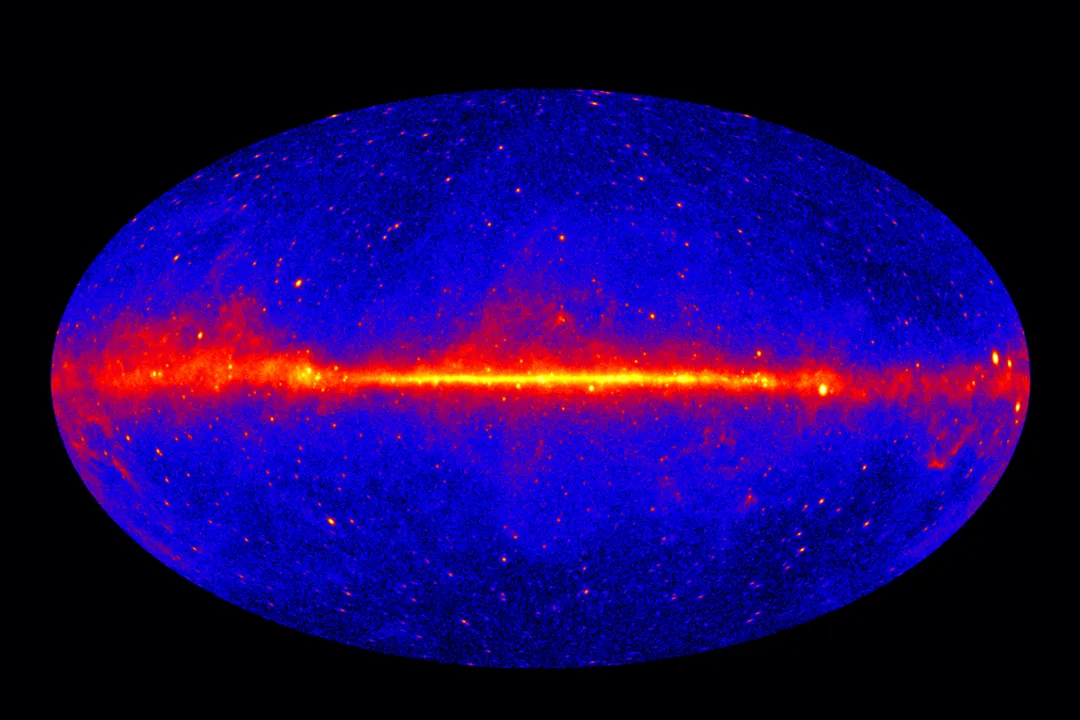
This leads to an interesting comparison: while the most luminous objects in the gamma-ray universe are often thought to be Active Galactic Nuclei (AGN) powered by central black holes, the cumulative effect of all the stars in a star-forming galaxy often makes the galaxy itself a major component of the diffuse gamma-ray background detected across the sky. [9][2] The radiation we capture from these distant galaxies is not just the signature of one singular, focused jet, but the integrated noise from billions of individual stellar processes occurring within them. [9] While the single, brightest sources might be black holes, the sheer number of active stars ensures stellar physics remains central to understanding the high-energy universe. [2]
Related Questions
#Citations
Gamma-ray astronomy - Wikipedia
Elizabeth Ferrara: “The gamma rays we see are mostly produced by ...
How much beta/gamma radiation does the core of a star that has ...
Gamma Rays from a Binary Star | Center for Astrophysics
What would happen if a star's temperature is so high that it ... - Quora
Young stars caught blasting high-energy gamma rays for the 1st time
First observational evidence that a low-mass star can emit gamma ...
Do neutron stars have something like a gamma-ray photosphere ...
Star-forming galaxies rule gamma-ray sky - CERN Courier