Where does a star get its fuel from?
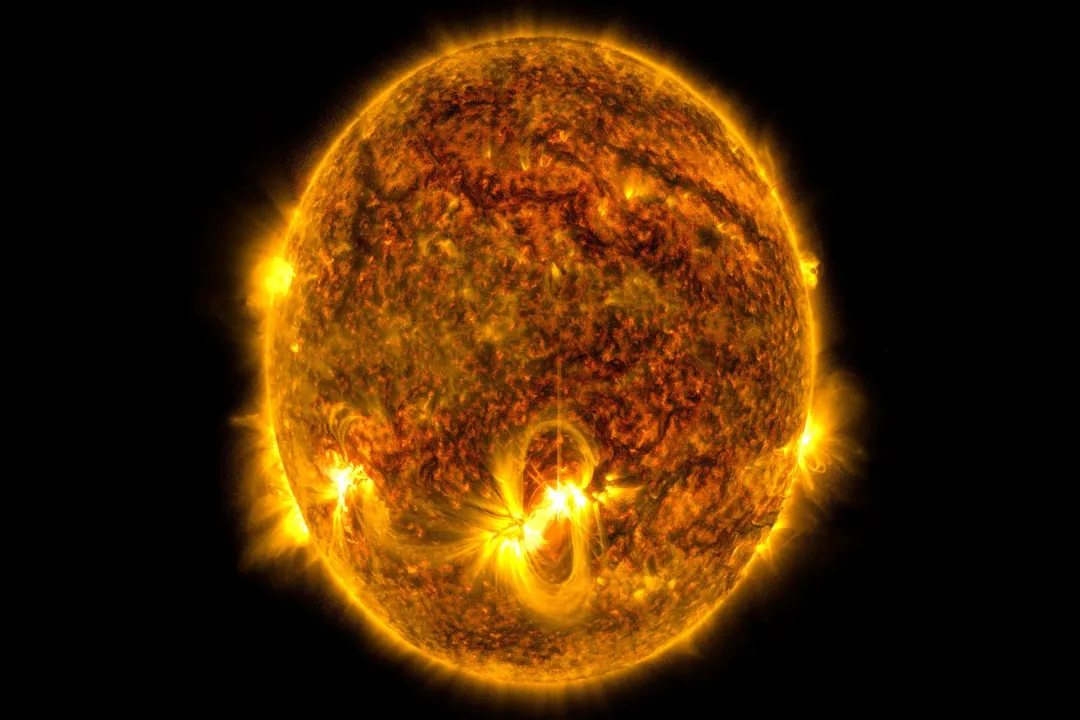
The brilliant, seemingly eternal light radiating from a distant star isn't powered by burning in the conventional sense; it originates deep within the star's core through a process of atomic transformation. The primary fuel that keeps these celestial giants shining for billions of years is, quite simply, hydrogen. [1][7] Stars are essentially gigantic, self-sustaining nuclear reactors, where the immense pressure and staggering temperatures at their centers force atomic nuclei to combine, releasing torrents of energy in the process. [9]
# Stellar Makeup
To understand where the fuel comes from, we first need to know what a star is made of. The composition of nearly every star in the universe is overwhelmingly dominated by the two lightest elements: hydrogen and helium. [7][4] On average, a star is roughly seventy-three percent hydrogen and twenty-five percent helium by mass, with the remaining small fraction consisting of heavier elements like oxygen, carbon, neon, and iron. [7] This initial distribution dictates the entire life story of the star. Think of it like setting the ingredients for a very, very long-lasting cake; the proportions of the initial mixture determine how long the oven can stay on before the main ingredient runs out. [2]
# The Core Reaction
The actual mechanism for energy production is known as nuclear fusion. [9] This process occurs only in the star's core, the only place hot and dense enough to overcome the natural electrical repulsion between positively charged atomic nuclei. [9] In the vast majority of a star's life—the main sequence phase—the primary reaction involves taking four hydrogen nuclei (protons) and fusing them together to form one helium nucleus. [1][7]
This conversion is not a one-to-one mass exchange. The resulting helium nucleus has slightly less mass than the four original hydrogen nuclei that went into it. [9] That missing mass hasn't vanished; it has been converted directly into pure energy, following Albert Einstein’s famous equation, . [9] This released energy manifests as photons (light) and neutrinos, which then slowly make their way from the core outward to illuminate space. [9]
This conversion process, turning the universe's most abundant element into the second most abundant, is what astronomers refer to as stellar nucleosynthesis. [4] It is this continuous, controlled nuclear burnout that generates the tremendous outward pressure necessary to counteract the inward crush of the star's own colossal gravity. [3] Without this outward push, the star would immediately collapse under its own weight. The long, stable life of a sun-like star is therefore a magnificent, sustained equilibrium between gravity and thermal pressure. [3]
If we consider the sheer efficiency of this energy generation, it becomes clear why stars shine for so long. Chemical burning, like burning wood or coal on Earth, rearranges electrons in atoms. Nuclear fusion, by contrast, rearranges the nuclei themselves. A single pound of hydrogen undergoing fusion releases millions of times more energy than a pound of coal burning chemically. This fundamental difference in energy density is what allows our Sun to happily burn for approximately ten billion years using only a fraction of its total mass as fuel. [9]

# Fueling Star Birth
Before a star can begin fusing hydrogen, it has to form. Stars begin their lives within massive, cold, dark clouds of gas and dust known as nebulae. [2] Gravity causes dense clumps within these clouds to contract. [2] As the clump shrinks, gravitational energy is converted into thermal energy, causing the core to heat up. [6] This collapsing cloud, now called a protostar, continues to shrink and heat up until the core reaches the critical temperature—around 15 million degrees Celsius for a star like our Sun—required to ignite sustained hydrogen fusion. [2][6]
Where does the initial hydrogen for this formation come from? It is drawn directly from the surrounding interstellar medium—the vast, thin gas that exists between stars. [5] Thus, the fuel for a new generation of stars is essentially the leftover material from previous stellar deaths and the primordial material from the Big Bang itself, residing dormant in galactic clouds until gravity pulls it together. [5]
# After Hydrogen
While hydrogen provides the energy for the longest phase of a star's life, it is not inexhaustible. Eventually, the supply of hydrogen fuel in the core begins to dwindle as it is converted into helium. [3] When the core runs out of hydrogen, fusion stops in that region, and the balance against gravity is lost, causing the core to contract and heat up further. [3]
This increased core temperature eventually becomes high enough to ignite fusion in a shell around the now-inert helium core. [3] For stars similar to our Sun, the next step involves fusing the newly created helium into heavier elements, primarily carbon and oxygen, though this happens only after significant changes in the star’s structure. [3] More massive stars, however, can achieve much higher core temperatures, allowing them to proceed through subsequent fusion stages, sequentially burning heavier and heavier elements—carbon, neon, oxygen, and silicon—in successive shells layered around an increasingly dense core. [4] This entire cycle of building up heavier elements inside a star is what eventually produces elements heavier than hydrogen and helium, which are then ejected back into space when the star dies. [4]
# Energy Transport
It is important to recognize that the energy created in the core does not instantly leave the star; it must travel outward. The path the energy takes varies depending on the star's size and age. [6] In some stars, energy is transported primarily through radiation, where photons are repeatedly absorbed and re-emitted by the plasma, a process that can take hundreds of thousands of years for a single photon to traverse the interior. [6] In others, especially in the outer layers of larger stars, convection takes over, where hotter plasma rises and cooler plasma sinks, much like boiling water on a stove. [6] This dual mechanism ensures that the energy generated by the core eventually reaches the photosphere, the visible surface, where it is radiated away as starlight. [6]
The source of a star's energy is fundamentally tied to its mass. A more massive star has a much hotter and denser core, causing its hydrogen fuel to be consumed at an exponentially faster rate. [1] A star ten times the mass of the Sun will burn through its fuel supply in mere millions of years, whereas the Sun is expected to last for ten billion years, and small, cool red dwarfs can sustain themselves for trillions of years. [1]
When we look up at the night sky, we are observing the stable endpoint of this gravitational collapse and nuclear ignition. Whether a star is a brilliant blue giant or a faint red dwarf, its existence, its temperature, and its lifespan are all dictated by the continuous, predictable conversion of hydrogen into helium deep within its heart. [7][9] This is the engine that lights up the cosmos.
Related Questions
#Citations
Star Basics - NASA Science
Stars and their life-cycle (article) | Khan Academy
When a star runs out of hydrogen, it begins using helium as fuel. Is ...
Stellar nucleosynthesis - Wikipedia
Where do new stars get their hydrogen from? [duplicate]
What is the source of a star's energy and how does it sustain ... - Quora
The Life of a Star - How Stars Work - Science | HowStuffWorks
What are stars made of? - Cool Cosmos - Caltech
How do stars create and release their energy? - Astronomy Magazine