What happens to supergiant stars when they run out of fuel?
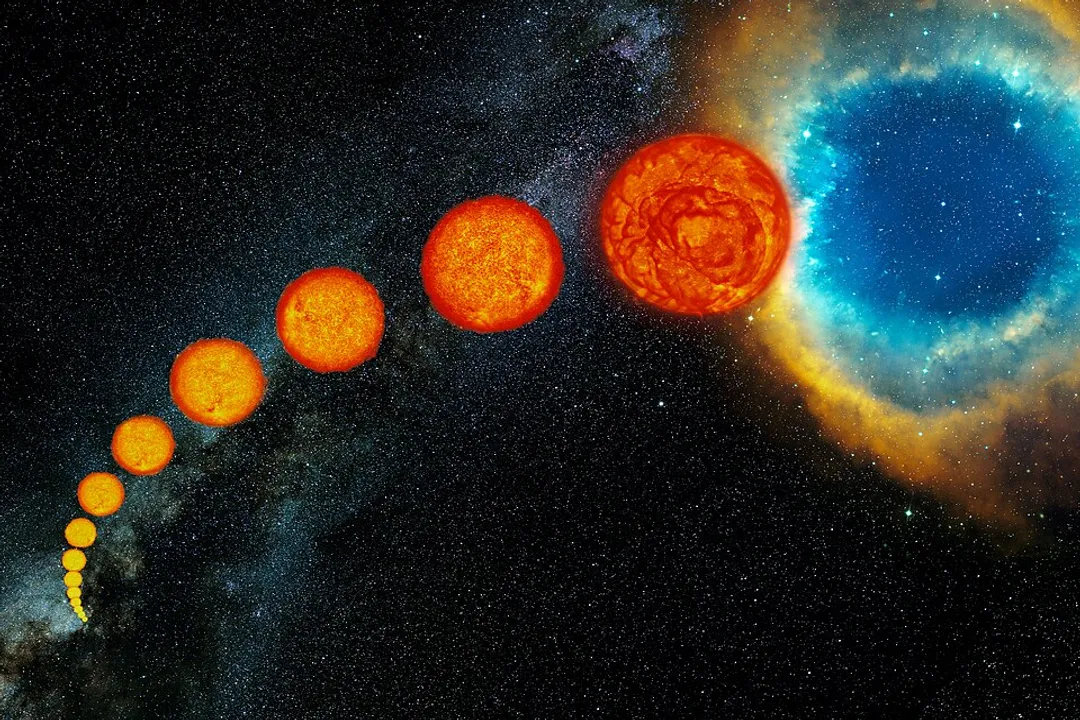
The lifespan of the universe’s most colossal stars—the supergiants—culminates not in a quiet fade, but in an explosive spectacle that redefines the fabric of spacetime around them. These giants, hundreds of thousands of times brighter than our own Sun, spend millions of years burning fuel at an astonishing rate, far outstripping smaller stars in sheer luminosity. But this incredible energy output comes at a steep price: a dramatically shortened existence, leading to one of the most violent ends known in astronomy. When a supergiant finally exhausts its primary nuclear fuel, the mechanisms holding it up against the crushing force of its own gravity fail catastrophically.
# Stellar Engines
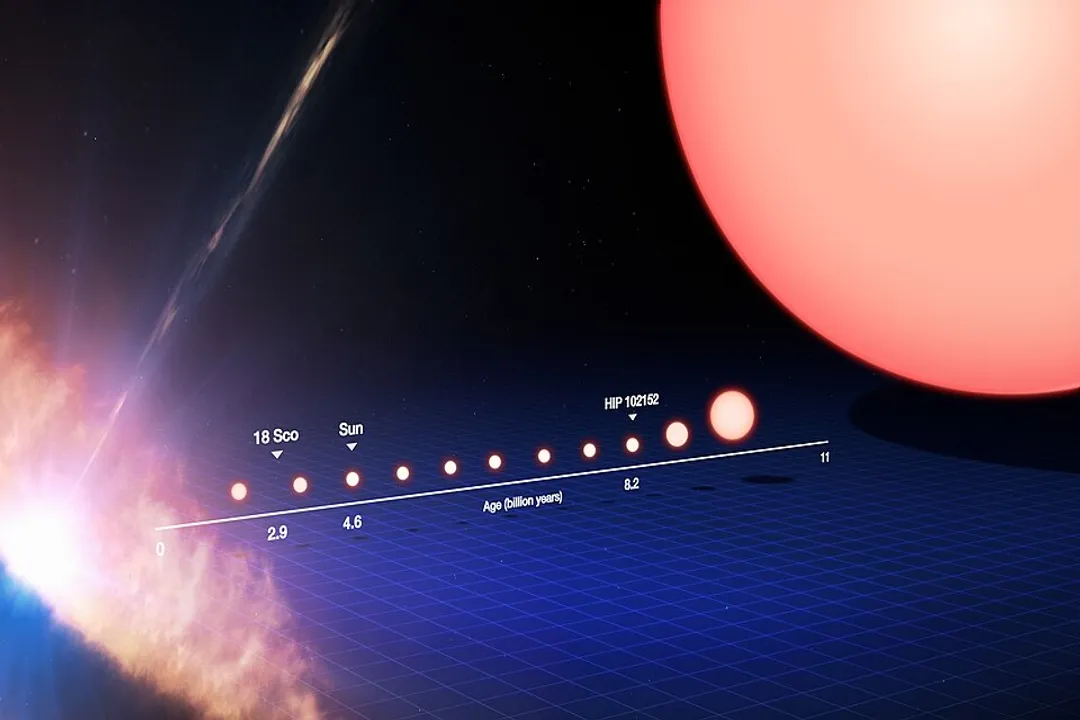
A star spends the vast majority of its life in a state of hydrostatic equilibrium. This delicate balance is maintained by the outward thermal pressure generated by nuclear fusion in the core pushing against the relentless inward pull of gravity. For a massive star, this process is far more aggressive than what powers our relatively modest Sun. The supergiant core burns through its lighter elements sequentially, creating heavier elements in layers surrounding the core, much like an onion.
Initially, hydrogen fuses into helium. Once the hydrogen supply in the center is depleted, the core contracts and heats up until it is hot enough to ignite helium fusion, creating carbon and oxygen. This process does not stop there for a star massive enough to become a supergiant. The core continues to contract and heat, sequentially fusing carbon, neon, oxygen, and silicon. Each successive stage of fusion burns for a shorter and shorter duration, sometimes only for a matter of days or even hours, as the star burns through its fuel reserves faster and faster in a desperate bid to maintain pressure.
The sheer timescale shift is astonishing. A star like the Sun might spend billions of years fusing hydrogen. A supergiant might consume its hydrogen in mere millions of years, and its subsequent fuel stages might last less than a year combined.
# Iron Barrier
This relentless fusion chain continues until the core begins producing iron (Fe). Iron is the stellar dead-end. Unlike all the lighter elements that preceded it, fusing iron does not release energy; instead, it consumes energy. When the core becomes predominantly iron, the nuclear furnace that has supported the star for eons simply switches off. The source of the outward pressure vanishes almost instantaneously.
This moment—the completion of the iron core—is the one event that dictates the star’s immediate future. Because the iron core cannot generate energy through fusion, it can no longer support the star’s colossal mass against gravity. The mass of the resulting iron core in a supergiant is often between about $1.4$ and $2.5$ times the mass of our Sun, though the final fate depends on what mass remains after initial outer layers are shed.
# Sudden Implosion
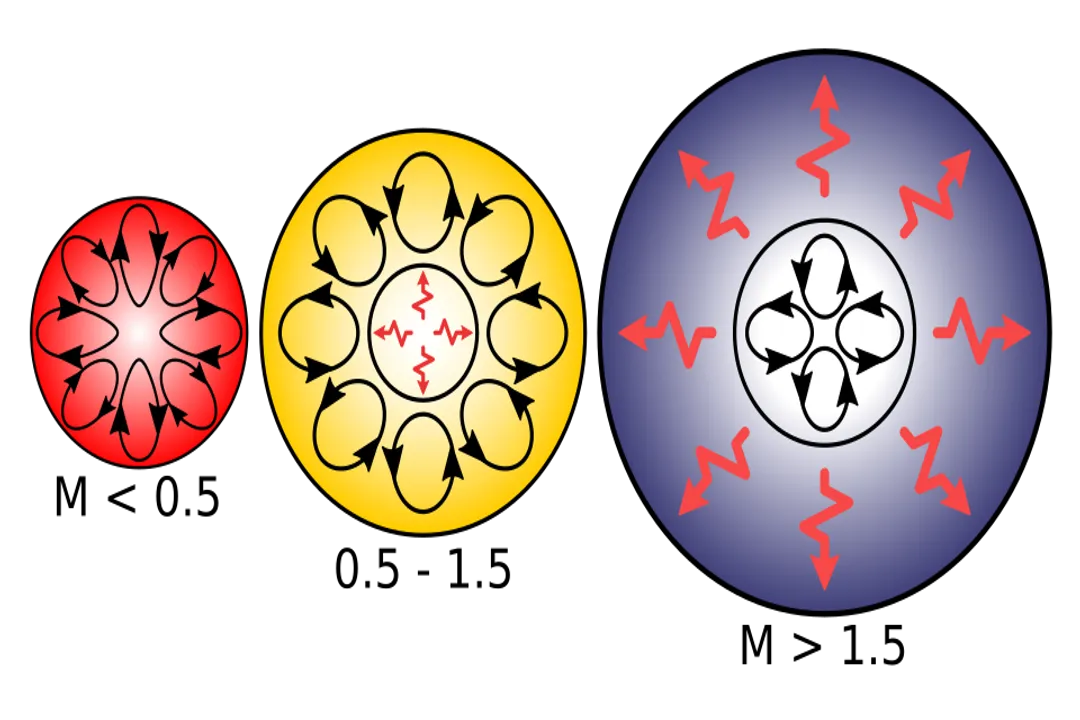
With the pressure support gone, gravity takes over completely, initiating a collapse so swift it borders on instantaneous. The outer layers of the star, which are still burning fuel, suddenly find themselves falling inward onto the inert iron core. In a massive star, this collapse happens incredibly quickly, perhaps taking only a fraction of a second for the core to shrink from the size of the Earth down to just a few kilometers across.
This implosion compresses the core matter to densities far exceeding anything found on Earth. Protons and electrons are squeezed together so tightly that they merge to form neutrons—a process called inverse beta decay. The resulting object is an incredibly dense ball of neutrons. While this compression generates a momentary rebound and a massive outward shockwave, the initial collapse is what determines the final outcome based on how much mass has fallen inward. This is where the initial label of "supergiant" gives way to the critical factor: the mass of the collapsing core.
# Explosive Death
The infalling outer layers slam into this new, incredibly stiff, incompressible neutron core. This collision generates a massive shockwave that violently rebounds outward, ripping the star apart in a Type II Supernova explosion. This event is a brief but spectacular release of energy, often briefly outshining entire galaxies. During this explosion, the extreme conditions forge elements heavier than iron, such as gold, silver, and uranium, scattering them and all the star's lighter processed materials into the cosmos to seed future generations of stars and planets.
When considering the fate of these massive stars, it is useful to think of mass as a threshold:
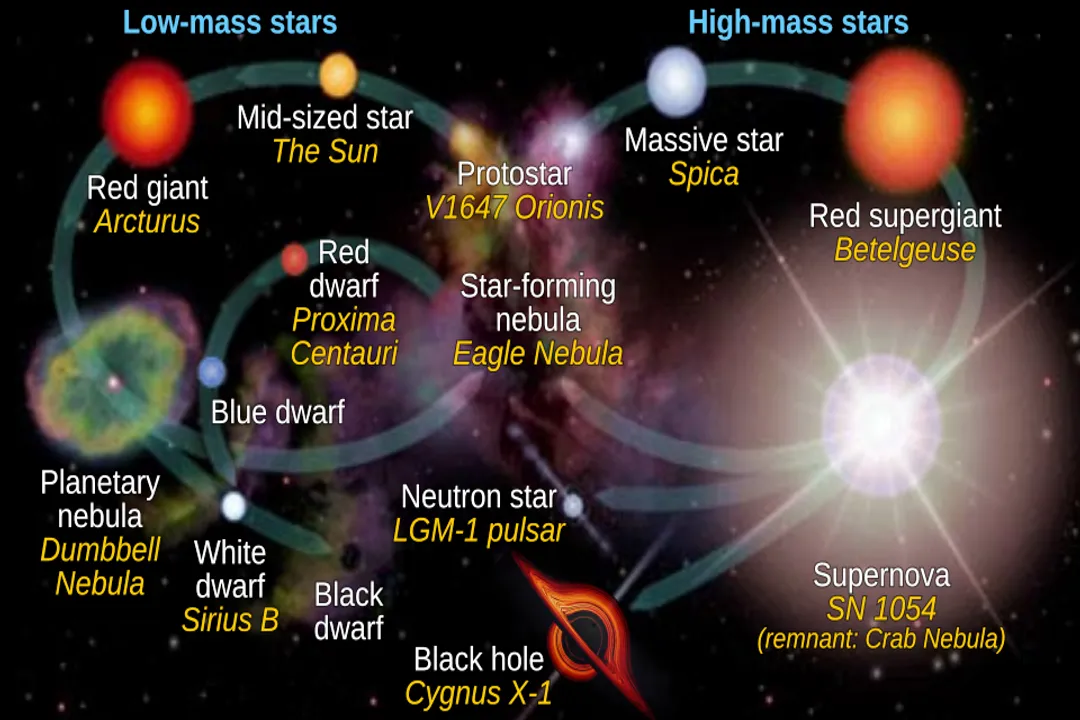
- Stars much less massive than the progenitors of supernovae eventually become white dwarfs.
- The most massive stars, the true supergiants, undergo the supernova process.
The critical distinction for the remnant lies in the mass remaining after the core implosion and explosion. If the remnant core mass after the supernova explosion remains below a certain threshold—often estimated to be around three times the Sun’s mass, though precise limits are still a topic of active research—the pressure exerted by the neutrons (neutron degeneracy pressure) can halt the collapse.
# Remnant Destiny
The final compact object left behind after a supergiant’s death depends entirely on the physics encountered during that brief, violent implosion.
# Neutron Star
If the mass of the collapsed core is kept in check by neutron degeneracy pressure, the remnant stabilizes as a Neutron Star. These objects are mind-bogglingly dense; a thimbleful of neutron star material would weigh billions of tons. A neutron star packs roughly $1.5$ to $2.5$ solar masses into a sphere only about $20$ kilometers across. They often spin extremely rapidly when first formed, sometimes hundreds of times per second, emitting beams of electromagnetic radiation that we detect as pulsars. The existence of a neutron star represents a successful resistance against total gravitational collapse, a brief victory for quantum mechanics over general relativity.
# Black Hole
However, if the initial supergiant was massive enough, or if the physics of the collapse allowed too much mass to pile onto the core, even the neutron degeneracy pressure cannot stop gravity. When the remnant core mass exceeds the Tolman-Oppenheimer-Volkoff (TOV) limit, the collapse continues without stopping. The matter is crushed down to an infinitely dense point called a singularity, surrounded by an event horizon from which nothing, not even light, can escape: a Black Hole.
It is interesting to note that the initial mass of the supergiant star itself might be $20$ or $30$ solar masses, but it is the leftover core mass, often much smaller, that determines this final, most extreme outcome. The difference between ending life as a rapidly spinning, visible neutron star versus an invisible black hole hinges on perhaps just half a solar mass being added or lost during the chaotic final moments. This sharp division, based on a still-debated mass boundary, provides a powerful illustration of how sensitive the stellar lifecycle is to initial conditions. The supergiant phase is merely the long preamble to a final, decisive moment where the laws of physics force a complete transformation of matter.
#Videos
What Happens When A Star Runs Out Of Fuel? - Physics Frontier
Related Questions
#Citations
Why does a supergiant star become blackhole only after it dies?
Stellar Evolution - | The Schools' Observatory
Red Giant - ESA/Hubble
The Life Cycles of Stars - Imagine the Universe! - NASA
What happens to a star when it runs out of fuel, and how does its fate ...
When a star runs out of helium for its fuel, is the change sudden or ...
Stellar evolution - Wikipedia
[PDF] Death of Stars
What Happens When A Star Runs Out Of Fuel? - Physics Frontier