scienceanswers.net
Home
/
Tags A-Z
/
S
/
supergiants
supergiants articles
What happens to supergiant stars when they run out of fuel?
What are supergiants composed of?
What makes a star a supergiant?
How do the luminosities of supergiant stars compare to our Sun?
What is the primary fuel source fused immediately following hydrogen depletion in a supergiant core?
What element marks the end of the energy-releasing fusion chain in the star's core?
What is the immediate effect on energy generation when a core becomes predominantly iron?
What process occurs as protons and electrons are squeezed together during the core implosion?
What process generates the massive shockwave responsible for ripping the star apart?
What type of explosion results from the sudden implosion and rebound of a supergiant core?
Which elements are forged in the extreme conditions of the supernova explosion?
What physical principle can halt the collapse after explosion if the remnant core mass is below a specific threshold?
What determines whether a massive star remnant becomes a Neutron Star or a Black Hole?
What was the approximate percentage of Hydrogen in a supergiant star at its birth?
What is the primary factor that defines a supergiant star's high rate of fuel consumption?
What element begins fusion in the core immediately after the initial hydrogen fuel in the very center is exhausted?
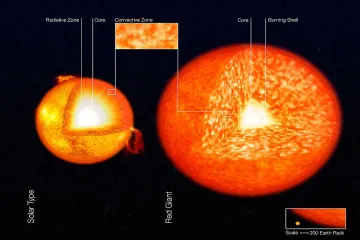
What distinctive internal structure develops in a massive supergiant as evolution progresses?
According to the stated progression, what elements primarily form when core Helium fusion concludes?
Why does nuclear fusion stop advancing beyond Iron in the core of a supergiant?
What immediately follows when the core of the supergiant becomes predominantly iron?
Where are elements heavier than iron, such as gold or platinum, synthesized in relation to the star's stable fusion phases?
How does the nucleosynthesis yield seeded into the cosmos differ between a supergiant and a star like the Sun?
What Yerkes Luminosity Class is often used to classify supergiant stars?
What two combined characteristics are essential for a star to be classified as a supergiant?
What is the fundamental determinant for a star achieving supergiant status?
In the Yerkes system, which Roman numeral class is specifically assigned to supergiants?
If a Red Supergiant like Betelgeuse were placed at the center of our Solar System, where might its outer layers extend?
Which evolutionary phase is characterized by incredibly hot surface temperatures up to 50,000 Kelvin?
Why are red supergiants generally observed more frequently than blue supergiants at any given time?
What process causes the dramatic mass loss observed in supergiants?
What is the approximate surface temperature of a cooler Red Supergiant star?
If a massive star's remnant core mass after a supernova exceeds roughly $3 ext{M}_ ext{odot}$, what object forms?
What type of explosive event marks the dramatic demise of a star that has gone through the supergiant phase (initial mass $> 8 ext{M}_ ext{odot}$)?