Do main sequence stars fuse hydrogen?
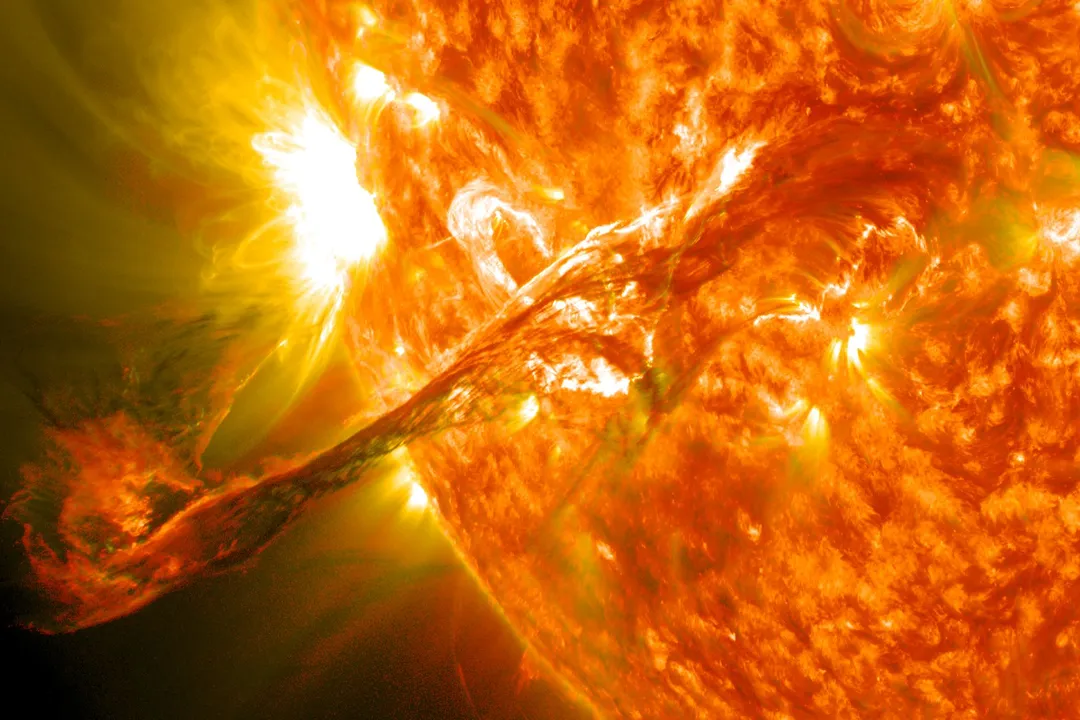
The answer to whether main sequence stars fuse hydrogen is an emphatic yes; in fact, this process is the very definition of the main sequence phase of a star's life. [1][3][7] For the vast majority of a star's existence—about 90 percent—it resides on this main sequence, a stage where it is converting hydrogen into helium in its core. [3][6][7] This nuclear alchemy is what generates the tremendous outward pressure necessary to counteract the relentless inward crush of gravity, establishing a state of hydrostatic equilibrium. [2][5][6] Without this continuous energy generation, the star would collapse. [2]
# Life Stage

The main sequence represents the longest and most stable period in a star's evolution. [3][7] When a protostar accumulates enough mass, its core temperature and pressure finally become high enough to ignite sustained nuclear fusion. [4][6] This ignition marks the star's arrival on the main sequence. [7] The star then settles into a steady burn, shining brightly as it converts its most abundant element, hydrogen, into the next element up the periodic table, helium. [1][5]
A star's position on the main sequence, often plotted on the Hertzsprung-Russell (H-R) diagram, is determined almost entirely by its initial mass. [1][5] More massive stars are hotter, brighter, and burn through their fuel supply much faster than their less massive counterparts. [1][5][7] This relationship is not linear; a star only a few times the mass of our Sun will have a main sequence lifetime dramatically shorter than the Sun's. [7]
# Core Power

The specific mechanism by which hydrogen fuses into helium depends crucially on the star's core temperature, which is directly linked to its mass. [1][5] For stars similar to the Sun or smaller, the primary energy-generating process is the Proton-Proton (p-p) chain. [1][5] This chain reaction involves multiple steps where protons (hydrogen nuclei) combine sequentially to eventually form a helium nucleus. [1]
In stars significantly more massive than the Sun, where core temperatures soar well above 15 million Kelvin, a different, more efficient pathway dominates: the Carbon-Nitrogen-Oxygen (CNO) cycle. [1][5] While this cycle uses carbon, nitrogen, and oxygen as catalysts, the net result is still the fusion of four hydrogen nuclei into one helium nucleus, releasing vast amounts of energy. [1] The CNO cycle produces energy at a rate far exceeding the p-p chain for similar masses, which explains the much shorter lifespans of these giants. [1]
It is fascinating to consider the sheer scale of this operation. The Sun, for instance, converts about 600 million tons of hydrogen into 596 million tons of helium every second. [7] The missing 4 million tons are converted directly into energy according to Einstein's famous equation, . [7]
Here is a simplified comparison of the two main fusion pathways:
| Feature | Proton-Proton Chain | CNO Cycle |
|---|---|---|
| Dominant in Stars | Solar Masses (like the Sun) [1] | Solar Masses [1] |
| Temperature Dependence | Less sensitive to temperature [1] | Highly sensitive to temperature [1] |
| Catalysts | None required (direct fusion) | Carbon, Nitrogen, Oxygen [1] |
| Net Reaction | [1] |
# Equilibrium Physics
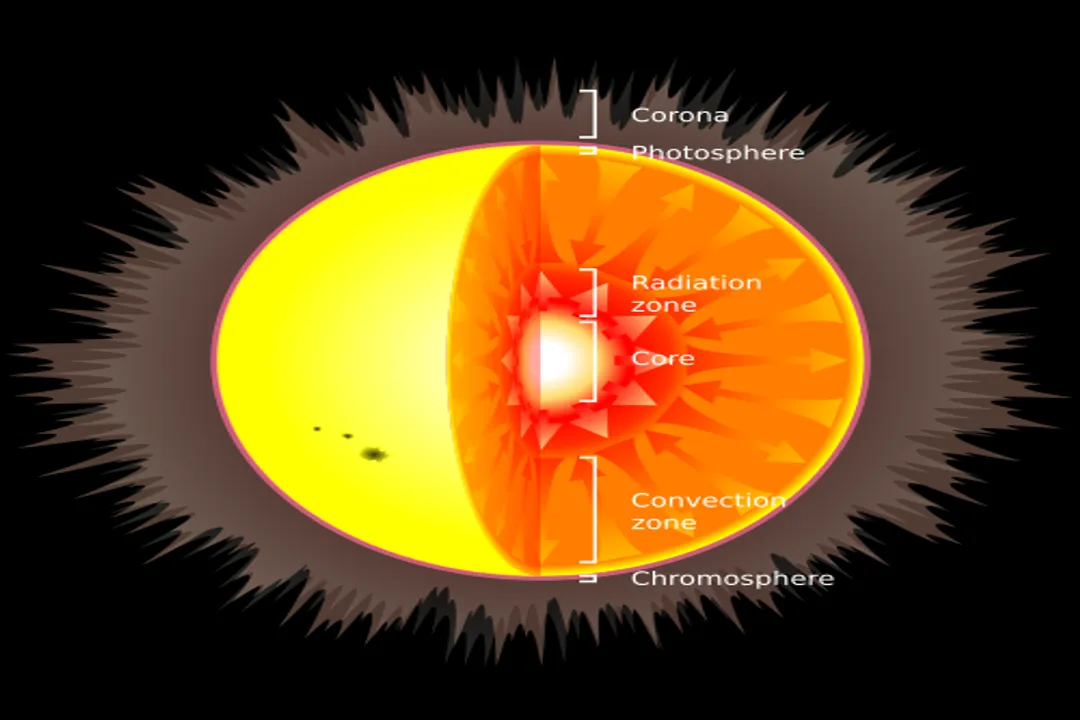
The persistence of the main sequence state hinges on a delicate, self-regulating balance. Gravity relentlessly tries to shrink the star, which would increase the core temperature and pressure, thereby accelerating the fusion rate. [2] A rapid increase in fusion rate generates more outward thermal pressure, pushing the stellar layers outward and causing the star to expand slightly. [2] This expansion, in turn, lowers the core temperature and pressure, slowing the fusion rate back down until equilibrium is restored. [2]
This self-correction mechanism is essential to the star's stability. It means that the star will maintain a nearly constant luminosity and size for billions of years while it has core hydrogen fuel available. [5] The entire reason we can use the main sequence as a benchmark for stellar age and distance is because this equilibrium period is so long and predictable. [3] If a star’s core were to suddenly stop fusing hydrogen, the gravitational force would instantly win, leading to immediate and catastrophic structural changes, marking the end of its main sequence life. [2]
# Fuel Consumption Rates

The differing rates of hydrogen consumption across the main sequence provide a powerful illustration of how mass dictates stellar destiny. Our Sun is predicted to remain on the main sequence, fusing hydrogen, for about 10 billion years. [3][7] This duration represents an immense period of stability from a human perspective, but in cosmological terms, it's just the prime of life for a G-type star.
Contrast this with larger stars. A star with 10 times the Sun's mass might only last a few tens of millions of years on the main sequence. [7] The increased gravitational pressure in these massive stars forces their cores to run the CNO cycle at an astonishing clip, depleting their hydrogen reserves almost recklessly quickly compared to a star like our Sun. [1][7] The main sequence defines the hydrogen-burning phase, and for these massive stars, that phase is over before geological features on their planets have time to fully stabilize. If you observed two stars of identical chemical composition, one 0.5 times the Sun's mass and one 2 times the Sun's mass, you could accurately predict the 0.5 solar mass star would still be comfortably fusing hydrogen long after the 2 solar mass star had already transitioned into a red giant phase. [5]
# Leaving the Sequence
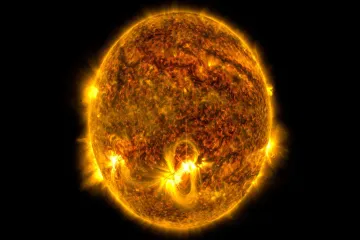
The main sequence ends abruptly for a star when the supply of hydrogen fuel in the core is exhausted. [5] Once the core is converted mostly to inert helium "ash," fusion ceases in that central region because the temperature is no longer high enough to initiate helium fusion (which requires far greater heat). [5] Gravity immediately begins to win this decades-long struggle, causing the helium core to contract and heat up. [5] This contraction eventually heats the shell of hydrogen surrounding the helium core enough to ignite fusion there, a process which is often more vigorous than the previous core fusion, pushing the outer layers of the star outward dramatically. [5] This dramatic expansion signals the star's departure from the main sequence and its transition into the subgiant or red giant branch of stellar evolution. [5][7] Therefore, the hydrogen-fusing stage is the main sequence; its cessation is the event that concludes it. [7]
Related Questions
#Citations
Main sequence
In a main sequence star, why does the fusion process stop ...
Main Sequence Stars: Definition & Life Cycle
Star Life Cycle
Stellar Evolution
G. C. Sloan: Main Sequence Stars, Giants, and Supergiants
Main Sequence Star Lives
Stars - Imagine the Universe! - NASA
Lecture 14: The Main Sequence