How does a nebula form a main sequence star?
The story of a star is one of an epic, slow-motion transformation, beginning in the cold, dark reaches of space within massive clouds of gas and dust known as nebulae. [1][5][6] These stellar nurseries are the fundamental building blocks from which all stars, including our own Sun, are eventually forged. [1][9] The journey from diffuse cosmic gas to a shining, self-sustaining star on the main sequence is a meticulous, multi-stage process driven entirely by gravity, culminating in a fiery atomic reaction at the core. [5][6]
# Cloud Beginnings
A star's genesis starts in a molecular cloud, a specific type of nebula that is vast, cold, and relatively dense compared to the rest of the interstellar medium. [1][6] These clouds are predominantly composed of molecular hydrogen (), alongside helium and trace amounts of heavier elements locked up in microscopic dust grains. [1][6] For gravity to gain the upper hand against the random motions and internal pressure of the gas, these initial conditions are crucial: the temperature must be extremely low, often only about ten degrees above absolute zero. [5] Without this intense cold, the kinetic energy of the gas particles would keep the cloud dispersed, preventing the necessary clumping that precedes star formation. [5]
# Collapse Trigger
While gravity is always present, the initial contraction required to start star formation is often too slow to be significant on its own. [5] Therefore, the process usually requires an external catalyst or trigger to initiate a large-scale gravitational collapse in a particular region of the cloud. [5] These triggers can manifest in several ways, such as the passage of a density wave through the galaxy, or more dramatically, the shockwave propagating outward from a nearby supernova explosion. [2][5] When the force of the trigger compresses a section of the cloud past a critical density threshold—known as the Jeans mass—gravity begins to win the local battle against outward pressure, causing that region to contract inward. [5][6]

# Gravitational Condensation
Once the collapse begins, the large molecular cloud doesn't usually form just one star; it often fragments into multiple smaller, denser clumps. [6] These clumps are the seeds of future stars, often referred to as pre-stellar cores. [6] As material falls toward the center of one of these cores, the potential energy of the falling gas is converted into kinetic energy, which then rapidly increases the internal temperature through friction and compression. [5][6] This heating is a necessary precursor to the later ignition of fusion. [5] The core continues to contract, becoming hotter and denser, while the surrounding gas orbits the center, flattening into a swirling structure. [6]
# The Protostar Stage
The hot, dense core at the center of the collapsing region officially becomes a protostar. [5][6] During this phase, the protostar is not yet a true star because its energy comes solely from gravitational contraction, not from nuclear reactions. [6] It grows substantially by continually pulling in mass from the envelope of gas and dust still surrounding it. [5][6] This infalling material doesn't drop straight down; instead, it settles into a rotating accretion disk around the protostar's equator. [5][6] A tell-tale sign of this active, messy phase is the bipolar outflow—powerful jets of material ejected from the star's poles, which help clear away some of the remaining natal cloud material. [5]
It's fascinating to observe that the initial mass gathered here dictates the star's entire future. A slight difference in the initial cloud fragment mass—perhaps just a few times the mass of the Sun—determines whether the final object burns brightly for only a few million years or calmly for billions. [4] The initial conditions set during this accretion phase lock the star into its eventual evolutionary path. [6]
# T Tauri Activity
For objects that will eventually become Sun-like stars (those in the low-to-intermediate mass range), the contraction phase continues after the main accretion has slowed, leading to the T Tauri stage. [6] These are sometimes called pre-main sequence stars. [6] During this period, the star is still shrinking, but it is becoming visibly hotter and brighter on the Hertzsprung-Russell (H-R) diagram as it moves toward its final state. [6] T Tauri stars are known for their irregular light curves and powerful stellar winds, characteristics that arise because they are still shedding the remnants of their birth cocoons. [6] The star is getting close, but the central engine has not yet fully engaged.
# Ignition Point
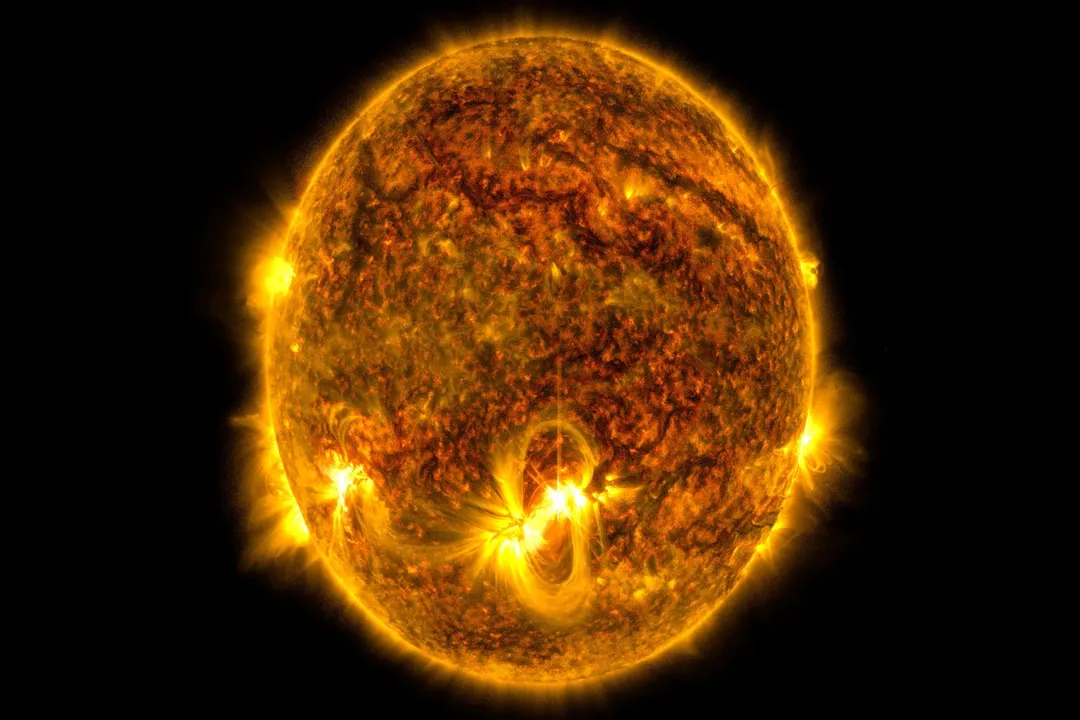
The transition from a contracting protostar to a true main sequence star hinges on a single, violent event: the ignition of sustained nuclear fusion in the core. [6] As gravity relentlessly squeezes the core, the temperature must eventually reach a critical threshold, approximately 15 million degrees Celsius (). [6] At this extreme temperature and corresponding density, hydrogen nuclei (protons) begin to fuse together to form helium nuclei. [1][6] This reaction releases an enormous amount of energy in the form of gamma rays and heat. [1]
When this fusion begins in earnest, the outward thermal pressure generated by the radiation perfectly counteracts the inward crushing force of gravity. [1][9]
# Main Sequence Stability
The achievement of this precise balance between inward gravity and outward fusion pressure is called hydrostatic equilibrium. [1][9] Once this state is established, the star officially settles onto the main sequence. [4] This is the longest and most stable phase of a star's entire existence, accounting for about 90 percent of its active lifetime. [4][6] During this long tenure, the star shines steadily by converting hydrogen to helium in its core. [4][9]
The duration a star spends on the main sequence is inversely related to its mass. [4] A low-mass star, like a red dwarf, burns its fuel so slowly that it can remain stable for trillions of years. [4] In sharp contrast, a massive star—one perhaps twenty or thirty times the Sun’s mass—has a core that operates at much higher temperatures and pressures, consuming its hydrogen fuel at a furious rate, resulting in a life span on the main sequence lasting only a few million years. [4] The stability achieved on the main sequence is a testament to cosmic fine-tuning; this equilibrium state is maintained for eons, representing a protracted battle where the forces of gravity and fusion are held in perfect, temporary check. [1] The entire process, from the initial cold cloud fragment to settling onto the main sequence, can take a few million years for a Sun-sized star, though the final, stable lifespan vastly eclipses that initial formation period. [5]
#Videos
Birth of a star - from nebula to main sequence - YouTube
Related Questions
#Citations
Star Basics - NASA Science
Stellar Evolution - | The Schools' Observatory
Protostars and Nebulae - ASPIRE
Main sequence - Wikipedia
Birth of a star - from nebula to main sequence - YouTube
Flexi answers - Explain the life cycle of a star. | CK-12 Foundation
How are stars formed from a nebula? - Facebook
How does a nebula form from a supernova? : r/askscience - Reddit
The Life Cycle of Stars | National Air and Space Museum