What force forms a star?
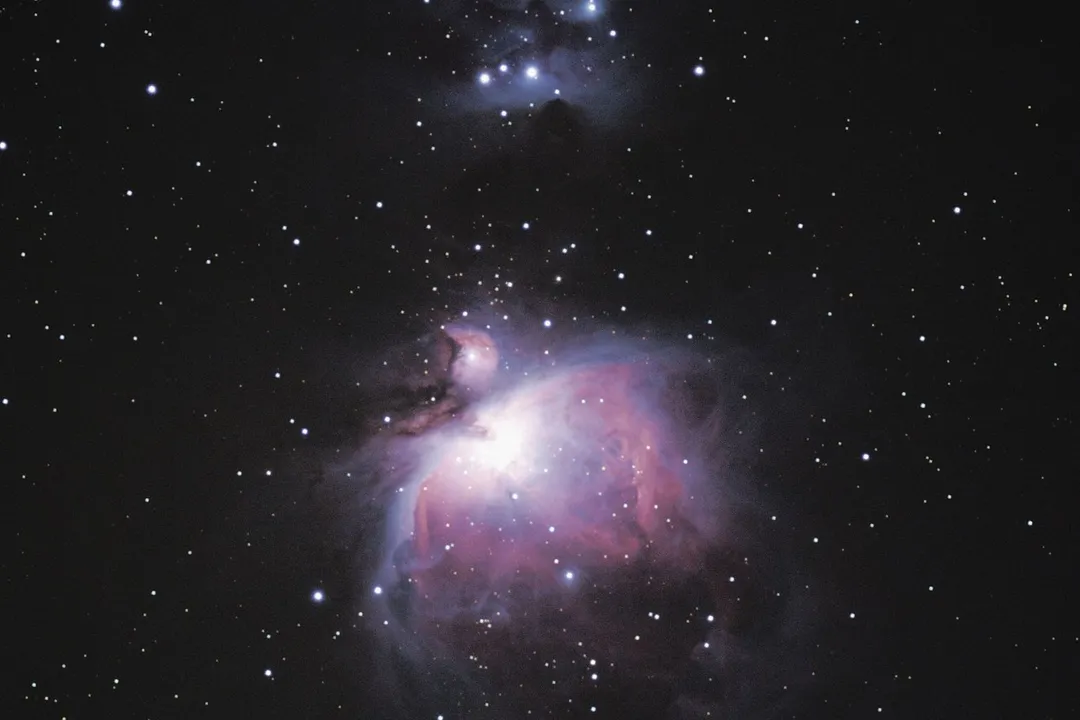
The fundamental agent responsible for sculpting a star out of the diffuse matter scattered throughout the cosmos is gravity. This persistent, attractive force is the engine of stellar birth, initiating a process that takes place within the coldest, densest regions of interstellar space, known as giant molecular clouds. [1][2][6] These immense nurseries are composed primarily of molecular hydrogen and helium, laced with trace amounts of heavier elements and dust grains. [2][7]
# Cosmic Nurseries
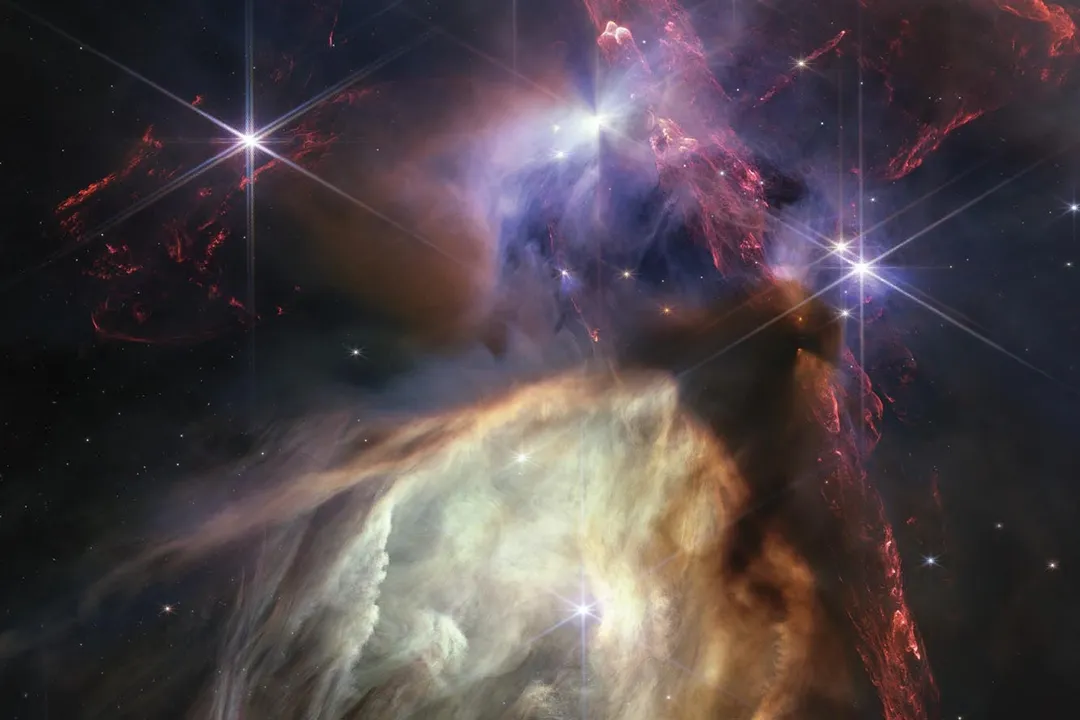
Before gravity can take hold effectively, the material needs to be concentrated. The space between stars, the interstellar medium, is generally too tenuous for star creation; a star cannot form from just any patch of gas. [8] Star formation demands the extreme conditions found within these giant molecular clouds (GMCs), which can span hundreds of light-years and contain masses millions of times that of our Sun. [2]
Within these cold clouds, the temperature hovers around ten to twenty Kelvin above absolute zero. [2][6] This frigid state is critical because it dramatically lowers the internal thermal pressure exerted by the gas particles. Star formation is essentially a contest between the inward pull of gravity and the outward push of gas pressure, which tries to keep the cloud dispersed. When the gas is extremely cold, the pressure term weakens, tipping the scales in favor of gravity. [2]
If we consider a localized region within a GMC, the Jeans Instability describes the critical mass or size a cloud segment must exceed for gravity to overcome the internal pressure and initiate a collapse. [2] In reality, these clouds are far from uniform; they possess internal turbulence, magnetic fields, and density variations that play critical roles in determining where and when star birth begins. [9]
# Triggering Collapse
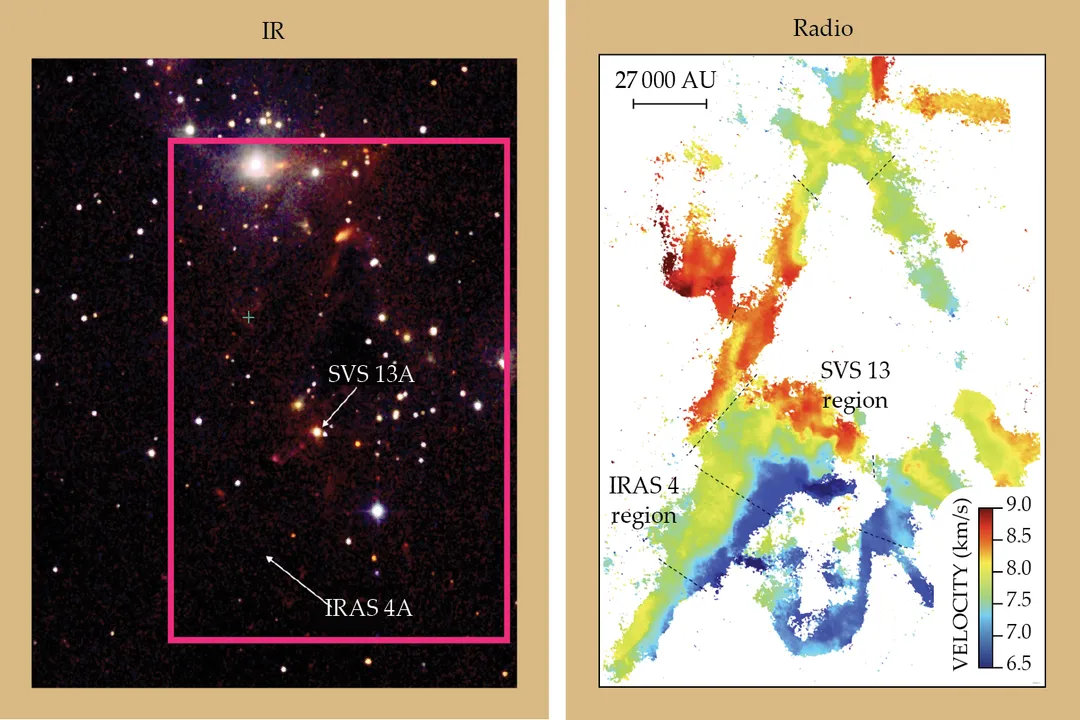
While some regions within a GMC might slowly contract due to minor density fluctuations, many stars appear to form relatively quickly, suggesting that a sudden external impetus is often required to initiate the rapid gravitational collapse. [9] Think of it like trying to push a heavy cart that is stuck—a small nudge won't do it, but a strong shove might get it rolling.
External events provide these necessary shoves. One of the most effective triggers involves shock waves traveling through the galaxy. [9] These powerful waves can originate from several cosmic cataclysms. For instance, the explosion of a massive star in a nearby supernova sends a shockwave sweeping through the surrounding interstellar medium, compressing the gas and dust it encounters. [9][6] Similarly, the collision of two molecular clouds or the passage of a spiral arm within a galaxy can create zones of high density that are suddenly unstable to gravity. [9] This compression rapidly increases the local density, pushing the region past that critical Jeans mass, allowing gravity to take over the dominant role in that area. [2][9]
# Gravitational Descent
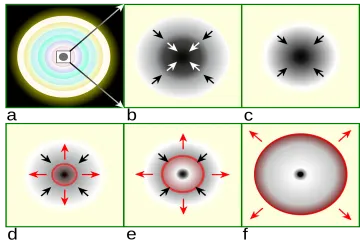
Once a region becomes gravitationally unstable, the process accelerates into what is known as a free-fall collapse. [2] This is not a smooth shrinkage; rather, the large cloud fragments into smaller, denser clumps, each destined to become one or more stars. [2][6] This fragmentation explains why stars often form in clusters rather than in isolation. [4]
As a fragment collapses inward, the gravitational potential energy of the infalling material is converted into kinetic energy, and subsequently, into thermal energy—the clump begins to heat up. [2] The center of this collapsing core becomes increasingly dense, forming a structure we identify as a protostar. [2][3]
At this stage, the object is not yet a true star because its energy source is purely gravitational contraction, not fusion. The outward pressure from this internal heat fights the continued infall, but gravity is still winning overall, drawing more material onto the growing core. [2]
If you examine the physics of this collapse, the rate at which mass accumulates is surprisingly quick for the most massive stars, taking only a few hundred thousand years, whereas less massive stars, like our Sun, might take tens of millions of years to build up their full mass from the surrounding envelope. [2]
An Analytical Observation: It is fascinating to contrast the conditions for the start of star formation with the conditions for the end of collapse. The beginning relies on achieving a state of near-absolute-zero temperature to minimize thermal resistance against gravity. The end, however, requires generating extreme, multi-million-degree heat via gravitational compression. This transition—from a state where coldness is power to a state where searing heat is power—highlights the dramatic physical reorganization that defines a star's birth. [2]
# Forming Disks
As the initial cloud core collapses, conservation of angular momentum becomes a significant factor. [6] Even a very slight initial rotation in the parent cloud is amplified as the material shrinks inward, causing the cloud to spin faster and faster, much like a spinning ice skater pulling in their arms. [2][6]
This rapid spin prevents material from falling directly onto the central protostar along the rotational axis. Instead, the centrifugal force flings the material outward, causing it to flatten into a rotating structure known as a circumstellar disk or accretion disk that surrounds the protostar. [2][7] This disk is crucial; it serves as the feeding reservoir, channeling gas onto the protostar over time, and it is also the birthplace of future planets. [4][7] Modern instruments like the Atacama Large Millimeter/submillimeter Array (ALMA) are specifically designed to image these disks in the act of formation, providing unprecedented detail about the structure where stars and planets coexist. [7]
# Protostar Winds
The process of accreting mass while maintaining a disk is not perfectly smooth. To shed excess angular momentum and allow the central mass to grow, the system must expel some material. This is accomplished through powerful, highly collimated jets of gas ejected from the poles of the protostar, perpendicular to the accretion disk. [2] These are known as bipolar outflows. [2]
These outflows, which are often visible as Herbig-Haro objects when they slam into surrounding gas, clear away some of the surrounding material, effectively stopping the accretion process once the star has gathered most of the mass available in its immediate vicinity. [3]
# Stellar Ignition
The protostar continues to contract under gravity, steadily increasing its core temperature and density over millions of years. [3] The defining moment in a star's life—the point where it officially becomes a true star—occurs when the core temperature becomes high enough to ignite sustained nuclear fusion. [3][6]
For a Sun-like star, this critical ignition temperature is approximately 15 million Kelvin. [1][5] At this extreme temperature and immense pressure, hydrogen nuclei (protons) begin to fuse together to form helium, releasing vast amounts of energy in the process—this is the proton-proton chain reaction. [1][5]
The energy released by fusion creates a tremendous outward thermal pressure that finally counterbalances the inward crush of gravity. [2] When this state of hydrostatic equilibrium is achieved, the object stops contracting and settles onto the main sequence, where it will spend the vast majority of its life stably burning fuel. [2][10] The mass of the object at this point determines its ultimate fate and characteristics, such as its color, lifespan, and luminosity. [1]
If the collapsing core never reaches this critical temperature, it fails to become a star. Instead, it becomes a brown dwarf, an object sometimes called a "failed star," which is too small to sustain hydrogen fusion but large enough to briefly fuse deuterium. [1]
A Practical Distinction: Astronomers often draw a sharp line between the gravitational era and the fusion era. While an object like the Sun spent roughly 50 million years as a protostar powered only by gravitational contraction, it only enters its long, stable phase after fusion ignites. This means that for the vast majority of a star's active existence, the force holding it up against collapse is the outward push from nuclear reactions, a direct consequence of the initial gravitational squeeze. [2][5]

# The Aftermath of Birth
The entire star-forming process, from the initial instability in the cloud to the ignition of the main sequence star, dictates the environment for any planets that might form alongside it. [4] The leftover material trapped in the accretion disk, which was too diffuse or too distant from the protostar to fall in, remains orbiting the new star. [7] Over millions of years, the dust and gas particles within this disk begin to clump together, eventually forming asteroids, comets, and the planets that populate the new solar system. [4]
Thus, the single driving force—gravity—not only creates the central light source but also structures the entire planetary system around it. The density fluctuations, the speed of rotation, and the eventual mass accumulated all stem from that initial, unstoppable decision by gravity to pull matter together in the cold, dark reaches of space. [2][6]
# Key Stages Summary
The formation process can be summarized through these sequential steps, each governed by the gravitational imperative:
- Giant Molecular Cloud: Cold, dense pockets form within vast interstellar gas clouds. [2]
- Triggered Collapse: An external event, like a supernova shockwave, compresses a pocket, making it unstable. [9]
- Fragmentation: The unstable region breaks into smaller clumps, each collapsing individually. [2]
- Protostar Development: Gravitational energy heats the core as mass falls inward, forming a hot, dense center surrounded by a spinning disk. [2][7]
- Bipolar Ejection: Outflows clear away excess angular momentum and surrounding envelope material. [2]
- Main Sequence Ignition: Core temperature reaches 15 million Kelvin, initiating hydrogen fusion, establishing hydrostatic equilibrium, and officially birthing a star. [1][2]
Related Questions
#Citations
Star Basics - NASA Science
Star formation - Wikipedia
Star Formation - | The Schools' Observatory
How do stars and planets form and evolve? | Center for Astrophysics
The Outer Planets: A Star is Born
Astrobiology Institute at the University of Hawaii
Star and planet formation | ALMA Observatory
How Does a Star Form? - Universe Today
A shocking beginning to star formation - Physics Today
Stellar evolution | Astronomy explained - SCNAT knowledge