What is formed when a star collapses?

The final moments of a star’s life are among the most violent and fascinating events in the cosmos. When a star exhausts its nuclear fuel, the outward pressure that has long counteracted the relentless inward tug of its own gravity ceases. This imbalance initiates a catastrophic implosion known as gravitational collapse. [4] What forms from this collapse is not a single entity but a range of exotic, ultra-dense objects whose nature depends almost entirely on the star's initial mass—ranging from a dense stellar ember to the most extreme warpings of spacetime we know.
# Life Balance Lost
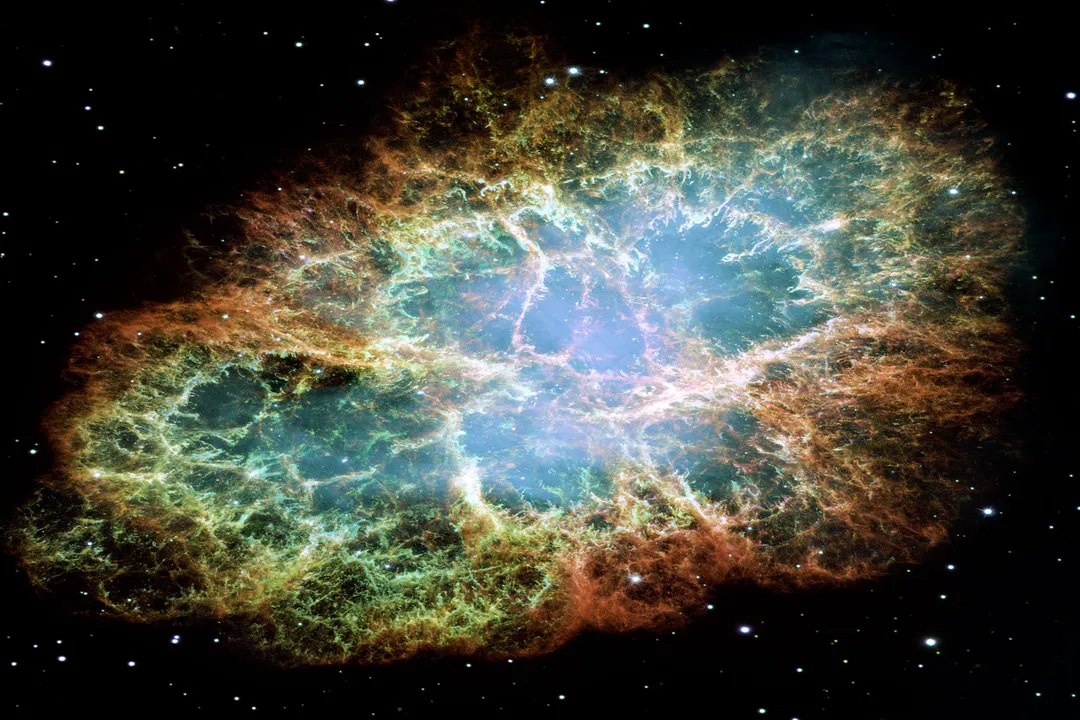
A star spends the majority of its existence locked in a delicate, titanic struggle: the crushing force of gravity pulling everything inward versus the thermal and radiation pressure generated by nuclear fusion pushing outward. [6][3] As long as a star is actively fusing lighter elements into heavier ones in its core, it remains stable, existing on what astronomers call the main sequence. [6] For stars like our Sun, this means fusing hydrogen into helium. [6]
However, every star has an expiration date dictated by its fuel supply. Once the core runs out of the primary fuel it needs to sustain fusion, this supporting pressure fades. [3] For stars up to about eight times the Sun's mass, the process is relatively gentle, leading eventually to a white dwarf. [5] But when the core mass of a truly massive star—one perhaps significantly larger than the Sun—runs out of fuel, the resulting gravitational crush is so extreme that nothing can stop it from proceeding to a far more dramatic conclusion. [5][7] The collapse is rapid, often occurring in less than a second. [3]
# Collapse Mechanics
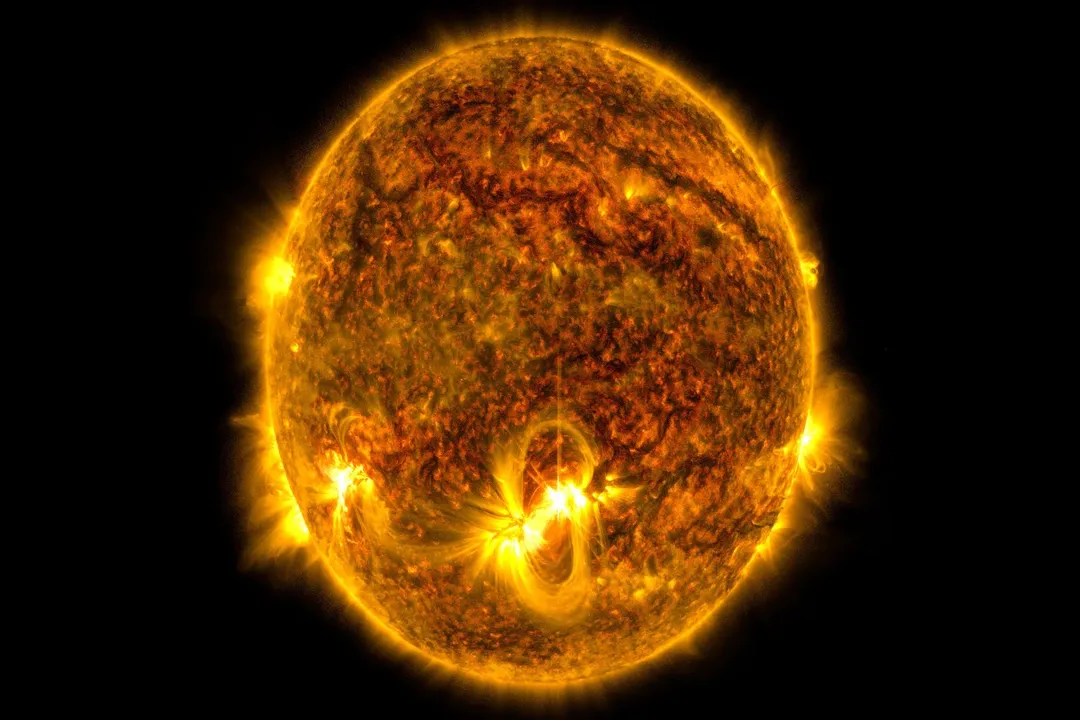
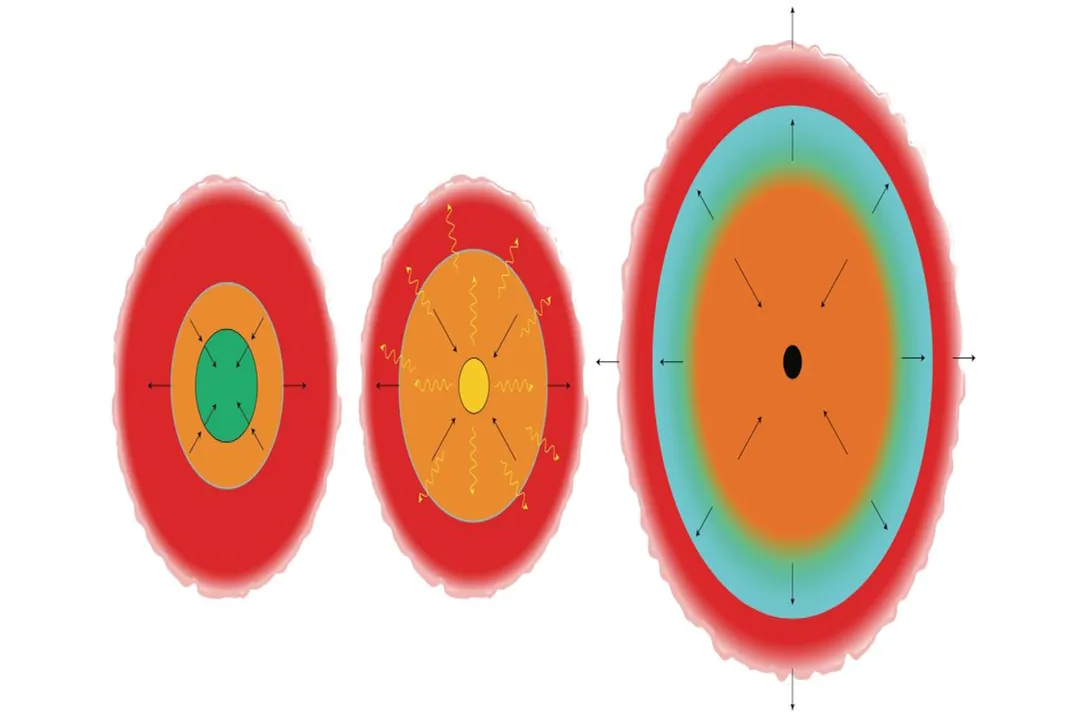
The physical process initiated when fusion stops is a rapid inward fall of matter, termed gravitational collapse. [4] In smaller stars, once the core shrinks enough, electrons are squeezed so tightly together that they generate a strong outward resistance called electron degeneracy pressure. This pressure is usually sufficient to halt the collapse, creating a stable, inert white dwarf. [7]
For much more massive stars, however, gravity simply overpowers this electron resistance. [7] As the core shrinks further, the pressure becomes so intense that the electrons are forced into the protons, turning them into neutrons and releasing a flood of ghostly particles called neutrinos. [3][1] This process is known as neutronization. [3]
When this stage is reached, the star’s fate hangs on a threshold known as the Chandrasekhar limit, or more relevantly for the more massive stellar endpoints, the Tolman-Oppenheimer-Volkoff (TOV) limit. [7] If the remaining core mass is below the TOV limit—roughly between $1.4$ and $3$ solar masses—the collapse is momentarily halted by neutron degeneracy pressure, the resistance offered by densely packed neutrons. [7] This scenario results in a core-collapse supernova. [2]
# Supernova Blast
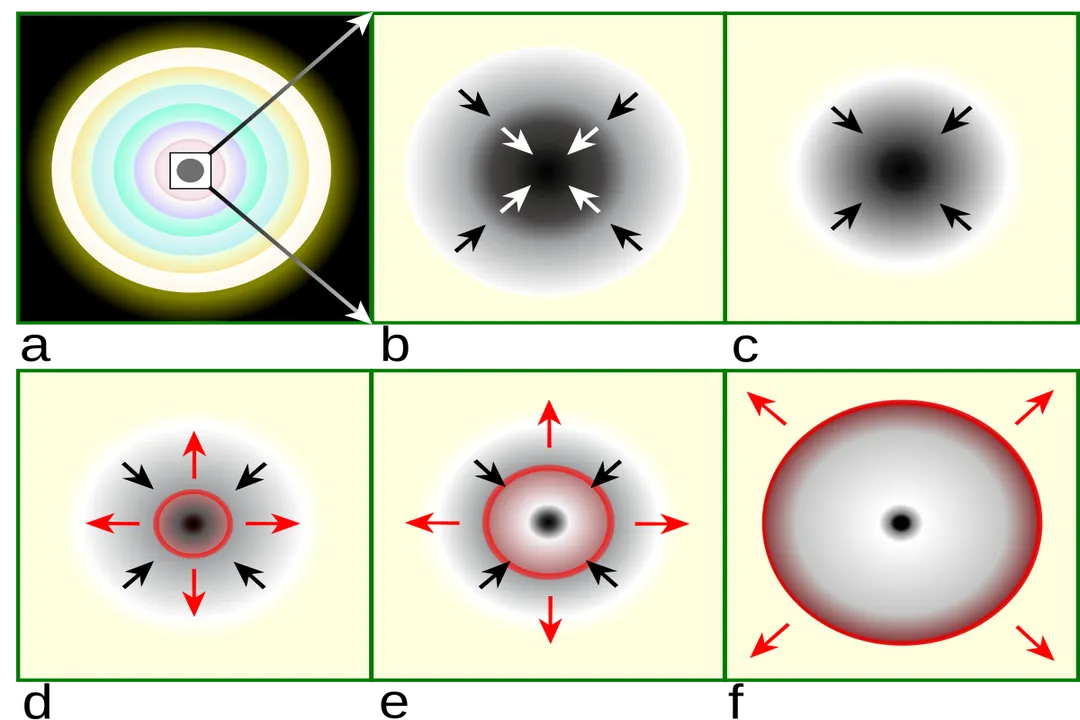
If the core mass exceeds the limit sustainable by neutron degeneracy pressure, the collapse cannot be stopped by any known force, leading to the formation of a black hole. [7] But before that happens, or in the case where the neutron star forms, the stellar death is often marked by a spectacular explosion: the supernova. [5]
In a core-collapse scenario, the outer layers of the star, which are still falling inward, slam into the newly formed, incredibly dense core material—either the nascent neutron star or the collapsing black hole progenitor. [3] This collision creates a massive shockwave that rebounds outward through the star. [3] This outgoing shockwave, coupled with the massive burst of energy carried away by the escaping neutrinos, powers the supernova explosion. [2][3]
The energy released during this event is staggering. A supernova can briefly outshine an entire galaxy, radiating as much energy in a few weeks as the Sun will produce over its entire ten-billion-year lifetime. [5] Consider the sheer scale: if you could witness a supernova from Earth, even at a distance of a few light-years, the visible light alone would cause daylight conditions to persist through the night for weeks, a truly disruptive event for any nearby planetary systems. [5] The explosion disperses the star's outer layers, enriched with heavy elements forged during the star's life and the supernova itself, scattering them across the interstellar medium. [5]
# End State One Neutron Star
If the collapsing core has a mass somewhere between $1.4$ and approximately $3$ solar masses, the immense pressure created by the core collapse arrests the implosion, resulting in a neutron star. [7] These objects are mind-bogglingly dense. A teaspoon of neutron star material would weigh about a billion tons. [3] This incredible density arises because the material is composed almost entirely of neutrons packed together almost as tightly as atomic nuclei. [3]
Neutron stars rotate incredibly fast, often spinning hundreds of times per second, due to the conservation of angular momentum during the collapse. [3] If these rapidly spinning stars emit beams of electromagnetic radiation from their magnetic poles that sweep across Earth, we detect them as pulsars. [3] The collapse is so swift and intense that it generates ripples in the fabric of spacetime itself, called gravitational waves, which we can now detect here on Earth, offering a direct signal of the catastrophic event. [2]
Here is a summary illustrating the mass-dependent pathways resulting from the core's final size, assuming the initial star was massive enough to undergo a core collapse:
| Core Mass (Approx.) | Resulting Object | Key Mechanism Stopping Collapse |
|---|---|---|
| Neutron Star | Neutron Degeneracy Pressure [7] | |
| Black Hole | No known force can stop collapse [7] |
Note: represents the mass of the Sun. This comparison highlights that the mass of the remnant core, not just the initial star, is the critical factor determining the final compact object. [7]

# End State Two Black Hole
When the progenitor star is exceptionally massive—generally starting at greater than 20 to 25 times the mass of the Sun, leading to a core mass above the TOV limit—neutron degeneracy pressure is insufficient to resist gravity. [7] The core continues to collapse past the point where any known physical barrier can stop it. [4]
This unending collapse forms a black hole. [4][7] A black hole is a region of spacetime where gravity is so strong that nothing, not even light, can escape its pull. [6] The boundary around the black hole from which escape is impossible is called the event horizon. [6] All the matter of the collapsed core is thought to be crushed down to an infinitely dense point at the center, known as a singularity. [6][4] The physics governing what happens at the singularity remains one of the great unsolved mysteries of modern science, as the mathematics of general relativity break down there. [4]
# Detecting the Collapse
The sheer power of these collapsing events means they leave distinct cosmic fingerprints. While light from the resulting supernova is easily visible across vast distances, [5] the formation of the compact remnant itself can sometimes be detected through its influence on nearby matter or, more recently, through the direct observation of spacetime distortions. [2]
The process that forms a neutron star or a black hole in a core-collapse event generates powerful gravitational waves. [2] These waves are propagating disturbances in the curvature of spacetime, like ripples on a pond. [2] When two massive stellar remnants, such as two neutron stars or a neutron star and a black hole, merge, they produce particularly strong signals detectable by instruments like LIGO and Virgo. [2] In fact, the detection of gravitational waves has provided empirical evidence confirming the processes described by general relativity in these extreme environments, giving us new ways to "hear" the universe's most energetic collapses, rather than just seeing the aftermath. [2]
The formation of these remnants—whether a spinning, ultra-dense sphere of neutrons or an inescapable singularity—represents the absolute endpoint of stellar evolution for the vast majority of the universe's mass. These collapsed objects are the cosmic nurseries for black holes and neutron stars, shaping the structure and dynamics of galaxies long after the original star has vanished in a blaze of glory. [5]
#Videos
How the Collapse of Stars Produces Elements | BBC Earth Science
Related Questions
#Citations
ELI5: Can someone explain how a star can collapse in on itself, and ...
Core Collapse Supernovae - gravitationalwaves – Syracuse University
Collapsing stars, supernovae, and gamma-ray bursts - MPA Garching
Gravitational collapse - Wikipedia
DOE Explains...Supernovae - Department of Energy
Star Basics - NASA Science
What is the process of a star collapsing into itself? What happens ...
Why do medium mass stars collapse to form supernovae while more ...
How the Collapse of Stars Produces Elements | BBC Earth Science
The Outer Planets: A Star is Born