What star is formed from a supernova?
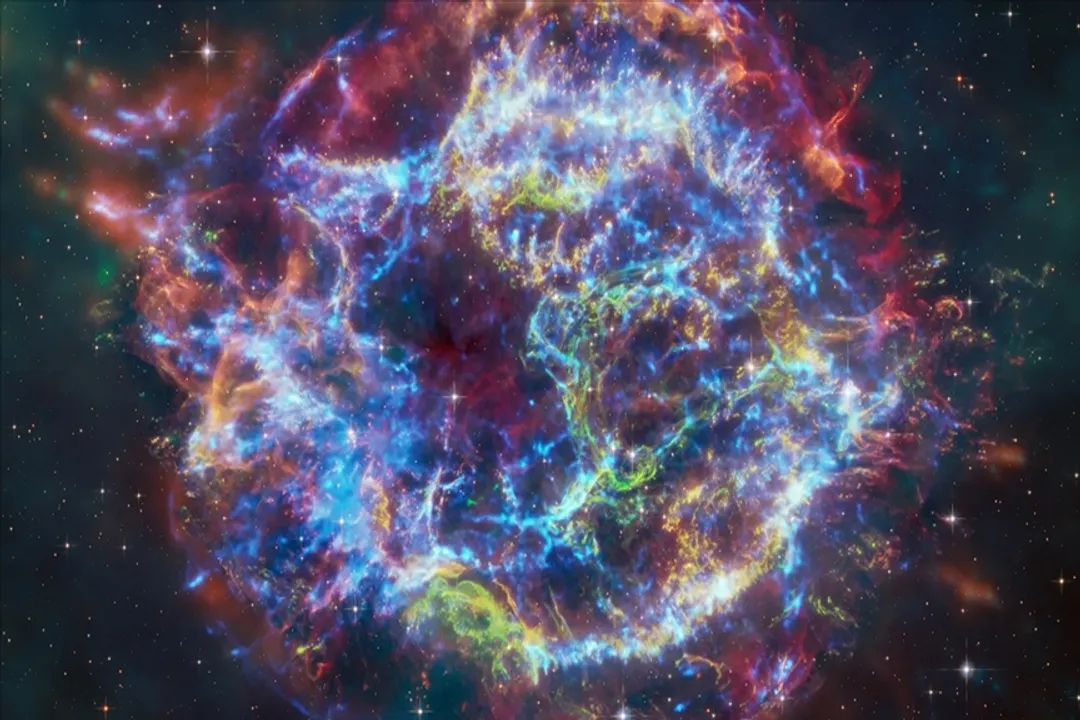
The aftermath of a massive stellar explosion, a supernova, results in the formation of one of the universe's most extreme objects: either an incredibly dense neutron star or, if the progenitor was massive enough, a black hole. [1][2] While we often think of stars as things that are born, they also experience dramatic deaths. The specific object left behind is entirely dependent on the mass of the star's core that remains after the cataclysmic blast. [8] It is important to distinguish this process from the end stages of stars like our Sun, which shed their outer layers gradually to form a white dwarf, rather than undergoing a core-collapse supernova. [4][5]
# Supernova Trigger
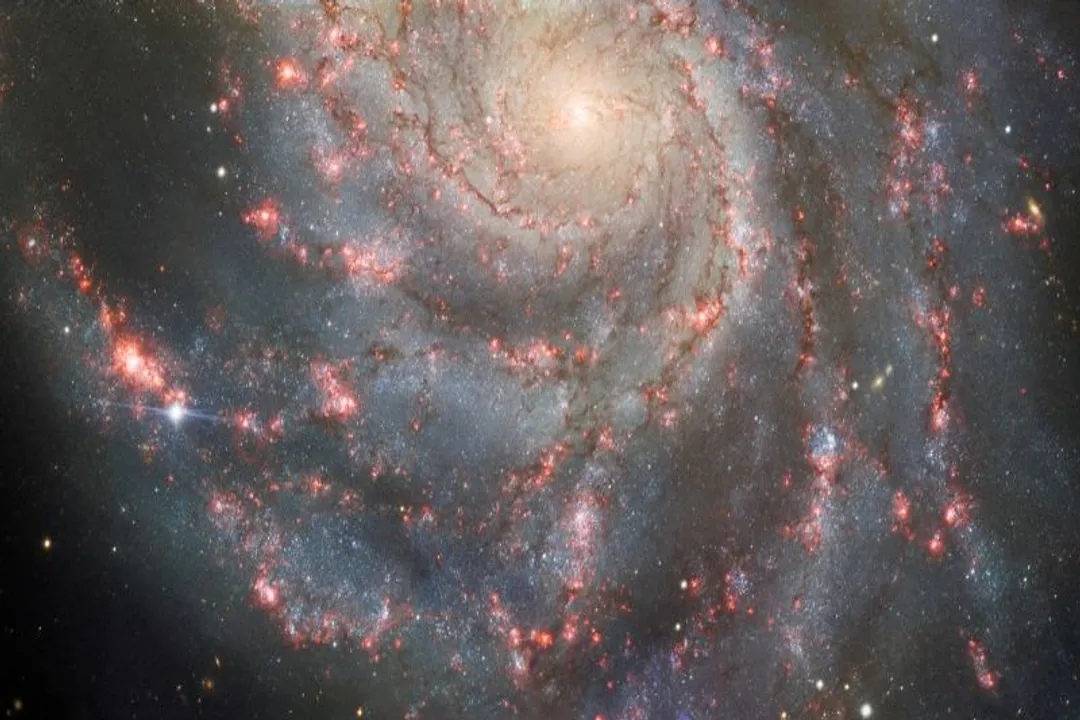
A supernova marks the violent end of a star that has exhausted its nuclear fuel and can no longer support itself against the crushing force of its own gravity. [8][9] When a massive star runs out of fuel, its core collapses inward rapidly. This collapse generates an outward-moving shockwave that blasts the star's outer layers into space at tremendous speeds, creating the brilliant, temporary beacon we call a supernova. [8][9] This event is a key process for creating and dispersing elements heavier than iron throughout the cosmos. [9]
Stars that end their lives in a Type II (core-collapse) supernova are significantly larger than our Sun, usually beginning with perhaps eight times the Sun's mass or more. [8] The fate of the remaining core material dictates whether a neutron star or a black hole will exist in its place. [2]
# Remnant Star Types
When the supernova explosion clears away the outer layers, the remaining core material is squeezed down to unimaginable densities. [7] The resulting compact objects are the physical stellar remnants of the explosion.
The first possibility is the neutron star. This exotic object is created when the core collapse is halted by neutron degeneracy pressure, meaning the protons and electrons are squeezed together so tightly they merge to form neutrons. [1] These remnants are supported by the resistance of neutrons packed together. [7]
If the remnant core is too massive for even neutron degeneracy pressure to stop the collapse, gravity wins completely, and the result is a black hole. [1][2] A black hole is a region of spacetime exhibiting such strong gravitational effects that nothing—not even particles and electromagnetic radiation like light—can escape from inside it. [1] The boundary past which escape is impossible is known as the event horizon. [1]
# Mass Thresholds
The dividing line between forming a neutron star and forming a black hole hinges on the mass of the collapsing core, often measured in solar masses (). [1][2]
Generally, if the star's core remnant is between about $1.4$ and $3$ solar masses, the result is a neutron star. [1][4] If the core remnant is greater than about $2$ to $3$ solar masses, the collapse continues indefinitely, forming a black hole. [1][2] This critical mass limit for neutron stars is often referred to as the Tolman-Oppenheimer-Volkoff (TOV) limit. [1]
To put these values into context, consider the progenitor mass required. A star with an initial mass perhaps between $8$ and $25$ solar masses often yields a neutron star. If the initial mass is greater than $25$ solar masses, the remnant is more likely to be a black hole. [2] It is a startling realization that an object several times the mass of our Sun can be compressed into a sphere only a few kilometers wide. [7]
| Progenitor Core Remnant Mass () | Resulting Stellar Object | Primary Support Mechanism |
|---|---|---|
| Less than | Fails to explode/White Dwarf (different scenario) | Electron Degeneracy Pressure |
| to $3$ | Neutron Star | Neutron Degeneracy Pressure |
| Greater than | Black Hole | None (Total Gravitational Collapse) |
The precision of these limits is still an active area of astronomical study, as factors like the star's rotation and the physics of hyperdense matter introduce complexities that slightly shift these accepted boundaries. [1]
# Neutron Star State
The neutron star is perhaps the most fascinating object formed directly from a supernova, representing matter at an extreme state achieved through gravitational compression. [7] These objects are incredibly small for their mass; they typically have a mass greater than the Sun packed into a sphere only about $20$ kilometers across—roughly the size of a major metropolitan city. [7]
This compression forces gravity to overcome the electrostatic repulsion between electrons and protons, causing them to merge into neutrons. [1] Because the neutrons resist further compression due to the Pauli exclusion principle (the same principle that supports white dwarfs, but here applied to neutrons), the collapse is momentarily stabilized. [1] If you could scoop up a single teaspoon of neutron star material, it would weigh about a billion tons. [7] Visualizing this immense density is challenging; it's like squeezing Mount Everest down to the size of a sugar cube. [7]
# Material Recycling
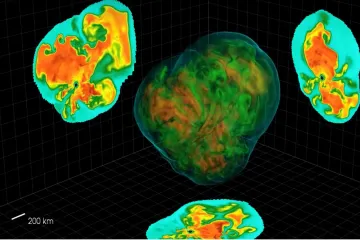
While the central remnant becomes a neutron star or a black hole, the supernova itself is an event of material ejection. [9] The vast majority of the progenitor star's mass is flung outward in the explosion, enriching the interstellar medium with heavy elements forged during the star's life and, critically, during the explosion itself. [9]
These expelled elements—including oxygen, carbon, and iron—are the building blocks for future generations of stars, planets, and, eventually, life. [9] Therefore, while the star that collapses forms a compact object, the event ensures that new stars can form later from the dispersed cloud of enriched gas and dust. [6] Think of it as the stellar equivalent of a massive recycling program: the death of one massive star provides the raw ingredients for countless future stellar systems, meaning the material that formed the supernova is widely distributed, not concentrated into a single subsequent star. [6]
The Sun, for example, is a second-generation star, meaning the elements that make up our planet and ourselves were once cooked inside massive stars that lived and died long before the Sun ignited. [5] The supernova is thus not just an endpoint, but a necessary, explosive step in the chemical evolution of the galaxy.
Related Questions
#Citations
Neutron star - Wikipedia
What kind of star or stars ended in a supernova which formed the ...
When Does a Neutron Star or Black Hole Form After a Supernova?
Neutron Stars and White Dwarfs | Center for Astrophysics | Harvard ...
What is the name of the star that created the Sun (like by supernova)?
How can many stars be formed from the remains of one supernova?
DOE Explains...Neutron Stars - Department of Energy
supernova - Cosmic Evolution Project - Cal Poly, San Luis Obispo