How does the end stage of a star like our Sun differ from a core-collapse supernova remnant formation?
Answer
Stars like the Sun gradually shed outer layers to form a white dwarf
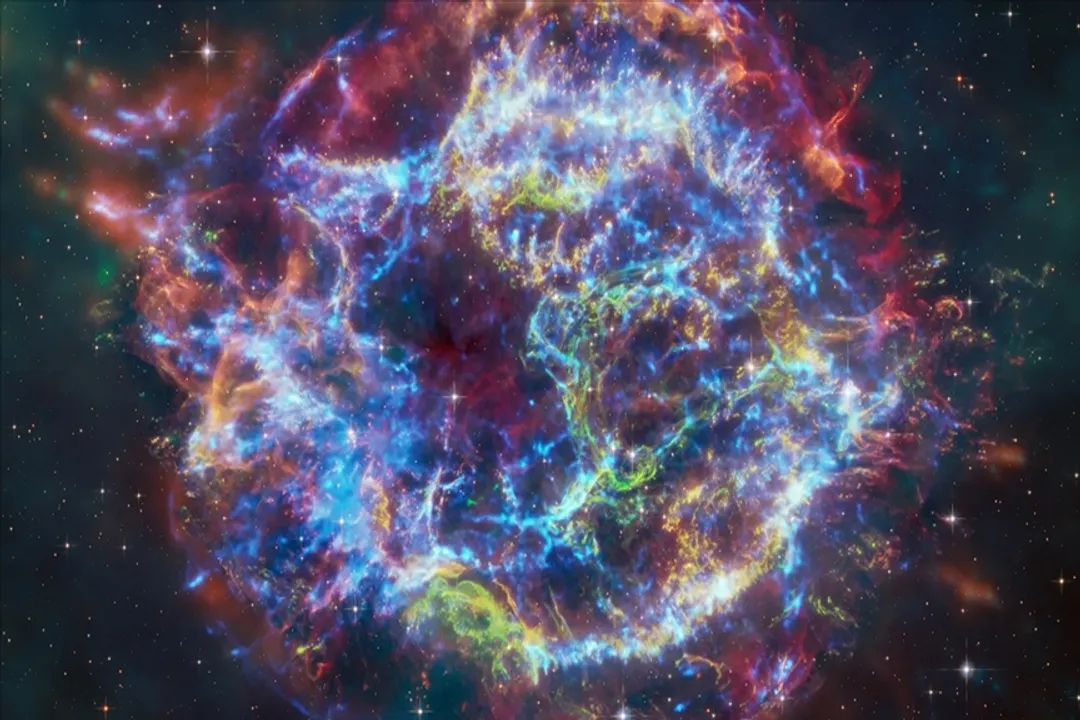
Stars similar in size to the Sun terminate their lives by gradually shedding their outer layers to form a white dwarf, a process distinct from the core-collapse supernova that forms compact remnants like neutron stars or black holes.
Related Questions
What extremely dense objects can form after a massive star undergoes a supernova?What fundamental stellar state causes a core-collapse supernova to be triggered?How does the end stage of a star like our Sun differ from a core-collapse supernova remnant formation?What pressure halts the collapse of the core to form a neutron star?Under what condition does gravity completely overcome degeneracy pressure leading to a black hole?What is the term for the boundary beyond which nothing, including light, can escape a black hole?What is the approximate mass range (in solar masses) for a remnant core that results in a neutron star?What initial progenitor mass often leads to the formation of a black hole remnant?What crucial role does the supernova event play in galactic chemical evolution?Which analogy describes the immense density of a teaspoon of neutron star material?What critical mass limit is often referenced when discussing the maximum stable mass for a neutron star?