What force causes the contraction of a cloud of interstellar matter to form a star?
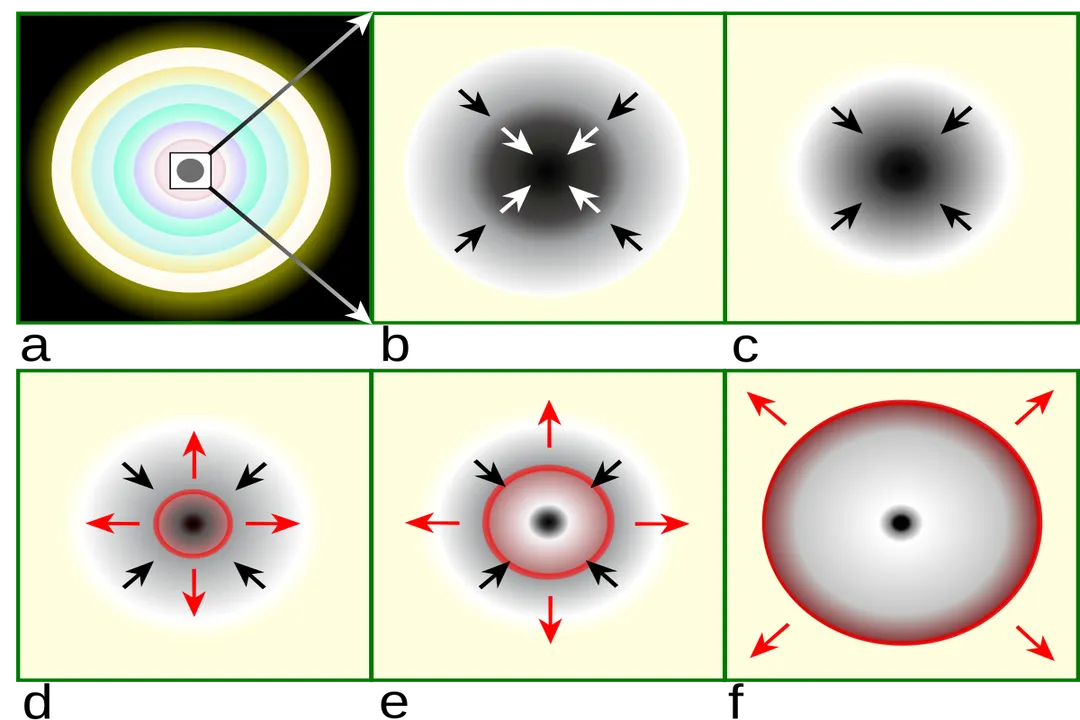
The immense, cold clouds scattered throughout the cosmos, the nurseries of future solar systems, do not simply decide one day to condense; their transformation is dictated by a single, relentless physical law: gravity. [1][4] This fundamental interaction is the engine of star formation, causing vast stretches of interstellar matter to pull inward upon itself, overcoming the forces that strive to keep the gas and dust dispersed. [6][1] The entire process, from a diffuse cloud to a shining star, hinges on gravity achieving dominance over internal kinetic energy and magnetic pressure. [1]
# Gravity's Power
The force responsible for initiating the entire stellar life cycle is gravity, the attractive force between any two objects with mass. [3][4] In the context of star formation, we are observing the cumulative effect of this attraction acting across astronomical distances within gigantic reservoirs of gas and dust known as giant molecular clouds (GMCs). [8] These clouds can span hundreds of light-years and hold masses equivalent to a million times that of our Sun. [8]
For a star to form, gravity must be allowed to win the battle against the cloud's own internal energy, primarily in the form of gas pressure. [1][6] If a region of the cloud is sufficiently cold and dense, the inward pull of gravity can exceed the outward push generated by the thermal motion of the gas particles and any opposing magnetic fields. [1] When this threshold is met, the region begins to collapse, leading inexorably toward the formation of a star. [1][6] Without this initial gravitational imbalance, the interstellar medium would remain stable, and new stars would never ignite.
# Cloud States
Interstellar space isn't entirely empty; it contains the raw material for stars—gas, primarily hydrogen and helium, mixed with trace amounts of heavier elements and dust. [8] These components congregate into structures. Star formation begins within the coldest and densest of these structures: Giant Molecular Clouds (GMCs). [8]
The internal conditions within a GMC are critical. These clouds are exceptionally cold, often hovering around ten Kelvin (). [8] Low temperature means low kinetic energy, which translates directly to low internal thermal pressure. This coldness is essential because it allows gravity to gain the upper hand more easily. [1]
Consider the sheer scale involved. A typical GMC might contain $10^5$ to $10^6$ solar masses, spread over many parsecs. [8] If we map this onto a familiar scale, imagine a cloud that is several times the distance from the Sun to Alpha Centauri, yet it only has the average density of Earth's best vacuum chambers. [8] It is the inhomogeneities—the small, slightly denser clumps within this vast, mostly empty volume—that serve as the true stellar seeds, as they can achieve the critical density needed for collapse sooner than the entire cloud at once. [4]
As an aside for perspective, when we discuss the required density, it’s helpful to think about the necessary conditions for collapse. While a whole GMC is tenuous, the process often relies on local triggers—like a shockwave from a nearby supernova or a galactic spiral arm compression—to push a small, self-gravitating core past the point of no return. Even a seemingly minor change in local pressure can shift the balance, turning a stable cloud fragment into a collapsing object, much like nudging a perfectly balanced stack of dominoes only slightly before the entire sequence falls. [1]
# Collapse Triggers
While gravity is the cause of contraction, the initial trigger for a specific region to start collapsing against its neighbors is often external or related to internal turbulence. [4]
Several mechanisms can initiate the gravitational instability within a molecular cloud:
- Self-Gravity: If a region's mass exceeds a certain critical value, known as the Jeans Mass, its self-gravity will cause it to contract spontaneously. [1]
- External Compression: A passing shock wave from a supernova explosion, or the pressure exerted by stellar winds from massive, nearby stars, can compress parts of the cloud, increasing density until the Jeans criterion is met. [4]
- Cloud Collisions: The collision or interaction between two molecular clouds can create localized zones of high density that begin to collapse. [4]
The process is rarely uniform. Instead of the entire cloud shrinking smoothly, it fragments into smaller, collapsing pieces, each destined to become a star or a binary system. [4] This fragmentation explains why stars are typically born in clusters rather than in isolation.
# Protostellar Evolution
Once a core begins its inevitable gravitational collapse, the dynamics change rapidly. The inward pull continues to accelerate as the density increases, a self-reinforcing cycle where more mass draws in more mass. [1] As the material falls inward, gravitational potential energy is converted into thermal energy (heat). [3][7]
This early, hot, contracting object is known as a protostar. [4][7] Importantly, the protostar is not yet a true star because it has not initiated stable hydrogen fusion in its core. [3] Initially, the intense heat generated by the infall of matter is radiated away efficiently, allowing the collapse to continue unabated. This phase is characterized by significant accretion, where the protostar is still gathering mass from the surrounding envelope of gas and dust. [4]
During this active accretion phase, powerful phenomena often manifest. Jets of material, sometimes called bipolar outflows, are ejected perpendicular to the accretion disk surrounding the nascent star. [5] These outflows are believed to be a mechanism for carrying away excess angular momentum, which prevents the entire cloud from simply spinning itself apart as it contracts. [5] The interplay between infall (accretion) and ejection (outflows) is a defining feature of early stellar evolution. [5]
# Temperature Rises
The contraction phase continues until the central temperature and pressure become so extreme that the object can no longer radiate away the gravitational energy fast enough to keep collapsing easily, marking a transition point. [7]
As the cloud core shrinks, the pressure opposes gravity more strongly, slowing the free-fall. However, the heat trapped inside continues to build up. When the core reaches a temperature of about $10^7$ Kelvin, the conditions are finally right for nuclear fusion to begin—specifically, the fusion of hydrogen into helium. [3]
This ignition marks the moment the object officially becomes a star and settles onto the main sequence. [3] The outward pressure generated by this sustained thermonuclear reaction perfectly balances the inward crush of gravity, establishing a state of hydrostatic equilibrium. [1][3] This balance dictates the long, stable lifetime of a star like our Sun.
This transition from collapse (dominated by gravity) to stability (dominated by fusion pressure) illustrates a beautiful physical dichotomy. Initially, gravitational collapse dictates the object's destiny, [1] but once formed, the star spends the majority of its life governed by the near-perfect equilibrium between gravity and the energy created by its own core. [3] Understanding the initial trigger—the moment gravity wins over pressure—is understanding the origin of virtually every star in the universe.
# Angular Momentum Management
While gravity pulls matter inward, the original cloud fragments possessed some small degree of rotation, or angular momentum. [5] As a cloud contracts, the conservation of angular momentum dictates that its rotation speed must increase dramatically, much like a spinning ice skater pulling in their arms. [5] If this rotation were not somehow shed, the centrifugal forces would halt the collapse long before a star could form, flattening the material into a fast-spinning disk or preventing fusion entirely.
The mechanism for dealing with this excess angular momentum is one of the most dynamic aspects of star formation, heavily involving the bipolar outflows. [5] These outflows and associated magnetic fields act as an exhaust system, venting away the excess spin, allowing the central core to contract further and increase its density enough to reach fusion temperatures. [5]
A crucial, often overlooked aspect of this rotational effect is that it imposes a fundamental limit on the size of the central object before it becomes a true star. The rapid spinning forces the infalling material into a disk structure—the protoplanetary disk. This disk acts like a barrier, slowing the rate at which new material can feed the central protostar. Therefore, the final mass of a star is not just determined by how much material was in the initial cloud core, but also by how efficiently that core, and its surrounding disk, can shed angular momentum over time. [5] The rate of accretion is often limited by the speed of this spin-down process.
The necessity of shedding this momentum means that the collapse isn't just a matter of density; it’s a complex fluid dynamics problem involving gravity, heat, magnetic fields, and rotational energy dissipation.

# Comparing Stages
The journey from a cold cloud core to a main-sequence star can be viewed as a succession of dominant physical regimes.
| Stage | Dominant Force/Process | Primary Energy Source | Key Outcome |
|---|---|---|---|
| Initial Core | Self-Gravity vs. Gas Pressure | None (Gravitational Potential Energy) | Gravitational Collapse |
| Protostar | Infall / Accretion | Conversion of to Heat | Core Heating, Bipolar Outflows |
| Pre-Main Sequence | Degeneracy Pressure / Heating | Gravitational Contraction | Core Approaches Fusion Temperature |
| Main Sequence | Hydrostatic Equilibrium | Nuclear Fusion () | Stable Star Lifetime |
The state that directly results from the initial force of gravity overcoming stability is the protostar phase. [4][7] This object is defined by its continuous contraction and heating until the internal pressure from fusion becomes self-sustaining. [3] The initial contraction phase, driven by pure gravity, can last for hundreds of thousands of years for solar-mass stars, but the subsequent phases, as the object begins to shine from the heat of contraction, are where the most visible structure—disks and jets—emerge. [4]
In summary, the contraction of an interstellar cloud into a star is governed by the overwhelming power of gravity acting on regions that have become cold enough and dense enough to overcome internal thermal and magnetic resistance. [1][6] This gravitational collapse converts potential energy into heat, leading to the formation of a protostar, until the core temperature is high enough to ignite sustained nuclear fusion, establishing the equilibrium that defines a true star. [3]
Related Questions
#Citations
Gravitational collapse - Wikipedia
What force causes the contraction of a cloud of interstellar matter to ...
The Outer Planets: A Star is Born
R.A.S 11.1-11.3//Bipolar Outflow Tutorial// HW Part 2 Flashcards ...
Astrobiology Institute at the University of Hawaii
SWAS Science - Molecular Cooling
What exactly happens during the contraction and expansion cycles ...
Star Formation - The University of Arizona
Star Formation - Teach Astronomy