What forces cause a star to form?
The genesis of a star is a dramatic, protracted battle between fundamental cosmic forces, initiated deep within the cold, dark recesses of the galaxy. Stars don't simply appear; they condense out of vast, diffuse reservoirs of interstellar gas and dust known as molecular clouds. These stellar nurseries are enormous, potentially spanning hundreds of light-years and holding the mass equivalent of thousands, or even millions, of Suns. The raw ingredients are generally consistent across these regions: roughly seventy percent hydrogen, twenty-eight percent helium, and a small fraction of heavier elements created by prior stellar generations.
# Cradle Clouds
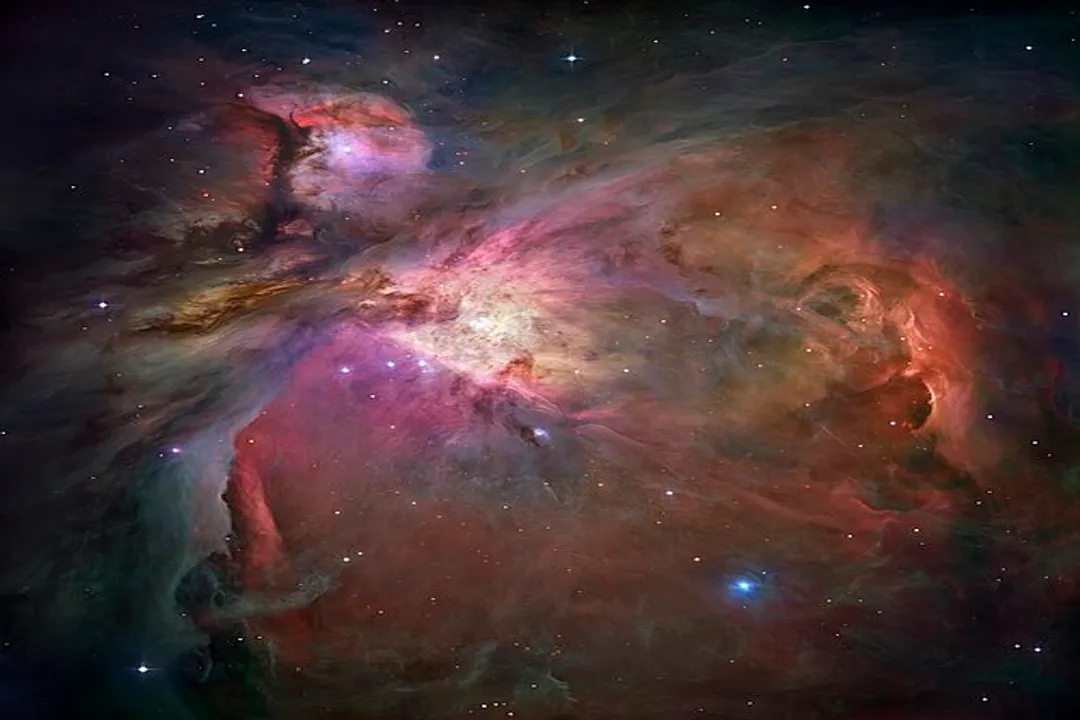
These molecular clouds are exceptionally cold, often hovering just a few degrees above absolute zero, or $0$ Kelvin. This low temperature is critical because it means the particles within the cloud move relatively slowly. This sluggish movement translates directly into low internal pressure, which is essential for the next, dominant step to occur. The interstellar medium (ISM), the general space between stars, is usually very diffuse, but within the ISM, these dense molecular clouds develop. Even within these dense clouds, the matter is not perfectly uniform; turbulence, like random churning motions, ensures that pockets of slightly higher density constantly form and dissipate.
The process of star birth only begins when gravity manages to gain the upper hand over the outward-pushing force generated by the kinetic energy of the gas molecules. For a region to begin collapsing irrevocably, its mass must exceed a certain threshold, mathematically related to the cloud's temperature and density, known in theory as the Jeans mass.
# Collapse Trigger
While gravity is the architect of the star, it often needs a little push to overcome the cloud’s initial resistance, which is its internal thermal pressure trying to keep the cloud in hydrostatic equilibrium. This "kick" can arrive from several catastrophic events in the cosmic neighborhood. A nearby supernova explosion can send a powerful shock wave rippling through the cloud, compressing sections enough to initiate collapse. Alternatively, the collision of two molecular clouds can compress the gas similarly. Even the tidal forces generated when galaxies collide can stir up massive star-forming regions, leading to intense bursts of new star creation.
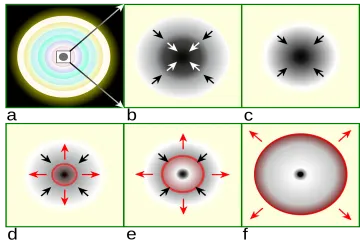
Once this tipping point is crossed, the region starts to fragment hierarchically, breaking into smaller, denser clumps that will eventually become individual stars or small star clusters. As a clump contracts, gravitational potential energy is converted into kinetic energy, and when particles collide, this kinetic energy transforms into thermal energy—meaning the core begins to heat up simply by being squeezed. The outer edges of these contracting regions might only warm to about $10$ K above absolute zero, but the inner part starts heating significantly, perhaps reaching room temperature ($300$ K) or more.
It is interesting to consider this initial transformation of energy. In the pre-stellar core, the sheer act of matter falling together converts potential energy into heat, creating an initial outward push. This self-generated heat temporarily slows the collapse, establishing a temporary truce with gravity. This is distinct from the energy that powers a star for billions of years, which comes from nuclear conversion deep inside the core, an event that has yet to occur.
# Rotation Shaping
As the initial, relatively slow-moving cloud core continues to shrink under gravity, a secondary, yet vital, consequence arises from the conservation of angular momentum. Just like an ice skater spinning faster when they pull their arms inward, the contracting cloud spins up rapidly. This increasing rotational speed forces the cloud to flatten out perpendicular to its axis of rotation, forming a wide, flat circumstellar disk around the increasingly dense central mass.
This rotation and the associated gravitational pull also give rise to the characteristic bipolar outflows, seen as powerful jets emanating from the poles of the forming object. These jets are thought to be the mechanism by which the system sheds excess angular momentum that would otherwise prevent further collapse onto the center. The geometry of this collapse—forming a central core surrounded by a rotating disk—is a nearly inevitable outcome when a large, randomly moving gas clump contracts.
Furthermore, the environment isn't entirely smooth. Turbulence helps break the cloud into fragments, promoting the initial collapse on the smallest scales, while magnetic fields are thought to influence the way filaments fragment and can also act to hinder the overall collapse of the cloud.
# Infant Heat
The central, collapsing region becomes known as a pre-stellar core, shrinking to perhaps a thousand Astronomical Units (AU) across. This core continues to contract, becoming significantly denser and hotter. At this stage, the object is a protostar—an infant star whose energy source is still solely the heat generated by its continued gravitational contraction, a process described by the Kelvin-Helmholtz mechanism.
As the core contracts further, the center becomes so dense that it turns opaque to its own radiation. This traps heat, causing the internal temperature to soar until the density reaches about g/cm$^3$, at which point the collapse is momentarily halted, forming what is sometimes called a 'first hydrostatic core'. As more material falls in, shock waves heat the core even further. When the temperature nears $2000$ K, the molecular hydrogen () in the core begins to dissociate, which absorbs some of the contraction energy and allows the collapse to continue until the core becomes transparent enough again for radiation to escape. The entire process from initial cloud collapse to the formation of a true star takes roughly one million years for a Sun-like star, though astronomical timescales are vast.
If the accumulating mass never reaches the critical temperature and pressure required for self-sustaining fusion, the object stalls out, settling into a state of slow cooling. These are the brown dwarfs, objects too big to be planets but not massive enough to ever shine like true stars through fusion.
# Ignition Point
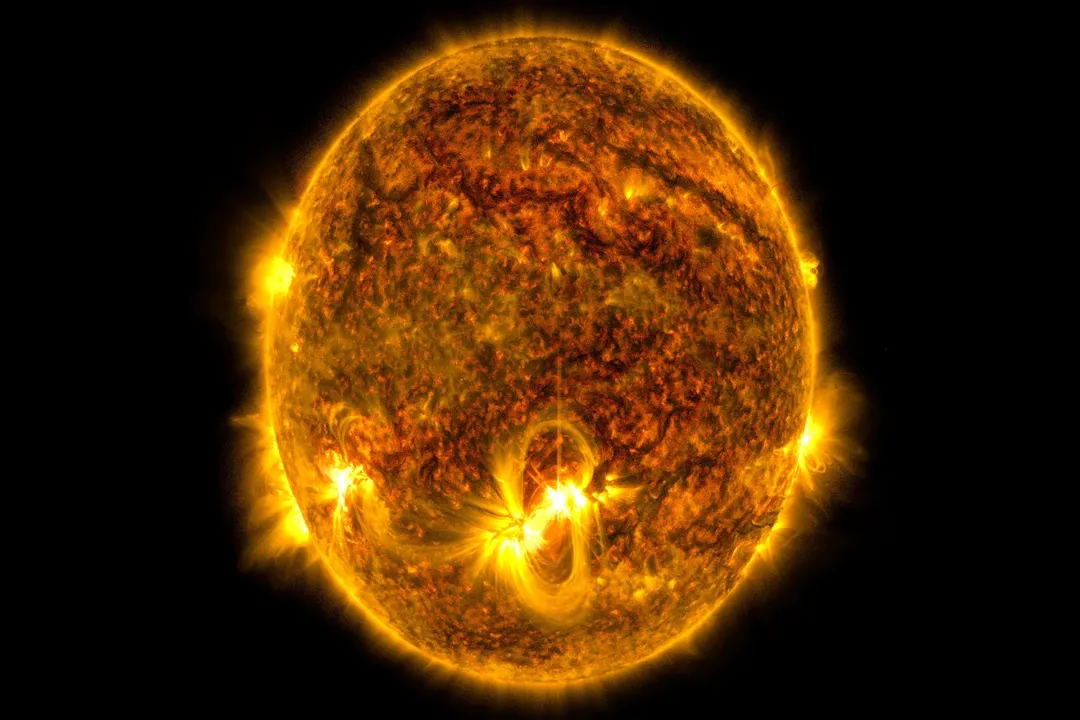
The ultimate force that defines a star is the initiation of nuclear fusion in its core. For a star similar to our Sun, this requires the core temperature to reach about $10$ million Kelvin. At this immense temperature and pressure, the nuclei of hydrogen atoms are squeezed together to form helium atoms in a process called the proton-proton chain reaction, though heavier stars use the CNO cycle.
This fusion process releases an enormous amount of energy, which manifests as intense heat and radiation pressure pushing outward from the star’s center. When this outward push perfectly balances the relentless inward pull of gravity, the star achieves hydrostatic equilibrium, and its collapse ceases. This marks the birth of a stable, main-sequence star. The energy released clears away the remaining gaseous envelope, and the star begins its long life, powered by this sustained fusion reaction.
It is a common conceptual hurdle to wonder how a star can remain stable if fusion is constantly converting mass into energy, which seems to reduce gravity over time. For a Sun-like star, the conversion of mass into energy via hydrogen fusion is actually a very slow, subtle process relative to the star's total mass. The Sun loses only about $4.25$ million tonnes of mass per second, which amounts to less than $0.03%$ of its total mass over its entire lifespan.
This mass loss due to fusion is largely inconsequential to the star’s structure. Instead, the outward force is balanced by the pressure generated, not the preservation of the total mass itself. Furthermore, as hydrogen converts to helium in the core, the core actually becomes denser, which locally increases the gravitational influence or, more accurately, allows the core to maintain a stable, high-density state against the surrounding layers. For most stars, the fusion radiation pressure is never strong enough to overcome the star’s massive gravitational binding energy; tearing the star apart happens only in the theoretical case of extremely massive stars, exceeding $150$ or $200$ solar masses.
# System Legacy
The forces governing stellar formation—gravity, thermal pressure, and angular momentum—also dictate what happens to the material not consumed by the star itself. As the protostar stabilizes, the leftover gas and dust residing in the circumstellar disk can begin to clump together. Since all this material orbits the same central object in the same plane, these clumps eventually coalesce to form planets and other solar system bodies. This explains why all planets in our solar system lie on roughly the same plane—they are the remnants of the Sun’s original dusty birth disk.
The star-forming environment is also far from solitary. Computer simulations and observations confirm that stars frequently form in groups or clusters rather than in isolation. The gravitational interactions between these newborn stars are dynamic; they can scatter, eject, or cause others to form tight binary or multiple systems. These close gravitational encounters, particularly in binary pairs, can cause tidal distortions and rapid accretion events, which astronomers observe as sudden, dramatic brightenings known as FU Orionis eruptions (FUors). This high frequency of multiple systems suggests that even our own Sun likely began its life surrounded by siblings from the same molecular cloud core.
Related Questions
#Citations
Star Basics - NASA Science
Star formation - Wikipedia
The Outer Planets: A Star is Born
Star Formation - | The Schools' Observatory
How Do Stars Form? - Frontiers for Young Minds
Astrobiology Institute at the University of Hawaii
Why does gravity increase in star formation?
How Does a Star Form? - Universe Today