What two opposing forces act to keep a star stable?
The sheer scale and longevity of a star, like our own Sun, appear static from our distant vantage point, yet they represent a state of perpetual, violent conflict. A star's existence, stretching across billions of years, is not one of passive stability but rather a dramatic, continuous "battle against gravity". This incredible balance—the key to keeping a star from either immediately imploding or violently exploding—rests entirely on the equilibrium between two fundamentally opposing forces acting throughout its vast volume of plasma. [2] Understanding this delicate negotiation reveals the physical principles that govern the structure and lifespan of every star in the cosmos.
# Inward Pull
The primary antagonist in this cosmic tug-of-war is gravity. Because a star is an immense collection of mass—trillions upon trillions of tons of hydrogen and helium—gravity is constantly working to pull every particle inward, crushing everything toward the star’s center of mass. [2]
This gravitational force acts as the binding agent, the "cosmic glue" seeking to condense the entire luminous sphere into the smallest possible volume. The sheer weight of the outer layers bears down intensely on the inner layers, meaning the pressure required to counteract this inward force is greatest right at the core. If gravity were allowed to win unopposed, the star would rapidly contract and collapse under its own immense weight, ending its life in an instant.
# Outward Push
Opposing this relentless inward squeeze is an equally immense outward force generated by the star's internal engine: nuclear fusion. [2][4] Deep within the core of any star on the main sequence, temperatures and pressures are so extreme that atomic nuclei—primarily hydrogen—are forced together to fuse, creating heavier elements like helium.
This process of nucleosynthesis releases a tremendous amount of energy, including heat and radiation. [4] This liberated energy generates an enormous outward gas pressure that constantly pushes against the inward crush of gravity. [2] The direction of this pressure is precisely outward, radiating from the high-pressure core toward the star's cooler, lower-pressure surface. [2] It is this relentless outward pressure that provides the structural support necessary to maintain the star's size, preventing the gravitational collapse that would otherwise occur. [2]
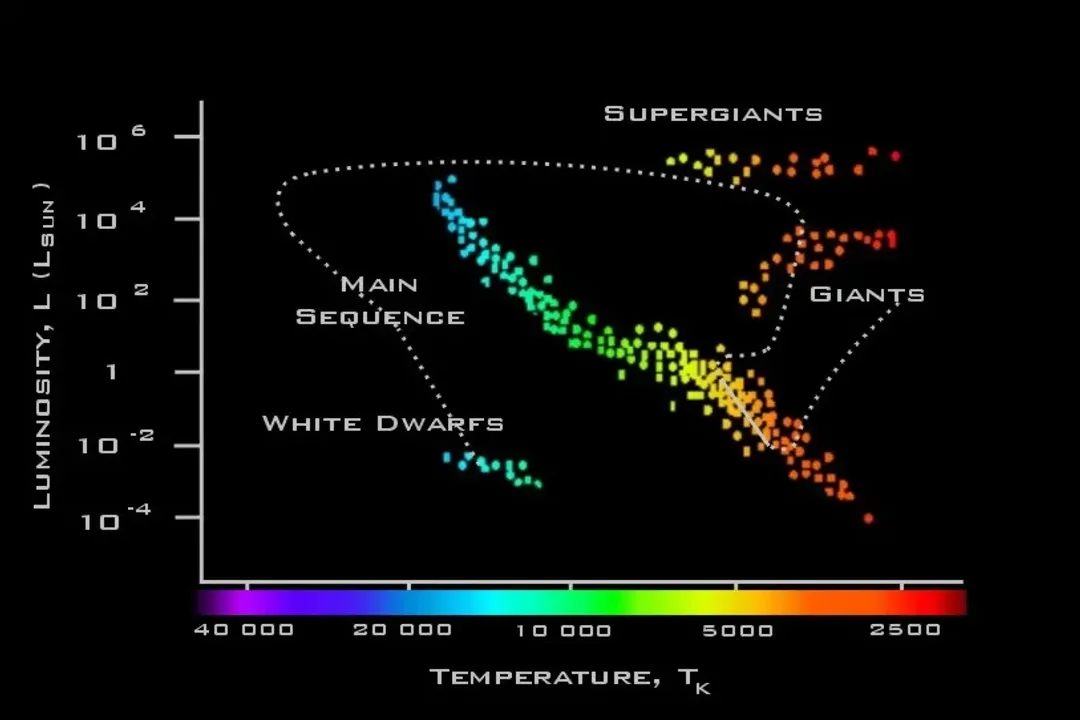
A star's brightness, or luminosity, is a direct measure of the energy being produced by these fusion reactions. A more massive star, having greater gravity to counteract, must generate higher core temperatures and thus a higher rate of fusion, leading to a greater outward pressure, which is why larger stars tend to be significantly brighter.

# Stable State
When these two colossal forces—the inward crush of gravity and the outward push of thermal gas pressure—are precisely matched, the star achieves a state of stable equilibrium. [2] In astronomical terms, this state is called hydrostatic equilibrium. [2]
For the majority of its existence, such as during its main sequence life, a star maintains this balance, neither expanding nor shrinking significantly. [2] This condition is not merely a passive standoff; it is an active, dynamic balance. The conditions inside the star—its temperature, density, and pressure—must adjust locally to ensure that the outward force at any given point exactly cancels out the inward gravitational force at that same point. This is why the inner layers must maintain higher temperature, density, and pressure; they are supporting the mass of all the layers above them.
Consider the analogy of a massive, self-supporting structure. The structure can only stand if the material composing its lower sections can bear the cumulative weight of everything stacked above it. For a star, that "material strength" is the thermal pressure derived from fusion reactions. [2]
This delicate balance dictates the star's entire main-sequence lifespan, which can last billions of years for stars like the Sun. The very presence of a stable star, creating conditions on nearby planets that allow for the existence of liquid water and, eventually, life, depends entirely on this precise, ongoing physical negotiation. [4] If the star runs out of hydrogen fuel in its core, the fusion rate drops, gravity gains the upper hand, and the collapse begins, ushering in the next, less stable phase, like becoming a red giant.
# Self-Check System

The most fascinating aspect of stellar stability is its self-regulating nature, often likened to an internal thermostat. The system constantly corrects for small fluctuations in the balance, acting to restore equilibrium automatically. [2]
Imagine a minor disturbance causes the fusion rate in the core to temporarily increase:
- Overproduction: The star generates too much energy, leading to an increase in outward pressure.
- Expansion: The excess pressure causes the star to slightly expand, moving its outer layers further away from the center.
- Cooling and Correction: This expansion leads to a lower core temperature, which, in turn, slows down the rate of nuclear fusion reactions.
- Restoration: The reduction in outward pressure allows gravity to regain a slight advantage, slightly contracting the star back toward its original size, thus restoring the balance. [2]
Conversely, if the energy generation rate were to become slightly smaller than the equilibrium value:
- Underproduction: The outward pressure slightly diminishes.
- Contraction: Gravity momentarily wins, causing the star to contract slightly.
- Heating and Correction: This contraction compresses the core, causing the temperature to increase.
- Restoration: The higher temperature boosts the fusion rate back up, re-establishing the necessary outward pressure to oppose gravity.
This pressure-temperature feedback loop is exceptionally effective. The relationship between mass, gravity, pressure, and temperature ensures that any deviation from equilibrium is met with an automatic counter-force that pushes the star back to its stable state, at least until the core fuel supply is exhausted.
To put this in a different context, consider the pressure gradient. In a stable star, the pressure at any radius must perfectly counteract the weight of the stellar material above it. If we use the definition of stellar structure, the pressure gradient is proportional to the mass enclosed, . The key takeaway here is that the local pressure is directly tethered to the amount of material it is supporting. If the star suddenly puffed up (expanded), the effective mass density supporting a given shell decreases dramatically because the volume increases faster than the mass enclosed, immediately weakening the outward support required and allowing gravity's influence (which depends on the total mass) to regain dominance until a new, slightly larger, equilibrium is found. This rapid mechanical response to volume change is what makes the feedback loop so immediate and effective.
# Consequences of Imbalance
While the main sequence is defined by this successful balancing act, the eventual exhaustion of core hydrogen fuel marks the end of this stable phase. When fusion slows too much or stops because the fuel is gone, the delicate equilibrium breaks down.
When gravity wins the initial post-main sequence skirmish, the core contracts and heats up intensely. This intense heat can then ignite fusion in a shell outside the core, leading to a massive energy surge that causes the outer layers to expand enormously, transforming the star into a red giant. In this evolved state, the forces are out of balance, leading to significant changes in the star’s size, temperature, and luminosity until a new, albeit temporary, equilibrium is found, or the fuel is exhausted again. Whether the star concludes its life as a white dwarf or results in a spectacular supernova hinges on whether the subsequent collapse can be halted by degeneracy pressure or requires the immense forces involved in forming a neutron star or black hole.
The two forces—the crushing, ever-present gravity pulling inward, and the energetic, self-regulating outward pressure generated by core fusion—are therefore not just physical properties of a star, but the very definition of its stable existence. [2] They are the twin requirements for a luminous sphere of plasma to shine steadily for eons instead of dissolving or collapsing in an instant. [2]
Related Questions
#Citations
The stability of a star is a balancing act between its own internal ...
Stability of Stars | Shaalaa.com
Video: Forces Keeping Stars in a Stable Equilibrium - Study.com
Option D: Astrophysics - IB Physics