What two forces work against each other in a star?
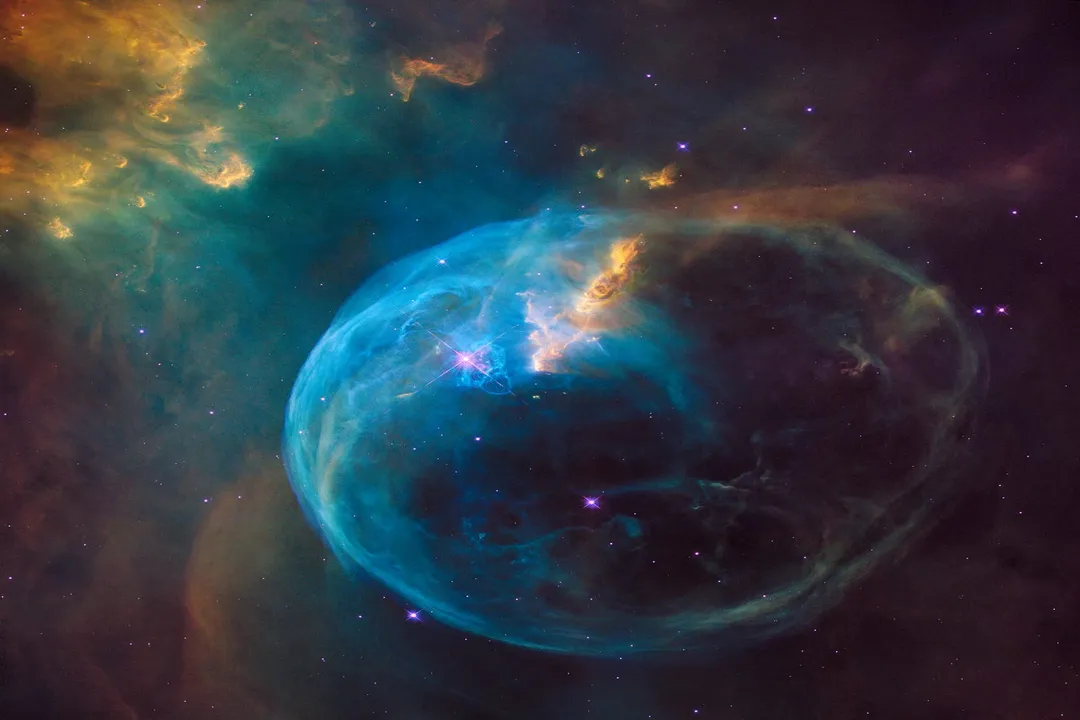
The life of a star, from its fiery birth to its eventual demise, is governed by a fundamental, never-ending contest between two immense, opposing forces locked in battle across billions of years and millions of kilometers. It is this internal struggle that dictates whether a celestial body remains stable, swells into a giant, or collapses catastrophically. [5][8] Understanding what these two opposing players are and how they interact reveals the secret to stellar existence itself.
# The Cosmic Tug
Every star spends the majority of its existence—the main sequence phase—in a state of near-perfect balance. [1][5] This balance is not a matter of coincidence or rest; rather, it is a dynamic equilibrium achieved through the constant exertion of two tremendous forces working directly against each other. [2][7] One force is dedicated to crushing the star inward, while the other works just as hard to blow it apart. [5] If the scales ever tip decisively, the star’s life stage changes dramatically. [8]
# Gravity's Pull
The inward-directed force is gravity. [2][5] Gravity arises simply from the star possessing mass. Since a star is an enormous collection of gas, primarily hydrogen and helium, its own mass generates a gravitational field that pulls all of that material toward the star's center of mass. [1][8] For a star like our Sun, this force is staggering; it is the pressure attempting to compress the entire stellar structure down to a single, impossibly dense point. [1][2] Gravity is relentless and always trying to win the tug-of-war, meaning the star is always on the verge of gravitational collapse. [5][8]
# Pressure's Push
To counteract this immense gravitational squeeze, something equally powerful must push outward. This outward push is supplied by thermal pressure, often referred to more broadly as radiation pressure. [1][2][5] This energy is generated deep within the star’s core through the process of nuclear fusion. [1][8] In the core, temperatures and pressures are so extreme that hydrogen nuclei smash together to form helium, releasing vast amounts of energy in the process. [8] This energy manifests as heat and outward-moving photons (radiation). [1] This outward thermal and radiation pressure effectively pushes the star’s material away from the center, countering the crushing effect of gravity. [2][5]
For a star to exist stably, the force generated by the outward pressure must exactly match the inward force generated by gravity. [1][2][8]
| Force | Direction | Origin | Effect on Star |
|---|---|---|---|
| Gravity | Inward | The star's total mass | Tries to cause collapse |
| Thermal/Radiation Pressure | Outward | Nuclear fusion in the core | Tries to cause expansion |
# Stable State Achieved
When these two forces are precisely matched, the star achieves a condition known as hydrostatic equilibrium. [1][2][7][8] This state means that for every chunk of gas within the star, the inward gravitational pull is perfectly balanced by the outward pressure pushing on it. [1] This is the defining characteristic of a star during its long, stable period on the main sequence. [1]
It is important to appreciate the subtlety of this balance. We often visualize a star as a static sphere, but hydrostatic equilibrium is a dynamic equilibrium. [7] Imagine a powerful water pump (fusion/pressure) trying to fill a high-pressure tank (gravity). The pump is not off; it is running at maximum capacity, expending massive amounts of energy every second, just to keep the tank from crushing itself. If the pump ever slowed down by even a tiny fraction, the immense pressure inside the tank—the gravity—would immediately begin to compress the whole structure. This internal reality means that a star maintaining equilibrium is a continuous, high-energy performance, not a state of quiescence. [5]
The mass of the star sets the baseline for this confrontation. A low-mass star, like a red dwarf, has less gravity pulling inward, so it requires a lower core temperature and slower fusion rate to maintain balance, resulting in a lifespan that can stretch for trillions of years. [8] Conversely, a very massive star possesses a far greater gravitational crush, necessitating extremely high core temperatures and an incredibly rapid rate of fusion to generate enough outward pressure to resist collapse. This intense rate means massive stars burn through their fuel rapidly, often existing for only a few million years. [8]
# Life Cycle Imbalance
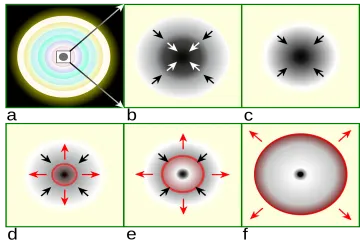
The concept of two opposing forces explains not just stability but also stellar evolution. A star’s active life begins when the gravitational collapse of its initial gas cloud heats the core enough to ignite fusion, creating the necessary outward pressure to stop the collapse. [8]
However, this phase cannot last forever because the fuel—hydrogen in the core—is finite. [8] As the core begins to run low on hydrogen, fusion slows down or shifts location, causing the outward pressure to diminish slightly. [8] When the outward pressure drops below the overwhelming inward pull of gravity, the star loses its hydrostatic equilibrium. [8] Gravity takes over, causing the core to contract and heat up further. This heating often triggers new, more vigorous fusion in shells around the core, causing the outer layers of the star to dramatically expand, transforming it into a red giant. [8] The entire sequence of aging and eventual death—whether culminating in a white dwarf, neutron star, or black hole—is simply the story of gravity progressively overcoming the various pressure mechanisms that once held it at bay. [8]
It is fascinating to consider how the eventual outcome is determined by the degree of imbalance. If gravity wins moderately, the star gently sheds its outer layers and settles into a dense, cooling remnant like a white dwarf, where quantum mechanical pressure (electron degeneracy pressure) can temporarily counteract gravity. [8] If gravity wins decisively, as in the most massive stars, the core collapses so completely that no known force can stop it, leading to the formation of a singularity—a black hole—where gravity reigns supreme and the concept of outward pressure becomes irrelevant within the event horizon. [6] The very existence of a black hole represents the ultimate victory of one force over the other, where the density becomes infinite and the opposing thermal force is completely overwhelmed. [4]
Related Questions
#Citations
What forces balance each other in a main-sequence star?
What are the two forces that balance out a star when it is in ...
What are the two opposing forces inside a star? Select both ...
Stars - Imagine the Universe! - NASA
Stars spend most of their lives balancing two forces: gravity ...
How do stars interact with each other? : r/AskPhysics
Star's Equilibrium
What forces are opposing one another throughout the life ...