What forces are in a star?
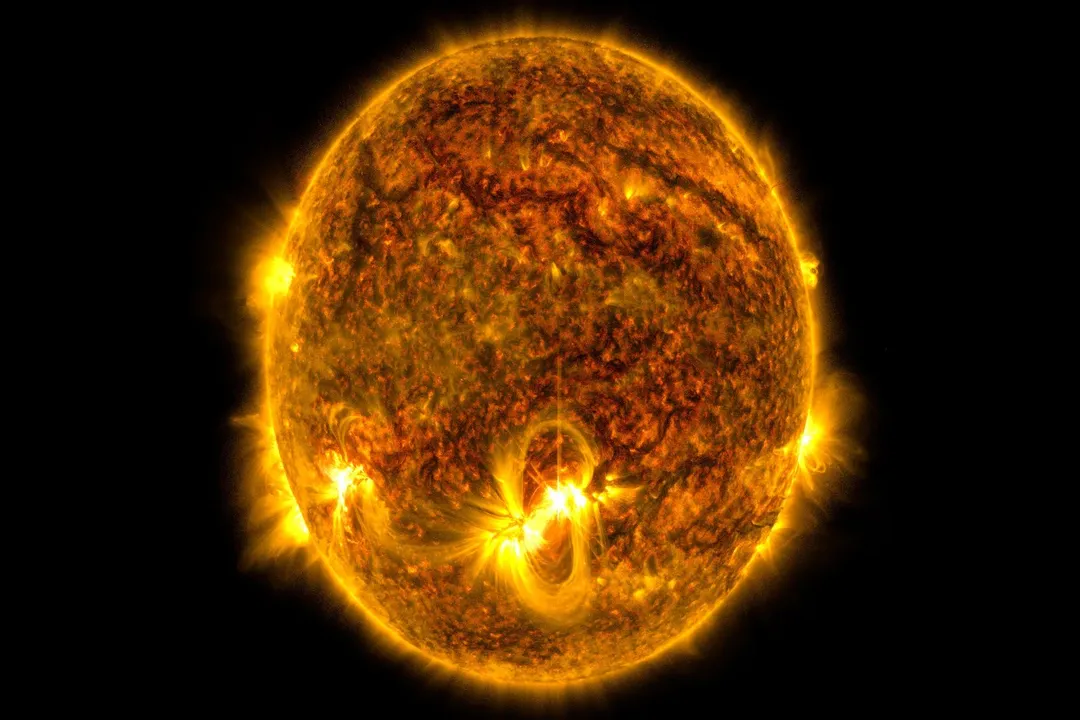
The interior of any shining star is the site of an incredible, eternal contest, a silent war waged across billions of years. This battle is not fought with soldiers or weapons, but with the universe's most fundamental influences: the crushing weight of gravity pulling everything toward the center, and the ferocious outward push generated by unimaginable heat and pressure. A star exists only as long as it maintains a precise, almost miraculous, truce between these two colossal forces. [5] When this truce—known in astrophysics as hydrostatic equilibrium—is broken, the star’s fate is sealed, leading either to a gradual fade or a spectacular, explosive end. [3][7]
# Cosmic Clumps
Long before a star ignites, the stage must be set. Stars are not conjured from nothing; they emerge from the coldest, densest regions of the interstellar medium (ISM), vast clouds of gas and dust known as molecular clouds. [1][2][5] In our own Milky Way, these clouds are primarily composed of about $70%$ hydrogen and $28%$ helium, with traces of heavier elements formed in previous stellar generations. [1][2]
The initial process that sparks a star's existence is driven entirely by gravity. [4][5] Within these clouds, slight variations in density, perhaps triggered by a passing shockwave from an exploding supernova or the collision of two clouds, allow the gravitational attraction within the denser knot to overpower the internal resistance. [1][2] As the knot gathers more mass, its gravitational pull intensifies, governed by the inverse square law of distance, . [1] This gravitational collapse is what transforms a diffuse cloud into a compact structure, initially termed a protostar. [2][5]
During this collapse phase, other forces are actively resisting gravity's advance. These include the thermal pressure from the randomly moving gas particles, turbulent flows within the cloud, and magnetic fields threading through the material. [2] However, as the cloud shrinks, its density and temperature rise dramatically, primarily due to the conversion of gravitational potential energy into kinetic and then thermal energy as infalling particles crash into one another. [1] When this inward pressure builds enough to slow the collapse down, a stable, but not yet shining, protostar has formed. [1]
# Nuclear Engine
A protostar only graduates to the status of a true star when the core temperature and density become sufficient to ignite nuclear fusion. [1][5] For hydrogen nuclei to fuse into helium, the core temperature must reach a minimum of about 10 million Kelvin. [1] In the Sun's case, the core is around 16 million Kelvin, hot enough to drive the proton-proton chain reaction. [4]
This fusion process is the engine that sustains the star. When atomic nuclei combine, a small fraction of their mass is converted directly into energy, as dictated by Einstein's famous mass-energy equivalence, . [4] This energy is released, initially as high-energy gamma-ray photons. [4] These photons then interact with the surrounding plasma, adding significantly to the thermal energy within the core. [4]
If we compare this energy generation to chemical burning—for instance, the combustion of hydrogen with oxygen—we see the staggering difference: nuclear fusion releases millions of electron volts per reaction, whereas simple chemical combustion releases only a few electron volts. [4] This sustained, massive energy release generates the outward heat and radiation pressure that stands against the crush of gravity. [5] For the vast majority of a star's life, the main sequence, this energy production is perfectly regulated to counteract the relentless inward pull. [3]
# Equilibrium State
The defining characteristic of a living, stable star is hydrostatic equilibrium. [3][5] Imagine any small volume of gas inside the star: the immense gravitational force acting to squeeze that volume inward must be exactly canceled out by the outward push resulting from the pressure gradient within the star. [3][5] The temperature gradient—the fact that the core is millions of degrees hotter than the outer layers—establishes this outward pressure. [3]
If the core were to temporarily cool, the pressure would drop, gravity would gain the upper hand, and the region would contract slightly. This contraction increases the core's density and temperature, immediately speeding up the fusion rate until the increased pressure restores the balance. [1] Conversely, if fusion momentarily surged, the star would puff out, lowering the core density and slowing the fusion rate until equilibrium was re-established. [5] This self-regulating mechanism keeps the star stable for billions of years. The Sun, for example, is estimated to have already spent $4.6$ billion years in this balanced state and is expected to remain there for roughly another 5 billion years. [1]
What is fascinating to consider is that this equilibrium is not static but constantly adapting. A star's core steadily accumulates helium as it burns hydrogen; this slightly changes the fusion conditions, causing the star's temperature and luminosity to slowly creep upward over its main sequence lifetime. [1][4] The system must constantly adjust its outward push to match the increasing demands of its changing core composition while fighting the same gravitational field. [1]
# Mass Defining Destiny
While the force of the battle is the same—gravity versus pressure—the outcome of the war is entirely determined by the star's initial mass. [3] Mass dictates the fuel supply, the core conditions, and consequently, the star's entire life cycle and eventual demise. [3]
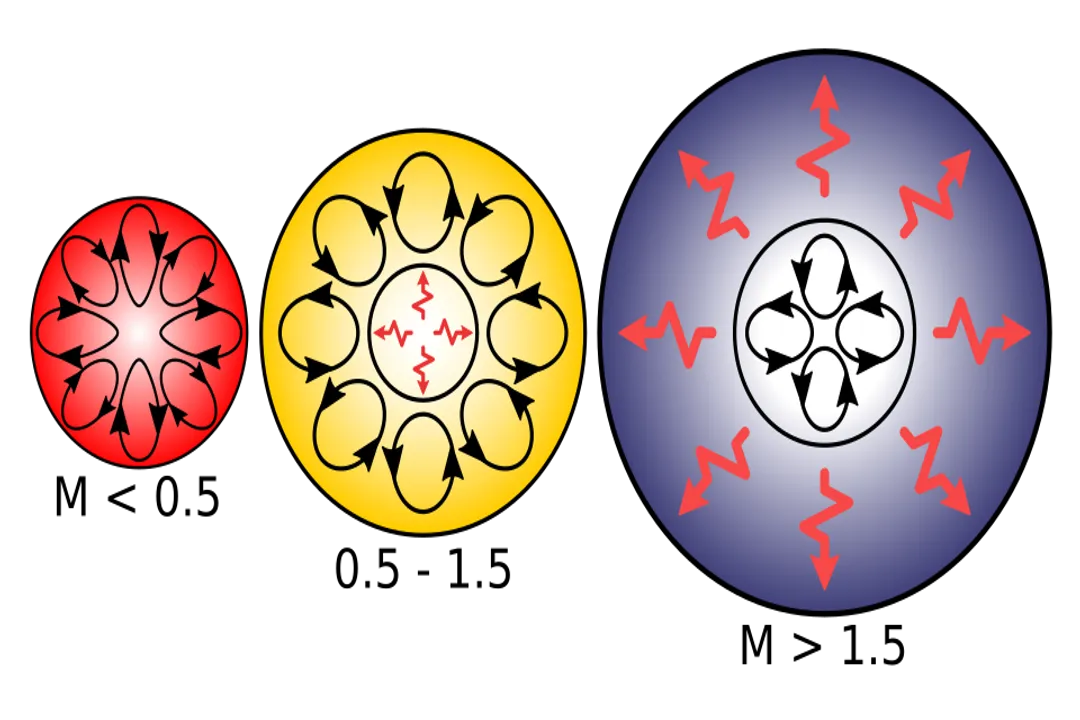
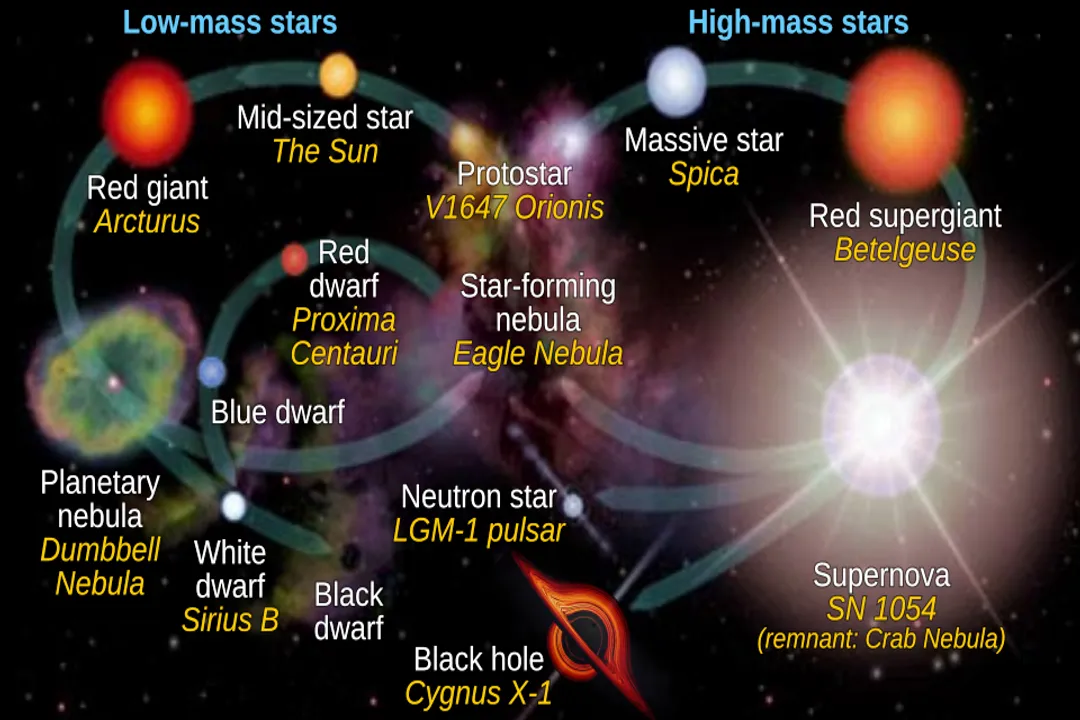
For less massive stars, including those below about $2.25$ times the mass of the Sun, the core's eventual exhaustion of helium support leads to a gentler end. When core hydrogen is spent, the star transitions into a red giant phase, perhaps igniting helium fusion in the core, and later, burning hydrogen in a shell around a degenerate helium core. [1] When the helium fuel is spent, the star does not have the gravitational punch to compress the core enough for further, more energetic fusion stages to take hold. [7] Instead, the outer layers gently drift away, creating a planetary nebula, leaving behind the super-dense, Earth-sized cinder of the core: a white dwarf. [5] This remnant is stabilized not by thermal pressure, but by electron degeneracy pressure—a quantum mechanical effect where electrons resist being squeezed too closely together. [7] This provides a stable, albeit cooling, final state. [5]
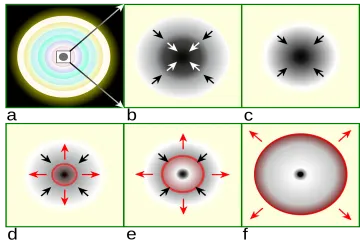
The fate of high-mass stars, those generally greater than about $8$ solar masses, is dramatically different. [5][7] These stars burn through their fuel supply incredibly fast—their intense gravity demands a far higher energy output, leading to main sequence lives measured in mere millions of years. [1][4] Once hydrogen is gone, they possess enough mass to compress the core until it ignites heavier elements: carbon, neon, oxygen, and finally, silicon. [5] This process creates an onion-like layering of different burning shells. [5]
# Gravity Triumphs
The final battleground for massive stars is the iron core. [5] Fusing elements lighter than iron releases energy, but fusing iron consumes energy. [5] When the core is flooded with iron, the energy source that provided the outward pressure instantly vanishes, and the force of gravity wins the contest catastrophically. [5][7]
The speed of this final collapse is terrifying. The core implodes nearly instantaneously. [7] Electrons are driven into protons, creating neutrons, neutrinos, and gamma rays in a process called electron capture. [5] The collapse is violently halted only when the material reaches nuclear density, causing the core to rebound and generating a massive outward shockwave. [5] This wave rips through the star, resulting in a supernova explosion that can briefly outshine an entire galaxy. [4]
Here we see the key differentiation in how the forces resolve:
| Star Type | Final Core Support Mechanism | End Product |
|---|---|---|
| Low/Medium Mass () | Electron Degeneracy Pressure | White Dwarf [7] |
| High Mass () | Neutron Degeneracy Pressure (if to remnant) | Neutron Star or Black Hole [5] |
It strikes me that the transition from a supported core to an unsupported one is not just a change in the star's state, but a difference in the nature of resistance itself. For the Sun's future, the outward push is provided by the orderly resistance of already-packed electrons. [7] For the massive star, the collapse is so complete that even the electron resistance fails, requiring the much stronger, more exotic neutron degeneracy pressure to stop the crush, or failing that, resulting in total gravitational collapse to a singularity—a black hole. [5] The sheer scale of the collapse in the supernova scenario, where the core shrinks from the size of the Earth to tens of kilometers across in a fraction of a second, highlights the ultimate supremacy of gravity when the energy source is exhausted. [5]
# Beyond Balance
While gravity and fusion-driven pressure are the titans governing a star's life, other forces and properties play a significant role, particularly in its development and structure. [3]
One force generated by the internal dynamics is the magnetic field. This field is created by the convective movement of the conductive plasma within the star, acting like a dynamo. [3] These magnetic fields extend far beyond the stellar surface and influence the stellar wind—the continuous outflow of particles like protons and alpha particles streaming into space. [3][4] A young, rapidly rotating star often has strong surface magnetic activity, which can manifest as starspots or sudden flares. [3] The magnetic field acts as a brake; as it interacts with the stellar wind, it gradually slows the star's rotation over billions of years, meaning older stars like our Sun spin much slower than their younger counterparts. [3]
Furthermore, a star's rotation can be a non-negligible factor in its shape. Very rapid rotation can cause an equatorial bulge, making the star noticeably oblate, or flattened, rather than perfectly spherical. [3] The rotation rate itself is a product of how the initial molecular cloud contracted, as conservation of angular momentum dictates that as the cloud shrinks, its spin rate increases. [1]
The material that stars expel through stellar winds or supernova explosions enriches the interstellar medium with heavier elements, ensuring that the next generation of stars, and any planets they might form, possess the necessary building blocks for complex chemistry. [4][5] Thus, the cycle of forces—gravity gathering material, fusion generating outward pressure, and the eventual victory of one force over the other—is what continuously recycles stellar material throughout the galaxy.
Related Questions
#Citations
Star Basics - NASA Science
Stars - Imagine the Universe! - NASA
Star - Wikipedia
Fundamental Forces of Nature | Multiwavelength Astronomy - eCUIP
Star formation | Astrophysics - University of Exeter
Are stars essentially a war between nuclear fusion and gravity?
stars | AMNH
The Outer Planets: A Star is Born