How is a stable star formed in IGCSE?

The formation of a star, a celestial body shining brightly for billions of years, begins in the coldest, darkest regions of space within vast cosmic nurseries known as nebulae. [1][5][9] These structures are immense clouds composed primarily of gas, predominantly hydrogen, mixed with traces of dust. [1][7][9] For an IGCSE student trying to picture this, imagine an enormous, diffuse cloud where the opposing forces of internal heat trying to push things apart and gravity trying to pull things together are almost perfectly balanced. [1][8] The transition from this relatively calm cloud to a fiercely burning star is entirely governed by gravity winning that tug-of-war. [3]
# Gas Clouds
The starting material is a nebula, a cold, low-density aggregation of interstellar matter, mostly hydrogen and helium. [1][7] For a star to condense out of this material, the cloud must first become gravitationally unstable. [1][8] In their natural state, these vast clouds have enough internal pressure from the slight thermal motion of the particles to resist simple gravitational collapse. [8]
# Collapse Trigger
To kickstart the process, something external or internal must compress a section of the nebula, increasing its density beyond a critical point where gravity can overcome the remaining outward pressure. [1][3] Several events can serve as this trigger. A common scenario involves a shockwave sweeping through the cloud, perhaps generated by the violent death of a nearby massive star—a supernova. [1][3] Alternatively, the simple gravitational interaction as two gas clouds drift into one another can initiate the necessary compression. [1][3]
# Gravitational Contraction
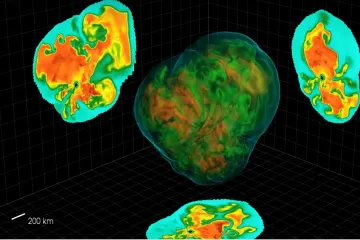
Once a region exceeds the necessary critical mass, gravity assumes control. The material within that dense region begins to fall inward towards the centre of mass. [3][8] As the cloud collapses, it often breaks up into smaller, denser clumps, each one destined to become a star or a binary system. [1][6] As the mass shrinks, gravitational potential energy is converted into kinetic energy, which rapidly increases the temperature throughout the collapsing matter. [1][8] This contracting object is not yet a star; it is a protostar. [1][5][6]
# Protostar Heating
The protostar continues to gather mass from the surrounding envelope of gas and dust that has not yet fallen in. [1] Due to the ongoing gravitational compression, the core of this protostar heats up significantly. [8] Crucially, at this stage, the energy generation comes only from this gravitational contraction, not from sustained nuclear reactions. [6][7] As the material contracts, it spins faster, causing the surrounding material to flatten into a protoplanetary disc. [1] The internal temperature continues to climb steadily as the radius decreases, driven by the sheer weight of the outer layers pressing down on the centre. [8]
This initial heating phase provides a good point to consider the underlying physics. While sources simply state the core heats up, the physical requirement is reaching a specific temperature threshold. The core pressure and temperature must eventually climb high enough to overcome the Coulomb barrier—the electrostatic repulsion between positively charged hydrogen nuclei (protons). [5] For most stars, this means achieving temperatures around 10 million Kelvin. [5] If the collapsing mass is too small, it might never reach this temperature, resulting in a brown dwarf, a "failed star," rather than a true main-sequence star. [1]

# Fusion Ignition
The moment of true birth occurs when the core temperature and density become so extreme that nuclear fusion can commence stably. [1][5][7] In stars like the Sun, this involves the fusion of hydrogen nuclei into helium nuclei. [5][7] This reaction releases a massive amount of energy in the form of high-energy photons (radiation). [1][6]
This energy release generates a powerful outward radiation pressure pushing against the inward crush of gravity. [1][3][6]
# Stability Achieved
A stable star is formed when this outward push from fusion energy perfectly counteracts the inward pull from the star's enormous gravitational force. [1][3][5][6][7] This state of balance is called hydrostatic equilibrium. [1][6][9]
When hydrostatic equilibrium is achieved, the star settles onto the Main Sequence on the Hertzsprung-Russell (H-R) diagram. [1][6] This represents the longest and most stable period of the star's life, during which it converts hydrogen to helium in its core. [6][7] A star remains on the main sequence as long as it has hydrogen fuel available to burn at the required rate to maintain the balance against its own weight. [6]
If we were to compare the required conditions for stability across different star types, we see that mass is the defining characteristic. A massive star requires much higher core temperatures and pressures to support its greater weight than a smaller star. [1][6]
| Stellar Mass Category | Relative Fuel Consumption Rate | Approximate Main Sequence Lifetime |
|---|---|---|
| Low Mass (e.g., Red Dwarf) | Very slow | Trillions of years |
| Medium Mass (e.g., Sun) | Moderate | Billions of years |
| High Mass (e.g., Blue Giant) | Extremely fast | Millions of years |
This inherent variation underscores that the initial conditions—the amount of mass condensed from the nebula—predetermine the energy output and lifespan of the resulting stable star. [1][6] The process is fundamentally a self-regulating system: if fusion slightly exceeds gravity, the star expands, the core cools slightly, and fusion slows; if gravity slightly overcomes fusion, the core contracts, heats up, and fusion accelerates until balance is restored. [1] This dynamic interplay is what maintains stability for eons. [6]
#Videos
6.2.2 The Formation of Stars - GCSE & IGCSE Physics - YouTube
GCSE Physics - The Life Cycle Of Stars / How Stars are Formed and ...
Related Questions
#Citations
Star Formation | Cambridge (CIE) IGCSE Physics Revision Notes 2021
6.2.2 The Formation of Stars - GCSE & IGCSE Physics - YouTube
The formation and life cycle of stars - AQA - AQA - BBC Bitesize - BBC
Life cycle of stars : r/igcse - Reddit
Life cycle of a star, including formation, main sequence, red giant ...
CIE IGCSE Physics (0625) Stars Study Notes - IITian Academy
What is the process behind star formation? - TutorChase
IGCSE Physics Notes Stars and the Universe - Smart Exam Resources