What element when formed is the death of a star?
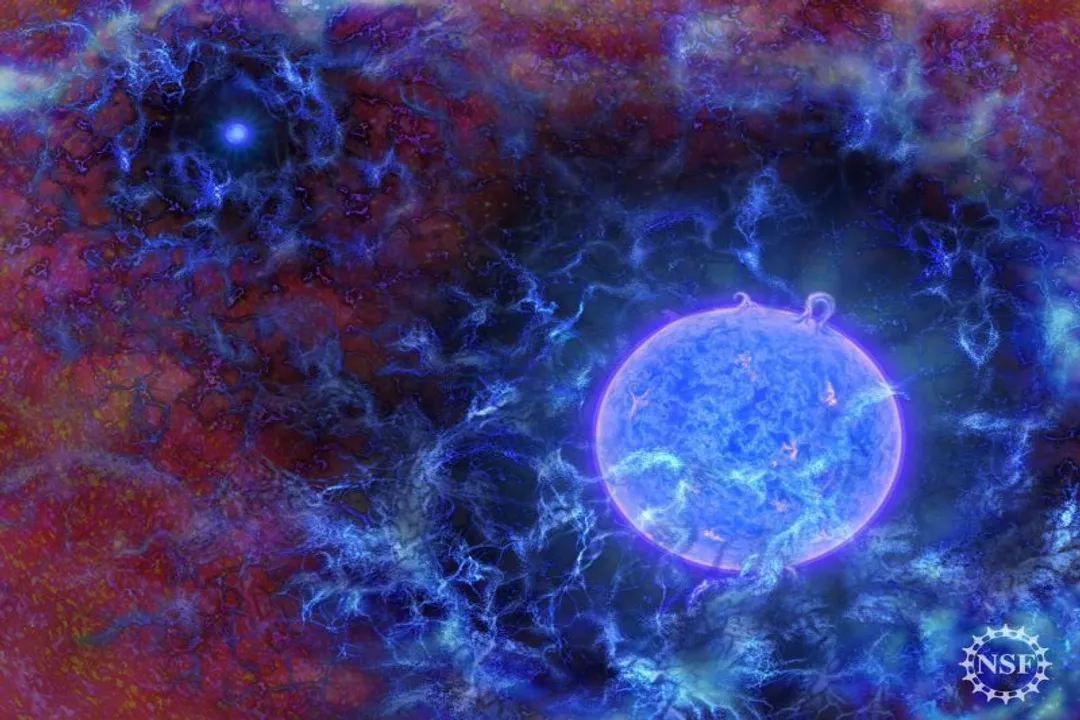
The element that marks the definitive, terminal phase of a massive star’s life is iron. [2][3] For billions of years, a star maintains a delicate balance between the inward crush of its own gravity and the outward push generated by nuclear fusion in its core. [7] This cosmic balancing act is a relentless process of element creation, starting with hydrogen being fused into helium. As fuel depletes, the core contracts, heats up, and ignites the next stage: helium to carbon, and eventually, through several intermediate steps involving oxygen and silicon, culminating in iron. [3][7] The formation of iron in the core signifies that the star has reached a thermodynamic dead end, a point where the ongoing fusion process can no longer generate the necessary outward pressure to stave off gravitational collapse. [1][7]
# Iron Core
The critical nature of iron lies in its nuclear stability, which is unique among elements. All nuclear fusion reactions proceeding from light elements up to iron release energy, which is what powers the star and supports its structure. [1][7] However, iron, specifically the isotope (with 26 protons and 30 neutrons), possesses the highest binding energy per nucleon of any nucleus. [1]
This high binding energy means that when a star attempts to fuse iron atoms together—say, into Nickel-62 (which is theoretically even more stable, but practically inaccessible in a star's core)—the reaction consumes energy rather than releasing it. [1] Think of it as running a furnace that suddenly requires you to pour gasoline onto the fire to keep it burning. Once the stellar core is composed primarily of iron, the energy source immediately switches off. [3] The outward thermal pressure that had successfully counteracted gravity for eons instantly vanishes. [7]
This transition point is fascinating because it represents a fundamental physical boundary. The energy dynamics of the core flip from being a net producer of heat to a net consumer. While a star's entire lifespan is dictated by energy conversion, the creation of iron is the specific element formation that signals the cessation of sustainable energy production within the star's engine. [1][7]
# Stellar Mass Matters
It is essential to distinguish between stellar deaths, as not every star ends its life dramatically due to an iron core. [6] Stars similar in mass to our Sun face a much gentler exit. They will eventually swell into red giants, shed their outer layers into space to form a beautiful planetary nebula, and leave behind a cooling ember known as a white dwarf. [6][8] These stars never accumulate enough mass to create the necessary temperatures and pressures to fuse elements all the way up to silicon, let alone iron, in their cores. [7]
The iron-core demise is reserved for stars significantly more massive than the Sun—those beginning their lives with at least eight to ten times the Sun's mass. [6] For these stellar behemoths, the fusion chain continues far longer and hotter than in smaller stars, building up layers of heavier elements like an onion until the innermost shell becomes pure iron. [3] This process, while dramatic, can be relatively quick once silicon burning begins; the entire journey from silicon fusion to iron core formation can take less than a day in the final stages of a very massive star. [2]
# Sudden Collapse
When the iron core reaches a critical mass—often cited in relation to the of about $1.4$ solar masses, though the actual limit for the collapsing remnant is higher—gravity overwhelms all remaining outward forces. [2] Without the heat from fusion, the core collapses violently under its own weight in mere milliseconds. [3]
The speed of this implosion is staggering. In less time than it takes to blink, the core shrinks from a size comparable to the Earth down to a dense sphere only tens of kilometers across. [3] As the core collapses, the density becomes so extreme that atomic nuclei are crushed together, forcing protons and electrons to merge into neutrons, releasing a flood of ghostly particles called neutrinos. [2][7]
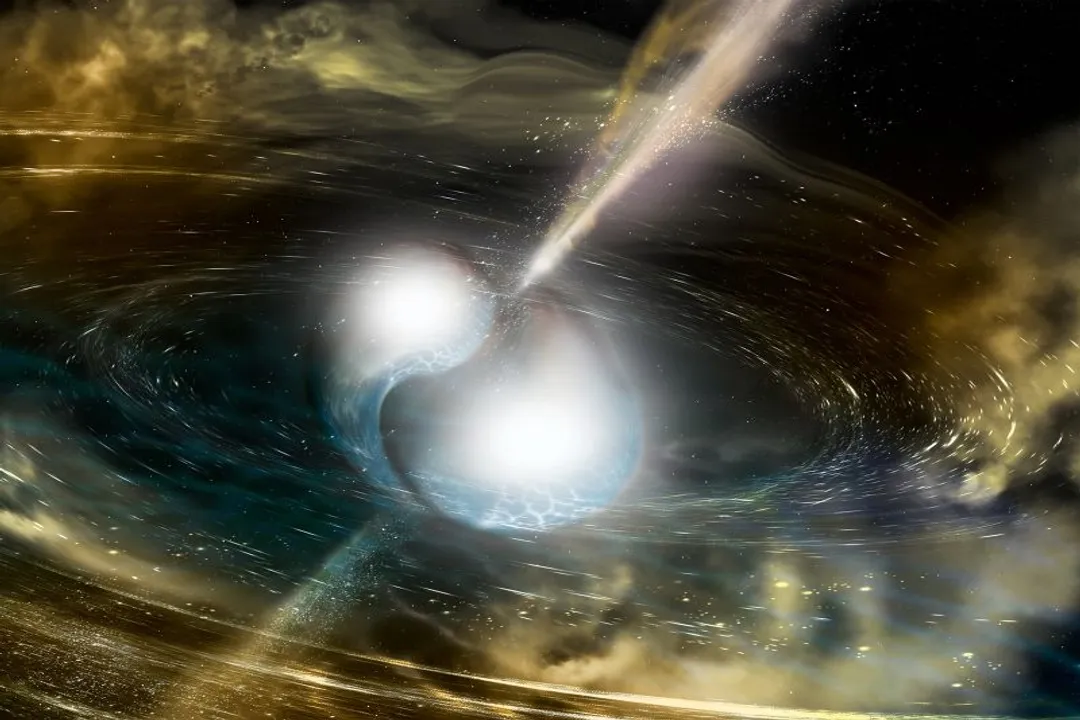
This initial, rapid gravitational collapse is what dictates the star's final state. The result of this compression is either a neutron star or, if the original star was extremely massive (perhaps over $25$ times the mass of the Sun), the collapse continues indefinitely, forming a black hole. [6] The sudden halt of the infalling material against the newly formed, incredibly rigid core triggers the spectacular explosion we observe as a Type II supernova. [2][3]
An interesting consequence of this event relates to the sheer mass of the iron core. The total amount of iron synthesized dictates the kinetic energy available during the rebound. A star that manages to hold onto slightly more of its mass and therefore forms a larger iron core will experience a proportionally more energetic explosion, fundamentally determining the brightness and destructive reach of the resulting supernova event. [2]
# Heavy Element Genesis
The death throes of the star, specifically the supernova explosion triggered by the iron core collapse, are responsible for creating most of the elements heavier than iron found throughout the universe. [2] While the core itself is made of iron (and perhaps a bit of nickel), the incredible energy released during the collapse and the subsequent shockwave blast the star's outer layers outward at enormous speeds. [2][7]
During this brief, violent period, conditions are right for rapid neutron capture processes (), where atomic nuclei are barraged with neutrons, building up elements heavier than iron such as gold, silver, uranium, and platinum. [2] Without the iron core signaling the star's end and triggering this catastrophic explosion, these heavy elements—the very building blocks of rocky planets and life—would never have been forged and distributed across the cosmos. [9] Thus, the formation of iron isn't just the star's death sentence; it is the necessary catalyst for the creation of the rest of the periodic table. The iron core is the cosmic equivalent of a high-pressure crucible that, upon breaking, scatters its enriched contents across interstellar space. [2]
Stars, therefore, function as stellar foundries, creating elements up to iron through peaceful, sustained energy production. The moment they form iron, they run out of the peaceful path. The subsequent, rapid transformation into heavier elements relies entirely on the violence unleashed by that iron core's failure to support the star against gravity. [2][7]
#Videos
Why Iron Kills Stars: Black Hole Birth - YouTube
#Citations
I don't understand why Iron is the element that starts the supernova ...
The creation of what element signals the death of a star? How much ...
Is my body really made up of star stuff? - StarChild - NASA
Why Iron Kills Stars: Black Hole Birth - YouTube
Dying Stars - Spitzer - Caltech
How stars are born and die - Astronomy Magazine
[PDF] Death of Stars
Space for Kids - Star death - ESA
The stars within us | NSF - U.S. National Science Foundation