What causes centrifugal effects?
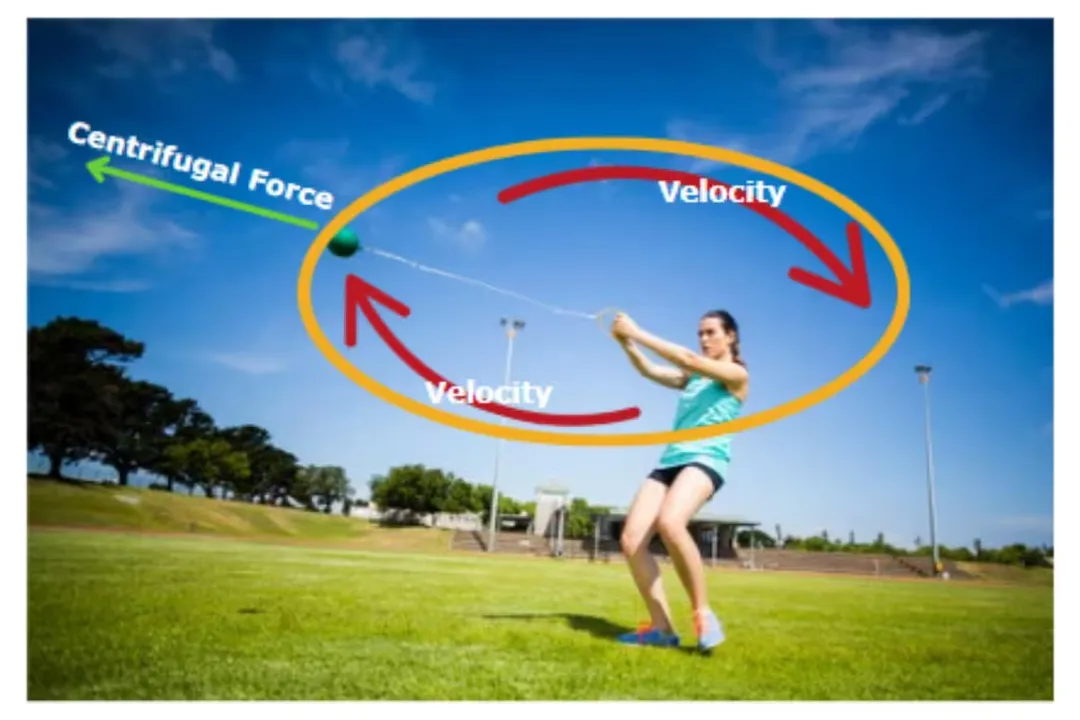
The sensation of being pushed away from the center of a spinning object is incredibly common, whether you are rounding a sharp corner too quickly in a car or experiencing the G-forces on a carnival ride. This outward sensation is what people commonly refer to as centrifugal force. [8] However, to truly understand what causes these effects, we must look closely at the role of motion, inertia, and the frame of reference from which we observe the action. [1][4] Fundamentally, the centrifugal effect is an apparent force, meaning it doesn't arise from a fundamental interaction like gravity or electromagnetism, but rather as a direct consequence of inertia when an object is moving in a curved path. [1][4][8]
# Frame Rotation Inertia
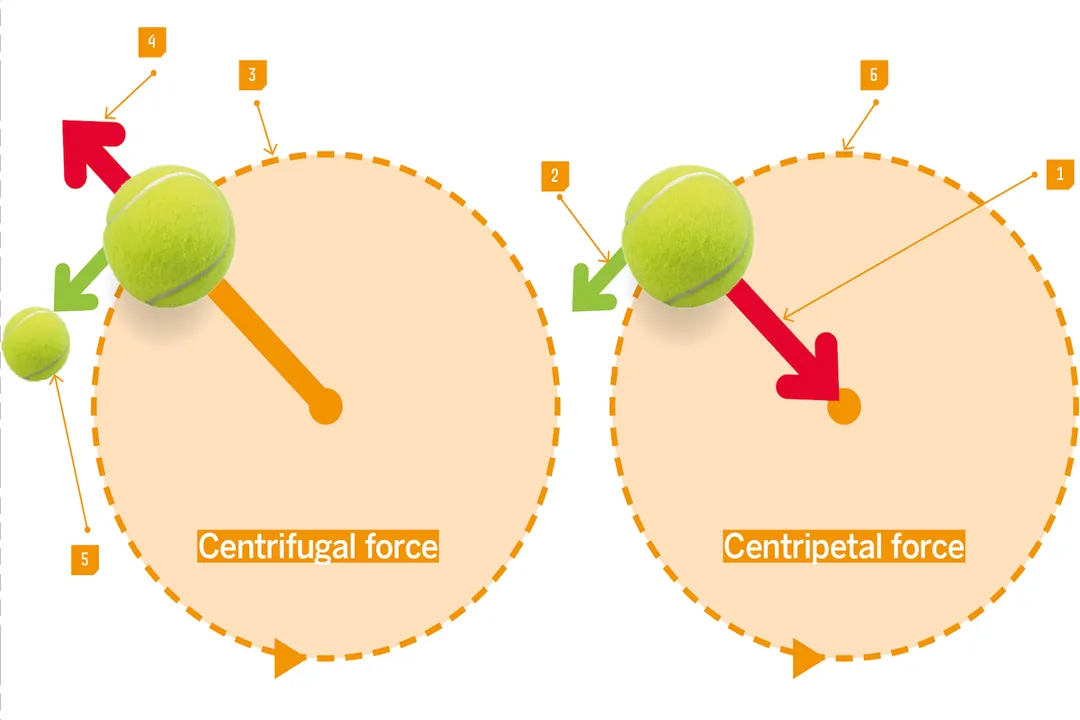
The primary mechanism behind experiencing a centrifugal effect is simple: inertia. [1][2] Inertia is the tendency of an object to resist changes in its state of motion, meaning a body in motion tends to stay in motion in a straight line unless acted upon by an external force. [4] When an object is forced into a circular path, such as a weight being swung on a string, its natural tendency is to continue moving in the direction tangent to the circle at that instant—in a straight line. [4]
In an inertial (non-accelerating) frame of reference, the outward push is not considered a true force acting on the object. Instead, the object is simply following Newton’s first law, trying to maintain a straight trajectory. [2][4] The string, in this case, provides the necessary centripetal force—a real force—that constantly pulls the object inward toward the center, thereby changing the direction of its velocity and maintaining the circular orbit. [1][4]
# Two Viewpoints

The confusion surrounding centrifugal force often stems from shifting between two distinct perspectives: the inertial frame and the non-inertial (or rotating) frame. [2]
In the inertial frame (an observer standing still off to the side watching the spinning), only the centripetal force is needed to explain the motion. [4] The object appears to be accelerating inward because the inward-pulling string is causing that change in direction. [1]
In the non-inertial frame (the observer spinning along with the object), the situation looks different. [2] From this moving perspective, the object appears stationary relative to the observer, yet it is clearly being forced away from the center. To make Newton’s laws work mathematically within this rotating system, physicists introduce fictitious forces—and centrifugal force is one of them. [2][3] This fictitious force is defined as pointing radially outward, balancing the inward centripetal pull, thereby keeping the object "motionless" relative to the observer in the spinning system. [1][4]
Here is a quick comparison illustrating the two descriptions of the same physical event:
| Feature | Inertial Frame (Stationary Observer) | Non-Inertial Frame (Rotating Observer) |
|---|---|---|
| Motion | Object moves in a circle, constantly accelerating toward the center. | Object appears fixed or follows a simple path relative to the observer. |
| Force Term | Centripetal Force (Real force, e.g., tension, gravity) | Centrifugal Force (Apparent/Fictitious force) |
| Direction | Inward (toward the center of rotation) | Outward (away from the center of rotation) |
| Cause | External agent applying a physical push/pull. [4] | Inertia of the object resisting the change in direction. [1][2] |
# Causality In Detail

The effect we call "centrifugal" is a manifestation of the conservation of linear momentum. [1] If you were inside a centrifuge and the motor suddenly failed, you would not fly out sideways; you would fly off along the tangent line where you were at the moment of failure. [7] This straight-line motion is what inertia dictates. [4] The cause of the feeling of being pushed out is your body attempting to follow that straight path while the apparatus constrains your motion to the curve. [2]
The magnitude of this perceived outward push is mathematically related to several factors. It depends on the mass () of the object, the square of its tangential velocity (), and inversely on the radius () of the circular path. [1] This relationship, often expressed as , shows that faster speeds lead to a much more significant outward effect because the velocity is squared, highlighting the sensitivity of the effect to rotational speed. [1]
When considering large-scale celestial mechanics, the Earth’s rotation provides a constant, subtle centrifugal effect. [6] Because the Earth is spinning, the gravitational force measured at the equator is slightly less than the gravitational force measured at the poles. [6] This difference occurs because the centrifugal effect, directed outward relative to the Earth's axis of rotation, partially counteracts the inward pull of gravity near the equator, where rotational speed is highest. [6] This is a superb example of the centrifugal effect being an apparent force that modifies a real force (gravity) within a rotating system. [1]
# Application Engineering

While physicists prefer the term "centripetal force" when analyzing motion from a fixed, inertial viewpoint, the concept of centrifugal force remains indispensable in engineering and mechanical design. [3]
For instance, in the design and operation of a centrifugal pump, the principle is applied intentionally. [5] The pump uses a rotating impeller to impart kinetic energy to a fluid. [5] As the impeller blades spin rapidly, they push the fluid outward into the casing due to the fluid's inertia, effectively converting rotational speed into pressure head—this is the centrifugal action. [5] In this context, thinking about the fluid being "thrown out" by a centrifugal effect simplifies the entire hydraulic design process compared to exclusively calculating the constantly changing vector of the centripetal force required by the blades. [3]
Consider this practical distinction: If a civil engineer is designing a highway curve, they must calculate the necessary banking angle. They might use the outward centrifugal force value () in their initial free-body diagram analysis to ensure the normal force from the road surface can provide the required centripetal force to keep the car on the road. [3] If the road isn't banked enough, the driver experiences the outward push as friction against the car door, which is the vehicle's inertia trying to maintain its straight-line course while the tires apply the necessary centripetal force to turn. [4] For the engineer concerned with structural stability and load bearing, treating the outward push as a calculable load vector is far more intuitive and actionable than exclusively working with the constantly changing inward acceleration from the inertial perspective. [3]
# Synthesis Comparison
It is helpful to draw a clear line between when the concept is primarily explanatory (physics) and when it is primarily descriptive (engineering). In pure dynamics, the centrifugal effect is inertia resisting acceleration. [2] In applied mechanics, it is a necessary term to describe the apparent load imposed on a system by rotation. [3]
If we were to design a simple rotating apparatus, say a small laboratory centrifuge, we need to know the required motor torque and bearing strength. The true physical requirement is the centripetal force needed to hold the sample in the tube: . However, the stress felt by the tube wall or the bearing is directly proportional to the inertial resistance—the centrifugal effect. For a given rotational speed (), the centripetal acceleration is . [1] The simplest way to visualize the load on the structural components is by equating the required centripetal force with the apparent outward centrifugal force, .
Here is an illustrative comparison of how different fields handle the cause:
| Field of Study | Primary Focus | How Centrifugal Effect is Treated |
|---|---|---|
| Classical Mechanics (Inertial Frame) | Describing actual acceleration/forces. | As a result of inertia, balanced by an external centripetal force. [4] |
| Engineering/Design (Non-Inertial Frame) | Calculating structural loads and required power. | As a real, outward-acting fictitious force to simplify vector summation. [3] |
| Astronomy/Geophysics | Describing planetary phenomena. | As an effect modifying the observed gravitational field due to rotation. [6] |
# Understanding Fictitious Forces
The term "fictitious force" might suggest something unimportant, but these concepts are crucial for understanding phenomena observed from accelerating frames, such as weather patterns or movement within a spinning laboratory. [2] Forces like the Coriolis effect and the centrifugal effect are essential tools for describing motion relative to something that is itself accelerating or rotating. [3]
When you are in a car turning left, you feel pressed against the right-side door. The door pushes inward on you (centripetal force), preventing you from going straight. [4] Your feeling of being pushed rightward is the centrifugal effect—your body’s mass obeying its own momentum, attempting to continue in a straight line while the car dictates the curve. [1][2] The door then resists this inertial tendency. The cause, therefore, is the inertia inherent in your mass interacting with the non-inertial (changing velocity) environment created by the turning car. [4]
In essence, the centrifugal effect is the observable symptom of inertia within a curved path; the underlying cause is the object's mass resisting the required change in direction dictated by the centripetal constraint. [1][7] It is the mathematical acknowledgment that a non-inertial frame requires extra terms to describe motion simply. [2][3]
#Videos
What is Centripetal force? - YouTube
Related Questions
#Citations
Centrifugal force - Wikipedia
What are centrifugal forces really? Why do some academics ... - Reddit
Why is the centrifugal force talked about so much if it's not real?
What are centrifugal & centripetal forces? - Live Science
Powering Fluid Flow: The Principle of Centrifugal Force - Wilo
Centrifugal Force - an overview | ScienceDirect Topics
What is Centripetal force? - YouTube
Does centrifugal force exist? - Physics Stack Exchange
Physicscalculations - Facebook