Why can't a protostar immediately collapse into a star?

The idea that a massive cloud of gas and dust simply shrinks until it ignites into a star, like a match being struck, overlooks the complex physics governing stellar formation. While gravity is the unrelenting engine driving the entire process, a protostar cannot simply snap into existence as a true star instantaneously because there are several physical barriers and necessary evolutionary steps that must occur first. The duration between the initial gravitational collapse and the onset of stable nuclear fusion defines the protostar phase, a period where the object is technically contracting, but not yet in equilibrium. [4]
The journey begins when a sufficiently dense core within a giant molecular cloud starts to collapse under its own weight. [3][9] This initial free-fall contraction is rapid, driven purely by the overwhelming force of self-gravity acting on the available mass. [7] As the material falls inward, gravitational potential energy is converted directly into kinetic energy, and subsequently, into thermal energy via collisions and pressure waves. [7] This conversion is fundamental: this heating is what ultimately leads to fusion, but it also creates a resistance that slows the collapse.
# Initial Collapse
The very first phase sees gravity gaining the upper hand over the initial, relatively low internal pressure of the surrounding cold gas cloud. [9] Imagine the cloud as being initially very diffuse. In this early, transparent state, any heat generated by the initial gravitational crunch can simply radiate away into space with relative ease. [1] Because the internal temperature does not rise high enough quickly to counteract the gravitational pull, the collapse continues unabated by thermal pressure—for a time. [1] The object is now officially a protostar, but it is still in a state of dynamic change, actively gathering mass from its surroundings, often through an accretion disk. [1]
# Thermal Pressure
The critical question for immediacy rests on whether the object can achieve the necessary outward pressure to balance the crushing inward gravity—a state known as hydrostatic equilibrium. [4] For a main-sequence star, this balance is maintained by the outward thermal pressure generated by sustained nuclear fusion in the core. [4] A protostar, however, is not yet hot enough for fusion. It achieves temporary, intermediate equilibrium through the pressure of its gravitationally heated gas.
When the core of the protostar becomes hot enough that the thermal pressure begins to resist the infall, the free-fall contraction slows dramatically. This slowing marks the transition into the slower, Kelvin-Helmholtz contraction phase, which can take millions of years. [1] The object is fighting gravity, but its internal thermostat—the heat generated by compression—is not yet set to the permanent fusion level. If the protostar could immediately reach the temperature required for hydrogen ignition simply through the initial collapse, it would indeed become a star without this protracted intermediate phase. The delay is mandated by how long it takes for the gravitational contraction to compress the core sufficiently to reach that ignition temperature. [2][6]
# Opacity Matters
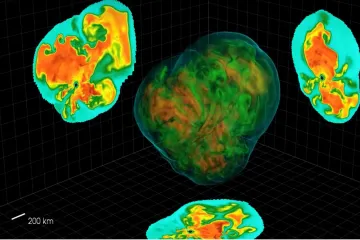
The change in the material’s transparency plays an essential role in accelerating the buildup of internal heat needed for the final push. In the early stages of collapse, the gas is relatively transparent, allowing photons to escape easily, which keeps the temperature lower, thus allowing gravity to press inward more effectively. [1]
As the protostar contracts, the density rises sharply. At a certain critical density, the material becomes opaque to its own radiation. [1] Once opaque, the heat generated by the continued gravitational squeezing can no longer escape easily; it becomes trapped within the core. This trapping mechanism causes the internal temperature and pressure to skyrocket far more rapidly than if the object remained transparent. [1] This sudden increase in internal pressure acts as a brake, fighting the ongoing infall more effectively than the pressure in the initial, transparent phase. It is a physical hurdle that must be overcome via increased compression before fusion can even be considered a possibility.
To put this into perspective, the initial collapse might be likened to dropping a ball from a moderate height: it accelerates quickly, but air resistance (like radiation escape) has minimal effect initially. As the ball falls faster and the air thickens around it (opacity), the resistance mounts significantly, causing the speed of approach toward the ground (the final state) to decrease as the air pressure pushes back harder.
# Fusion Threshold
The defining event that officially transforms a protostar into a true star is the commencement of sustained nuclear fusion in the core. [6] For a star like our Sun, this occurs when the core temperature reaches approximately $15$ million Kelvin (). [2] Only at this extreme temperature and pressure do hydrogen nuclei possess enough kinetic energy to overcome their mutual electrostatic repulsion (the Coulomb barrier) and fuse to form helium, releasing the enormous energy that defines a main-sequence star. [6]
Until that critical temperature is achieved, the object remains a protostar, deriving its energy solely from gravitational contraction (the Kelvin-Helmholtz mechanism). While fusion might briefly sputter in localized pockets before the core is fully dense and hot enough, the sustained reaction that produces the steady outward pressure capable of balancing gravity requires the entire core to reach this threshold temperature. [2] The duration of the protostar phase is essentially the time required for gravity to compress the core through the preceding stages (from diffuse cloud to opaque, self-heating object) until this ignition point is reached. [3]
This duration varies enormously based on the final mass of the star. A very massive star might contract and ignite incredibly quickly, perhaps in mere thousands of years, because gravity has a much stronger grip. Conversely, a star similar to the Sun takes tens of millions of years to complete this slow, controlled contraction toward hydrostatic equilibrium. [4]
# Stellar Nursery
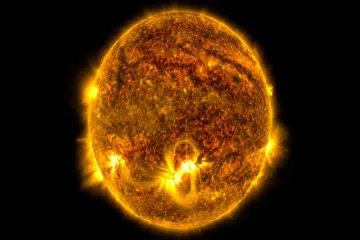
The protostar phase is more than just a waiting period; it is an active, turbulent environment distinct from the stable main sequence. During this time, the object sheds significant angular momentum and sheds mass through bipolar outflows, often seen as jets emanating from the poles of the nascent star system. [1] These outflows are critical for regulating the final mass accreted by the central object and dispersing surrounding material. A fully formed star is characterized by its stable energy generation via fusion and its hydrostatic balance. [4] It is no longer actively accreting in the same dramatic fashion, nor is it shedding the powerful, collimated jets characteristic of the protostellar stage. [1]
Considering the time scales involved provides helpful context. For a solar-mass object, the initial collapse phase might be relatively quick, but the subsequent slow contraction stage, where thermal pressure battles gravity before fusion takes over, can last for about 50 million years. [4] This multi-stage evolution underscores why the process is not instantaneous. The system must first become dense enough to trap heat (opacity), then contract long enough for that trapped heat to build the necessary core temperature, all while managing angular momentum removal.
In essence, the protostar cannot immediately become a star because it is in the middle of an energy transition: it is converting the brute force of gravity into the gentle, self-sustaining power of nuclear fusion. This conversion is mediated by the physical properties of the gas itself—density and transparency—which dictate the speed at which the core can be compressed to the required million Kelvin ignition point. The time taken is the time required for the gas pressure to finally match the gravitational force, and that match only happens when fusion begins. [4][6]
Related Questions
#Citations
Protostar - Las Cumbres Observatory
When a protostar begins fusion and becomes a star is there ... - Reddit
Protostar - Wikipedia
Star formation - Astronomy 1101 - The Ohio State University
The formation of a star begins as a cloud of gas and dust - Facebook
What event officially makes a protostar become a star, the start of ...
What happens during gravitational collapse to cause the formation ...
Protostar physics | IOPSpark
The Process of Star Formation | ASTRO 801