How long does it take the core to collapse in a supernova?
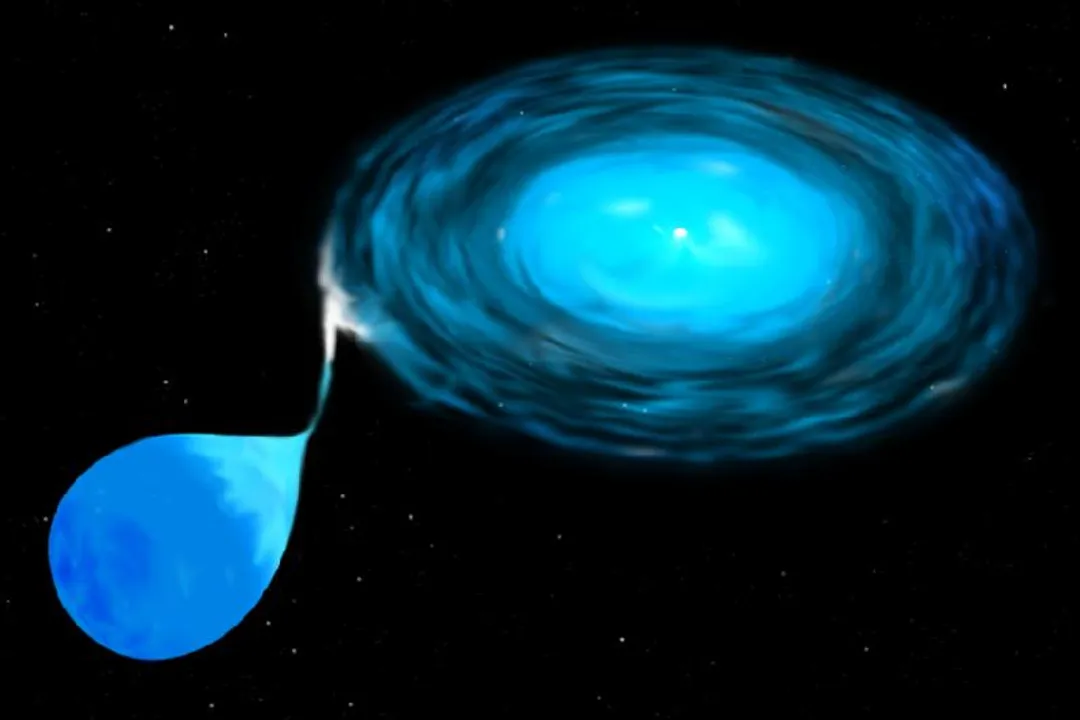
The final moments of a massive star’s life are an event of almost unimaginable speed, a sudden gravitational implosion that results in the brightest explosion in the known universe: the core-collapse supernova. When we ask how long this process takes, the answer depends entirely on which part of the event we measure. The actual structural failure—the core's collapse—is over in less time than it takes to blink, but the aftermath unfolds over days, months, and even years. [1][7]
# Core Ignition
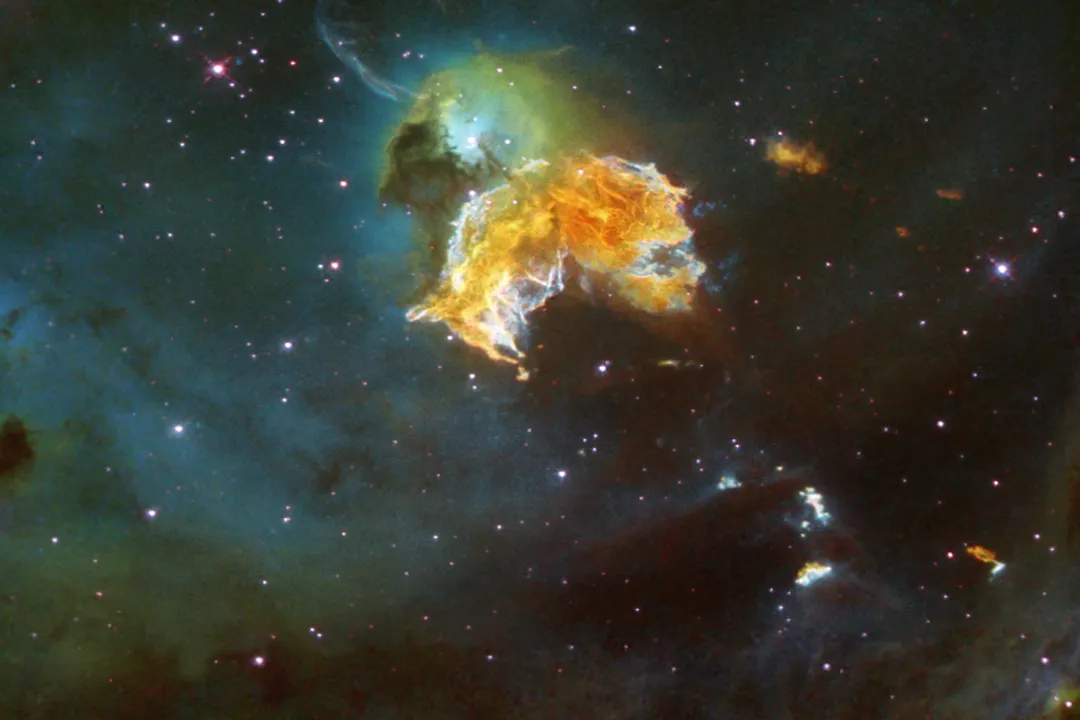
The sequence leading to a core-collapse supernova begins in stars several times the mass of our Sun—generally greater than about eight solar masses. [7] Throughout most of its life, such a star maintains a precarious equilibrium. Inward gravity, trying to crush the star, is perfectly balanced by outward pressure generated by nuclear fusion in the core. [7] The star burns through fuel—hydrogen to helium, then helium to carbon, and so on—building up layers like an onion until it forms a dense, inert core of iron. [1]
Iron is the cosmic dead end for fusion because, unlike lighter elements, fusing iron consumes energy rather than releasing it. [1][5] Once the iron core grows beyond the stability limit (the Chandrasekhar mass, around $1.4$ solar masses), the outward pressure stops, and gravity wins instantly. [2]
# Millisecond Catastrophe

The core collapse itself is characterized by its terrifying swiftness. Once iron fusion begins, the star has roughly 100 seconds to live until explosion. [3] This period is the star’s final, fatal free-fall. [3]
The collapse accelerates rapidly. Infalling material rushes inward at speeds reaching up to , which is about $23%$ of the speed of light. [1] The core, initially Earth-sized, compresses dramatically into an object just a few kilometers across, achieving densities comparable to that of an atomic nucleus. [2]
It is during this implosion that the most fundamental physical transformation occurs: the electron degeneracy pressure that had been supporting the core is overwhelmed. Electrons are forced into the atomic nuclei, combining with protons to form neutrons in a process that releases a tremendous burst of electron neutrinos (). [5] The density at which this occurs—around in some models—traps these initial neutrinos briefly, but the process continues until the core reaches nuclear density, at which point the collapse is violently halted by neutron degeneracy pressure. [2]
This entire process—from the loss of support to the rebound off the newly formed neutron core—occurs incredibly fast, estimated to take less than a quarter of a second, or on the timescale of milliseconds. [1][3][5] The moment the core "bounces" marks the beginning of the explosion, generating an outward-propagating shock wave. [2]
A fascinating analysis arises when considering the sheer compression. If a core with the mass of the Sun collapses from an Earth-sized radius (roughly ) to a neutron star radius (perhaps ), the reduction in size is a factor of about $600$. The corresponding increase in density is proportional to the cube of this factor, meaning the density increases by a factor of approximately in under one second. This astronomical compression dictates the extreme physics that follow. [2]
# The Neutrino Warning
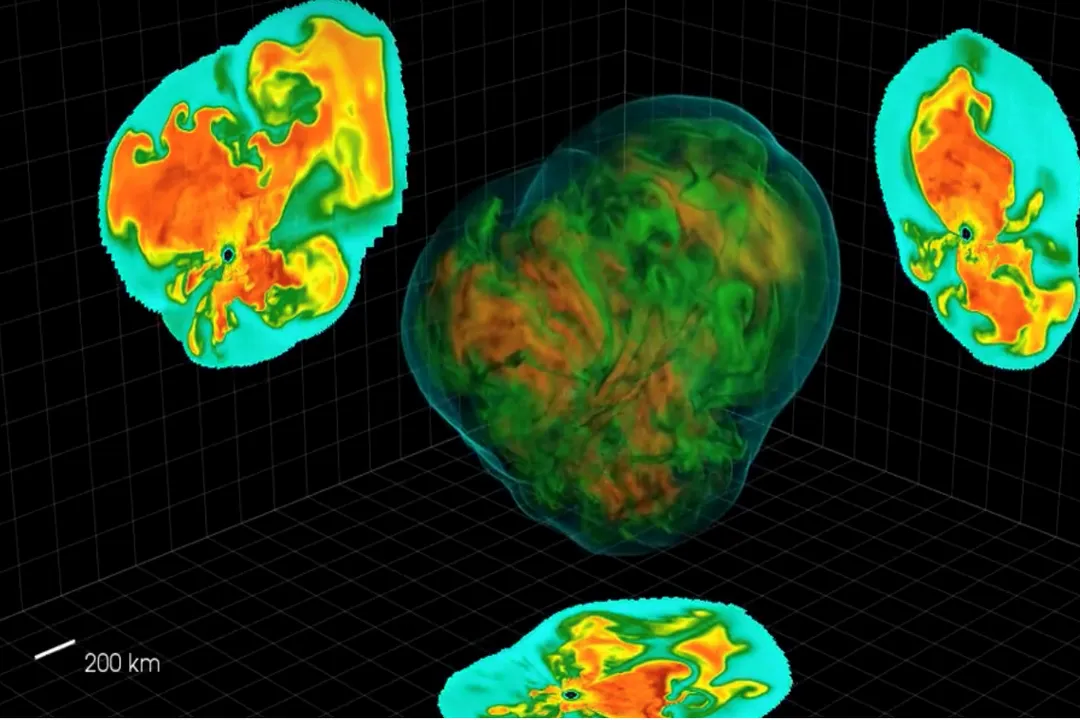
While the light from the explosion takes time to emerge, the first discernible signal that the collapse has occurred is the burst of neutrinos. [5] Because neutrinos interact so weakly with matter, they escape the star almost immediately, arriving at Earth hours or possibly even days before the visible light from the shockwave reaches us. [5][2]
For a star like a red supergiant, the shockwave generated by the core bounce can take several hours to propagate through the star's outer layers and reach the surface, where it manifests as the visible supernova flash. [1][2][5] This time lag between the neutrino detection and the optical arrival is crucial for real-time astrophysics. [5] Even for characters stranded in the same system, the massive neutrino flux generated during the collapse itself—carrying away about joules of energy, or $10%$ of the star's rest mass—would be easily detectable, even with hypothetical near-future technology. [1][5]
# Evolving Light Curve
Once the shockwave hits the surface, the visible event begins, but this is not instantaneous either. The light curve—the graph of brightness over time—shows a gradual ascent following the initial detonation. [3]
For a Type Ia supernova (the thermonuclear explosion of a white dwarf), the light peaks and fades relatively quickly, sometimes over a matter of days. [1] However, for the core-collapse Type II supernovae derived from massive stars, the process is slower:
- The initial flash brightens over a period, often taking a few months to reach its absolute peak luminosity. [1] Supernova took about $85$ days to reach peak brightness. [1]
- After peaking, the light slowly declines over the next few years. [1]
This extended glow is not powered by the initial mechanical shock, which is brief, but by the radioactive decay of newly synthesized heavy elements like Nickel-56, which decays into Cobalt-56, and then into stable Iron-56. [2]

# Material Motion Post-Explosion
The speed at which the stellar debris moves outward is also a measure of the event's duration and scale. The shockwave propagating outward after the bounce can reach speeds around . Other sources suggest the material can be ejected at velocities up to "several percent of the speed of light," with some high-energy events (hypernovae) possibly reaching . [1][2]
If we consider the chronological time from the point the star could no longer be considered "normal" (iron core formation) to when it is definitively a supernova, the time is dominated by the final moments: from the onset of iron fusion to the shock breakout, the total process spans from mere seconds to a few hours. [3][5]
One point of comparison helps put the core collapse speed into perspective. A Type Ia supernova—where a white dwarf explodes after exceeding $1.4$ solar masses—is also rapid. Within a few seconds, a significant fraction of the white dwarf undergoes runaway nuclear fusion, releasing energy to unbind the star. [2] While the mechanism differs, both canonical types feature an event in the core that completes in mere seconds, immediately followed by a multi-hour or multi-month visible effect. [1][3]
# Unpacking Precursors and Density Thresholds
The question of observability just before collapse suggests an interesting technical nuance. While the star’s surface layers are slow to respond to the core’s demise—taking days or even weeks to fall in response to total loss of support—the core itself changes rapidly. [5]
If a science team were situated close to the dying star, they would want to monitor for the most immediate, non-electromagnetic precursor: the neutrino flux. The process of electron capture and other density-dependent reactions drastically increases neutrino emission as the core approaches the final collapse point, providing hours or days of warning for observers located hundreds of parsecs away. [5] If your fictional characters are in orbit around the star, this signal would be so amplified that their onboard detectors could register it immediately, possibly requiring a detector much smaller than current terrestrial models, perhaps only a few kilograms of scintillation material, due to the vastly increased flux. [5]
Furthermore, in Type II core-collapse events, the core temperature spikes to about $100$ billion Kelvins at the moment of bounce, releasing an immense ten-second burst of neutrinos, roughly joules. [2] While most of the energy is carried away by these neutrinos, a fraction of that energy, about joules, must be reabsorbed by the stalled shockwave to power the subsequent visible explosion. [2] This energetic transfer is the key link between the sub-second core event and the long-lasting visible light.
# Timescales of Element Formation
The timescale of the core collapse is also directly tied to the creation of the heaviest elements. While general fusion in stars creates elements up to iron, the elements heavier than iron—like gold, silver, and uranium—are forged in the extreme conditions of the explosion itself. [1]
Specifically, the rapid neutron capture process (r-process), responsible for roughly half of all isotopes heavier than iron, happens during the explosion phase. [2] Since the r-process requires the immediate, intense neutron flux from the collapsing and rebounding core, the window for creating these elements is locked into the same ultra-fast timescale as the collapse and bounce—the milliseconds following the core's cessation of support. [1][2] The elements that drive the light curve's visible peak, like Nickel-56, are also a direct product of this extremely rapid, high-energy core event. [2]
# Conclusion on Timescale
To summarize the chronology of a core-collapse supernova:
| Event Phase | Approximate Timescale |
|---|---|
| Fuel Exhaustion to Iron Core Collapse | Millions of years of evolution, ending in seconds of instability [1][3] |
| Core Collapse (Implosion/Bounce) | Less than a quarter of a second (milliseconds) [1][2] |
| Neutrino Burst Emission | Simultaneous with collapse/bounce |
| Shockwave Reaches Stellar Surface (Light Flash) | A few hours [1][5] |
| Peak Optical Brightness | Several weeks to a few months [1][2] |
| Fading to Near-Invisibility | Several years [1] |
The fact that a star’s most violent, energetic release occurs in a fraction of a second—while the resulting light show lasts for years—highlights a profound physical dichotomy. The energy output of a core-collapse event is dominated by neutrinos, where over $99%$ of the energy escapes in the first few minutes, making the subsequent visible light an almost secondary effect powered by radioactive decay. [2] This speed is why the detection of gravitational waves, which also travel at the speed of light and arrive with the neutrinos, is so important; they provide direct, immediate information about the non-spherical way the core collapses, something the light curve cannot reveal. [5]
If we consider the extreme case of a rotating star collapsing directly into a black hole (a "failed supernova"), the gamma-ray burst, if produced, might be confined to milliseconds when viewed down the rotational axis. [5] Yet, even in these events, the underlying mechanism relies on the same rapid implosion of the iron core that defines the timeframe. [2]
#Videos
How Quickly Does A Supernova Happen? The Stunning Speed of a ...
Related Questions
#Citations
How long chronologically does a supernova take to 'happen'? - Reddit
Supernova - Wikipedia
How Quickly Does A Supernova Happen? The Stunning Speed of a ...
What Is a Supernova? | NASA Space Place – NASA Science for Kids
Are there observable changes in a star about to become supernova ...
DOE Explains...Supernovae - Department of Energy
Supernova explosions - Las Cumbres Observatory