What triggers a type II core collapse supernova?
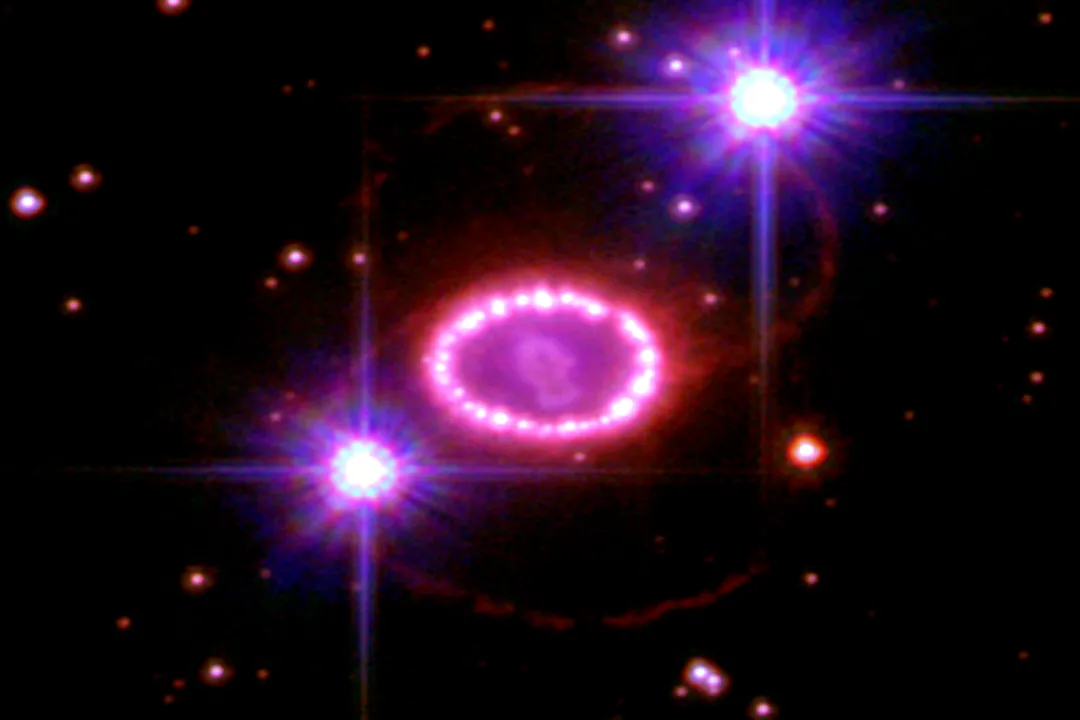
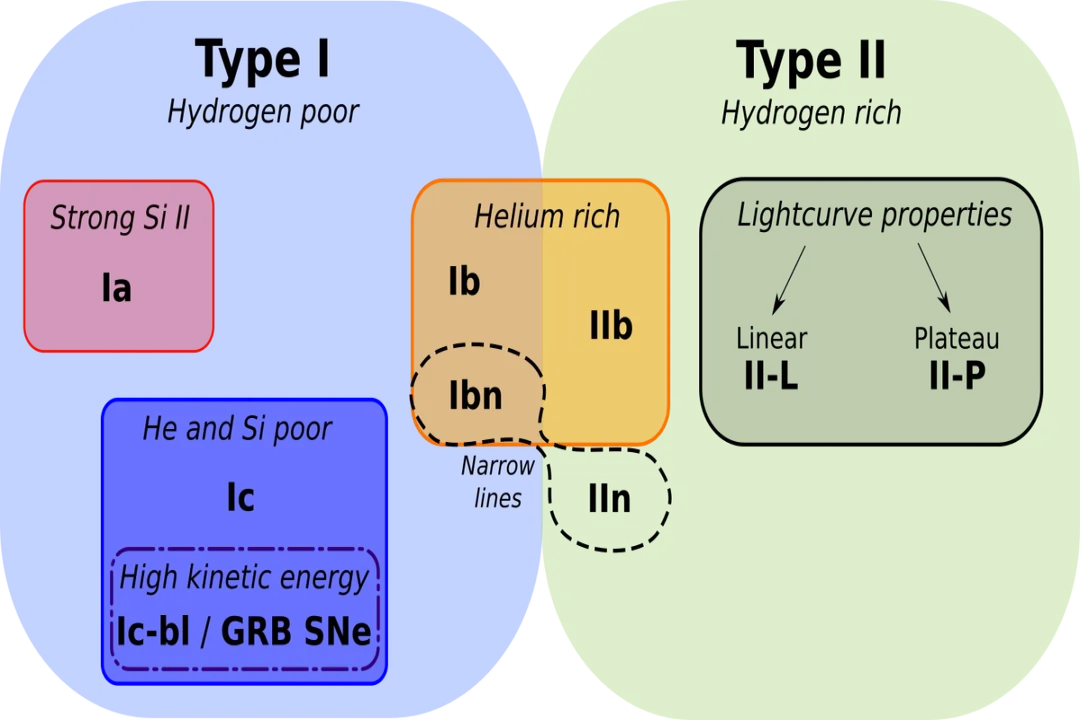
Stars don't just wink out; the most massive ones end their lives in a cosmic cataclysm known as a Type II supernova. [1][7] These spectacular explosions are the signature of a core-collapse event, occurring when a star significantly larger than our Sun—typically one with an initial mass greater than about eight solar masses ()—has exhausted its ability to sustain itself against its own crushing gravity. [1][8][9] Unlike some other supernova types, Type IIs are defined by their spectral signature: they conspicuously display the spectral lines of hydrogen because, crucially, the star has not yet shed its massive outer envelope of this primordial element before detonating. [1][7] The true trigger for this monumental outburst isn't a sudden external push, but an internal, unstoppable failure in the star’s energy production machinery. [5]
# Stellar Life Cycle

Throughout the majority of its existence, a massive star maintains equilibrium by balancing the outward pressure generated by thermonuclear fusion in its core against the inward pull of gravity. [5] As the star ages, it burns progressively heavier elements in its core, creating an internal structure resembling an onion. [8] Hydrogen fuses into helium in the center, then helium fuses into carbon and oxygen, and so on, creating shells of different burning processes surrounding the core. [5][8]
This tiered fusion process is incredibly efficient at generating energy, as long as the resulting ash can be used as fuel for the next stage. However, this steady march of energy production hits an absolute dead end when the core is converted into iron (). [5][6][7]
# Iron Core
The formation of an iron core marks the beginning of the end, effectively sealing the star's fate. [5] Iron is the most tightly bound atomic nucleus; this means that fusing iron atoms together—or splitting them apart—does not release energy as heat and radiation; rather, it consumes energy. [5][6]
This fundamental change in energy dynamics is the immediate trigger for the ensuing collapse. Once the core is primarily iron, the furnace goes cold, and the energy source that held the star up against gravity vanishes. [5][6] The star has effectively run out of usable fuel in its central region. [3] While the outer layers might still be fusing lighter elements—perhaps silicon into iron in the outermost shell—this energy is no longer sufficient to support the sheer weight of the stellar mass pressing inward. [8]
The star’s entire structure depends on the outward pressure derived from these fusion reactions. When that pressure disappears due to the iron core, the star's long-held balance is shattered. Gravity immediately wins the cosmic tug-of-war. [9]
# Rapid Collapse
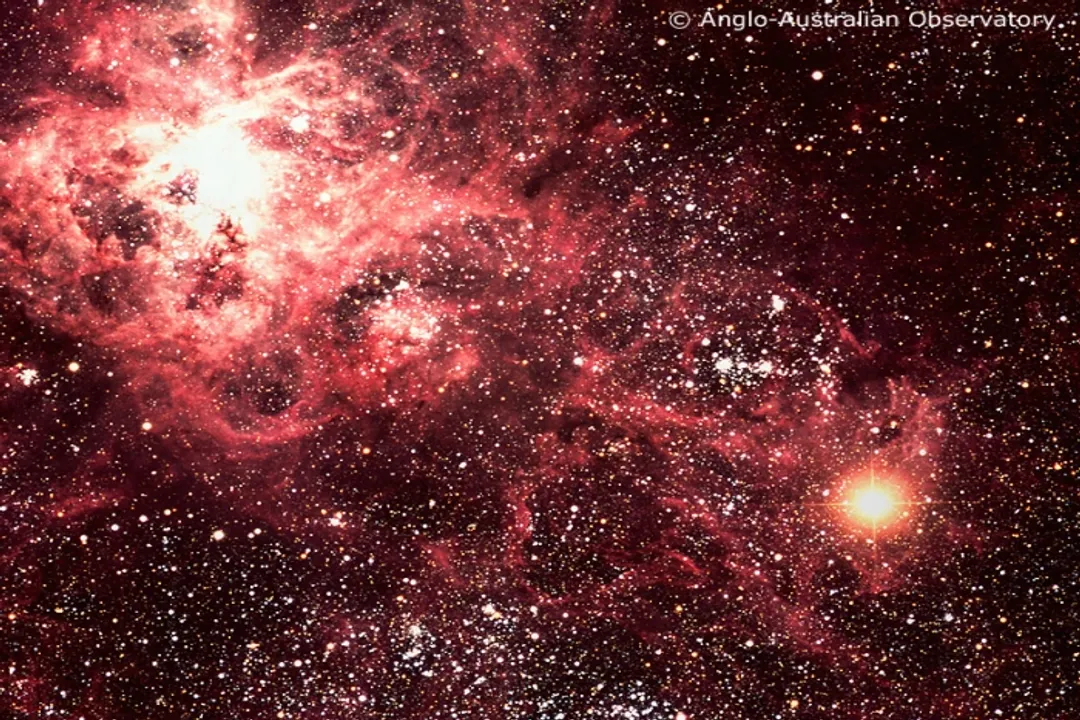
When the iron core reaches a critical mass, which is estimated to be around $1.4$ to $2$ solar masses, the core can no longer be supported by electron degeneracy pressure—the quantum mechanical resistance electrons offer to being squeezed too close together. [9] At this point, gravity overcomes this last line of defense, and the core begins to collapse with astonishing speed. [9]
The collapse is not a gentle contraction; it is a catastrophic implosion occurring in mere milliseconds. [6] The timescales involved here are stunning: while the star might have lived for millions of years fusing lighter elements, the final transition from a stable iron core to a collapsed object takes less than a second. [6] As the iron nuclei are crushed together, protons and electrons are forced to combine, creating neutrons and releasing a massive burst of ghostly particles called neutrinos. [6][8] This process, known as inverse beta decay, rapidly converts the core material into a dense ball of neutrons. [9]
The collapse continues until the core reaches the incredible density of an atomic nucleus, around grams per cubic centimeter. [4] At this point, the core stiffens immensely, and the collapse is finally halted by neutron degeneracy pressure and the strong nuclear force. [4] What remains is an unimaginably dense object, typically a neutron star. [3][4]
As an aside, the fate of the remnant depends on the initial mass of the star. If the collapsing star was slightly less massive (perhaps between and ), a neutron star is the outcome. If the initial mass was much higher, even the immense pressure of the degenerate neutrons cannot halt the collapse, and the remnant will continue shrinking past the event horizon to form a black hole. [4] For the classic Type II supernova mechanism, however, the formation of a nascent neutron star is the key step that sets the stage for the explosion. [3]
# Shock Rebound
The formation of the stiff, incompressible neutron star core is the physical event that initiates the outward explosion, though the actual propagation is complex. As the outer layers of the core continue their infall, they slam into this newly formed, ultra-dense stellar remnant. [4][8] This impact causes the infalling material to abruptly stop and violently rebound. [4]
This rebound generates a powerful, outward-moving shockwave that propagates through the star's interior layers. [3][8] In a perfect, idealized scenario, this shockwave would immediately rip through the star, ejecting the outer layers into space and creating the observed supernova. [4]
However, reality proves more challenging for the shockwave. As it travels outward through the dense, infalling stellar envelope, the shockwave loses energy rapidly. The material it is trying to push is still falling inward, and the shockfront effectively gets bogged down, or stalls, very close to the newly formed neutron star. [6] For a brief period, the outward-moving shock stalls, and the star seems poised to simply collapse again into a black hole, with the shock dying out. [6]
# Neutrino Power
This is where the previously mentioned neutrino production becomes critically important to the visible event we call a Type II supernova. [5] The formation of the neutron star releases a staggering amount of energy, nearly Joules, but over $99%$ of this energy is carried away by the flood of neutrinos created during the core's conversion from iron to neutrons. [8]
While only a tiny fraction of this neutrino energy escapes, it is still more energy than the Sun will produce in its entire ten-billion-year lifetime. [5] The critical insight here is that these neutrinos stream outward through the stalled shock front. [2][5] As they interact with the dense material just behind the stalled shock, they deposit enough energy to re-energize it, effectively giving the shock a second, crucial push—a process often called shock revival. [2][5][6]
This neutrino-driven heating provides the final impetus needed for the shockwave to break free from the star's gravitational grip and accelerate the outer layers outward at tremendous velocities, leading to the brilliant, observable supernova explosion. [5] Without this neutrino kick, the shock would likely fade, and the massive star would simply form a black hole without the dramatic visible fireworks we associate with Type II supernovae. [6]
To put the energy scale into perspective, consider a comparison: if we could somehow capture just one percent of the total neutrino energy released, it would be enough to power every electrical grid on Earth for millennia. [5] This vast, hidden energy reservoir, released in the first few seconds of the collapse, is the true engine that drives the explosion that we observe across the galaxy. [8] The visible light of the supernova itself represents only the barest fraction of the total energy expended during the event. [8]
The final type of star that undergoes this process is constrained by its appearance after death, defining it as a Type II rather than a Type Ib or Ic supernova—it must still possess that hydrogen envelope at the time of detonation. [1] The entire sequence, from the final silicon fusion phase to the light curve peaking, is triggered by the failure of the iron core to maintain equilibrium against overwhelming gravity. [5][9]
Related Questions
#Citations
Type II supernova - Wikipedia
Why do type-2 supernovas involve an explosion? - Reddit
Core-collapse | COSMOS
A Brief Introduction to Core Collapse Supernovae
[PDF] Core Collapse Supernovae
Why do Type II supernova happen? - Physics Stack Exchange
Type II supernova - Grokipedia
The Evolution of Massive Stars and Type II Supernovae | ASTRO 801
Type II Supernova Definition - Astrophysics I Key Term | Fiveable