What triggers adaptive radiation?

The process of life diversifying rapidly from a single common ancestor into a multitude of new forms, each adapted to a specific role, is known as adaptive radiation. This phenomenon results in a burst of new species where, previously, only one or a few existed. Understanding what initiates this explosive evolutionary event requires looking at specific environmental or genetic shifts that fundamentally change the rules of survival and competition for a lineage. It is not a constant state of affairs; rather, it is typically a response to an opening, a vacuum in the biological landscape that a pre-existing lineage is suddenly equipped to fill.
# Ecological Opportunity

The most frequently cited trigger for an evolutionary radiation is the presence of ecological opportunity. This concept centers on the idea that resources, habitats, or ways of life are available but currently underutilized by existing organisms. When competition is low, natural selection pressures shift. Instead of weeding out slight variations in the struggle for limited resources, selection favors traits that allow a lineage to move into and exploit those vacant niches.
# Reduced Competition
Reduced competition is a critical component of ecological opportunity. In a stable ecosystem with high biodiversity, nearly every available niche is occupied by specialized species, making it extremely difficult for a new arrival or a recently modified lineage to establish itself without outcompeting a resident specialist. However, if a catastrophe clears out dominant species, or if a lineage arrives in a completely new area, the immediate competitive pressure drops significantly. This reduction allows even relatively small advantages—a slightly different beak shape, a minor shift in feeding time—to translate into massive long-term reproductive success, leading to rapid speciation across the available resource spectrum. It is this temporary relaxation of biotic resistance that allows for the speed associated with radiation.
# Niche Availability
The availability of diverse, untapped niches is the landscape upon which opportunity is built. A large lake, for instance, might have varying depths, substrate types, and food sources—deep water, shallow rocky areas, soft sediment beds, plankton-rich zones, insect-heavy zones. If a single ancestral fish species arrives, it doesn't just have to compete with other fish; it has to compete with the potential for specialization. If the environment offers many distinct feeding strategies, for example, the radiating lineage will likely develop multiple distinct feeding morphs, one for each strategy. The sheer variety of available microhabitats dictates the potential breadth of the resulting radiation.
# New Habitats
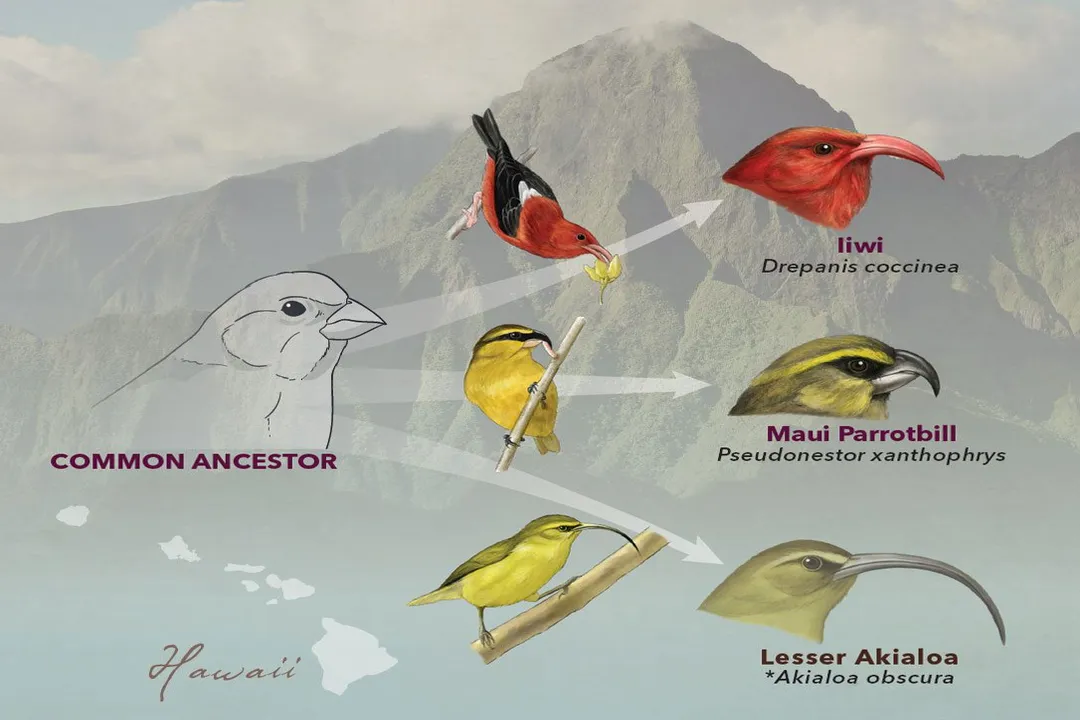
The physical colonization of a novel environment often sets the stage for adaptive radiation because these new settings frequently present the required ecological opportunity. Isolation plays a significant role here, as it prevents interbreeding with established populations, allowing the newly arrived lineage to evolve independently along new trajectories.
# Island Colonization
Islands are perhaps the most celebrated natural laboratories for observing adaptive radiation. When a small number of individuals from a mainland species arrive on a remote island—perhaps carried by a storm or floating debris—they have successfully navigated a major dispersal barrier. Once established, several factors combine to trigger radiation:
- Lack of Competition: The island often lacks predators, specialized herbivores, or competitors that constrained the ancestors on the mainland.
- Novel Resources: The island's flora and fauna present a different set of food sources and habitats than those the ancestors were adapted to.
- Founder Effect: The small initial population is genetically different from the source population, providing a potentially unique genetic starting point for subsequent changes.
Darwin’s finches on the Galápagos Islands are the classic example, where subtle variations in beak morphology adapted to different local food sources—seeds, insects, nectar, or even blood—drove rapid diversification from a single finch ancestor. The isolation ensures that the diversification happens on the island, leading to endemic species found nowhere else.
# Internal Diversification
Adaptive radiation isn't strictly limited to island colonization; it can occur when a lineage successfully colonizes a vast, previously uninhabited area within a larger region, or when a geological event creates new, isolated environments. For example, the formation of a large, deep lake, like Lake Victoria, can present an array of distinct aquatic niches within a single geographical boundary, leading to a rapid explosion of cichlid fish species tailored to those specific depths and substrates. This is effectively an "island" created inland by geography. The key is the establishment of reproductive isolation alongside the availability of diverse resources.

# Evolutionary Innovation

Sometimes, the trigger isn't environmental emptiness but an internal genetic or morphological breakthrough that unlocks previously inaccessible ecological space. This is often termed a key innovation.
# New Trait Acquisition
A key innovation is a novel trait that significantly enhances the bearer's ability to exploit resources or survive in a new way. If a lineage develops a feature that allows it to bypass an ecological bottleneck that restricted its ancestors, the lineage can suddenly diversify into many new forms based on how they utilize that new capability.
Consider the evolution of flight in insects or the development of specialized structures for feeding. Once a lineage possesses the ability to fly, for instance, it can access resources distributed over a much wider area, colonize distant habitats, or escape ground-based predators more easily. This new capability doesn't necessitate moving to a new continent; it simply means that the entire world now presents new opportunities relative to the non-flying ancestors. Different species might then adapt their flight patterns or wing shapes to optimize for different purposes—fast, direct flight for long-distance migration versus slow, maneuverable flight for navigating dense vegetation.
The evolution of the flowering mechanism in angiosperms is another frequently cited example of a key innovation leading to massive diversification, allowing them to dominate terrestrial ecosystems by forging new reproductive relationships with pollinators. The innovation itself is the cause of the radiation, as it immediately opens up new selective pressures and possibilities for specialization.
# Catastrophic Reset

In macroevolutionary terms, some of the most dramatic adaptive radiations follow periods of mass extinction. These events, such as the one that wiped out the non-avian dinosaurs, act as a severe environmental filter that removes a vast proportion of the life forms present in an ecosystem.
# Vacating Niches
When a mass extinction occurs, it is not just that some species die; entire functional groups—like large terrestrial herbivores or specialized marine predators—can be eliminated. This leaves behind enormous ecological vacuums. The surviving lineages, though potentially small in number and having passed through a severe population bottleneck, suddenly find themselves facing minimal competition across a wide range of environments.
The radiation that followed the K-T extinction event, which cleared the way for the diversification of mammals to fill roles previously held by dinosaurs, is the prime example of this trigger. The mammals had existed alongside the dinosaurs for millions of years, but their radiation was constrained by the dominant reptilian groups. Once the constraint was removed, the survivors rapidly evolved into the large terrestrial forms we recognize today—carnivores, herbivores, flyers, and swimmers. It is a case where the trigger is a massive, external environmental stressor that fundamentally resets the community structure, allowing for evolutionary opportunities that were previously impossible.
# Mechanisms of Speciation
Once the primary trigger—be it an empty niche, a new landmass, or a new physical trait—is in place, the actual process of generating new species must occur. Radiation is the result of these triggers channeled through the mechanics of evolution.
# Role of Selection
The driving force behind the splitting of lineages during radiation is divergent selection. In an environment rich with opportunities, individuals within the founding population will encounter slightly different resource distributions. Selection acts strongly to favor the traits best suited to that specific sub-niche. If a group of ancestral birds lands on an island where one side has hard nuts and the other has soft berries, the lineage facing nuts will be selected for thicker, stronger beaks, while the lineage facing berries will be selected for thinner, more precise beaks. If these two groups become geographically or behaviorally isolated while specializing, they will eventually become reproductively isolated, resulting in two distinct species—the very definition of speciation.
It is often the case that the initial colonization or innovation creates the potential for divergence, but the actual rate of radiation is dictated by the strength and persistence of these divergent selective pressures. A steady supply of slightly different challenges ensures a steady supply of new adaptations.
# Isolation Barriers
Reproductive isolation must evolve for the radiation to be visible in the fossil record or through contemporary observation as separate species. In geographically isolated settings like archipelagos, allopatric speciation—where physical separation leads to reproductive divergence—is common. However, in large, internally diverse areas like a vast lake or a newly available continent, sympatric speciation, where divergence occurs within the same geographic area due to differential resource use or mating preferences, can also be a major factor. For instance, if two groups of insects start exclusively feeding on two different host plants that grow side-by-side, they may stop interbreeding simply because they never encounter each other during mating season, even though they occupy the same overall habitat.
If we were to map the triggers against the resulting isolation mechanism, we might find that island colonization strongly favors allopatric divergence due to the relative isolation of small habitat patches, whereas key innovations in a widespread environment might favor rapid sympatric divergence driven by the exploitation of newly viable niches within the same range. The island scenario often imposes a harsh genetic bottleneck initially, favoring fast fixation of new traits, while a widespread innovation allows for slower, more numerous parallel radiations across the entire range.
# Analyzing Radiation Speed
The speed at which adaptive radiation occurs is a fascinating metric, and it seems inherently linked to the nature of the initial trigger. When considering these triggers, we can observe a hierarchy of evolutionary velocity.
| Trigger Mechanism | Primary Consequence | Expected Radiation Speed |
|---|---|---|
| Colonization of Remote Island | Immediate, high ecological opportunity, genetic bottleneck | Very Rapid |
| Mass Extinction Event | Wholesale clearing of niches across a biome | Rapid (Post-Recovery) |
| Key Morphological Innovation | Unlocking new resource possibilities across existing range | Gradual to Rapid, depending on dispersal |
The extreme isolation of a small island population, combined with the complete absence of established competitors, often results in the fastest observable diversification rates in the fossil record because all available niches—from specialized predator to generalized herbivore—are potentially open to the few colonizers. Conversely, if the trigger is a key innovation in a highly competitive environment (like the flowering plant example), the radiation might proceed more gradually as the new innovation allows the lineage to slowly displace, rather than simply ignore, established competitors. The descendants have to earn their way into the ecosystem, albeit with a significant head start provided by the new trait.
The presence of a strong trigger initiates the process, but the duration of the radiation depends on the persistence of the opportunity. Once all the ecologically distinct, accessible niches within a particular environment have been filled by specialized forms, the rate of new species formation slows down to the background rate of evolution, as further speciation would require competition against the highly adapted, radiating species themselves. The radiation ends when the adaptive landscape becomes saturated.
To summarize the mechanism: A trigger initiates a period where fitness differences between variants are amplified due to reduced competition or novel function, leading to strong divergent selection across available resources, which, when coupled with reproductive isolation, culminates in the rapid generation of new, distinct species. The environment doesn't create the traits, but it provides the perfect stage for existing or newly evolved traits to become dominant and lead to speciation.
Related Questions
#Citations
Triggering adaptive radiation - Understanding Evolution
Adaptive radiation - Wikipedia
5.4 Evolutionary radiations - Digital Atlas of Ancient Life
Adaptive radiation versus 'radiation' and 'explosive diversification ...
Ecological Opportunity: Trigger of Adaptive Radiation - Nature
Adaptive radiation | Research Starters - EBSCO
Adaptive Radiation - an overview | ScienceDirect Topics
On the Origin and Trigger of the Notothenioid Adaptive Radiation - NIH
22.5: Adaptive Radiation and Biological Diversity
Why Evolution Goes Wild on Islands: The Science of Adaptive ...