What triggers a supernova explosion?
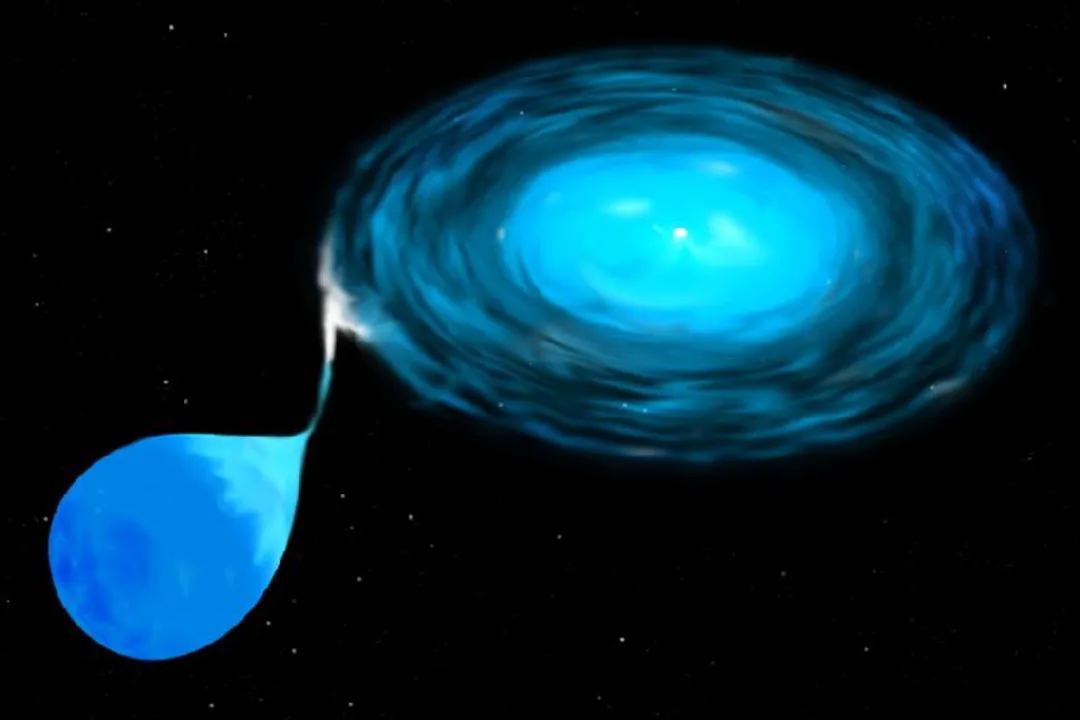
A supernova explosion represents one of the most cataclysmic events in the cosmos, briefly outshining entire galaxies and playing a fundamental role in cosmic evolution. These brilliant stellar detonations mark the dramatic endpoint for certain types of stars, fundamentally altering the interstellar medium by dispersing heavy elements forged over millions or billions of years. [1][6] Understanding what triggers such an immense burst of energy requires differentiating between the two primary pathways leading to a supernova: the explosive death of a single, very massive star, or the catastrophic destabilization of a white dwarf in a binary system. [2][7]
# Stellar Mass Limits

Stars spend the majority of their lives in a stable state, a balance between the inward crush of gravity and the outward pressure generated by thermonuclear fusion occurring in their core. [2][6] This stability is maintained as long as the star has fuel to burn, typically hydrogen, in its core. The ultimate fate of a star, and whether it will end its life quietly or spectacularly, is overwhelmingly determined by its initial mass. [2]
Stars less massive than about eight times the mass of our Sun will generally fade away after exhausting their fuel, eventually becoming a white dwarf. [2] Stars significantly exceeding this threshold, however, face a far more energetic demise. The critical difference lies in the star's ability to continue fusing heavier and heavier elements once the initial hydrogen supply is depleted. [2]
# Core Collapse Triggers

The most common mechanism for a star to trigger its own supernova explosion involves massive stars—those significantly larger than the Sun—that progress through several stages of fusion, building up layers of heavier elements like an onion. [2][3]
# Fuel Exhaustion
A massive star fuses hydrogen into helium, then helium into carbon, and so on, progressing up the periodic table until it creates an inert core of iron. [2][3] Iron is the crucial turning point because its nucleus is the most stable; fusing iron does not release energy; it consumes it. [2][3] Once the iron core accumulates to a critical size—often estimated to be around $1.4$ to $3$ solar masses, depending on the star's total mass and internal structure—the energy-producing engine shuts down abruptly. [2]
# Implosion Rebound
With the outward thermal pressure gone, gravity wins decisively, causing the massive iron core to collapse inward in a fraction of a second. [2][9] This implosion is incredibly fast, shrinking the core from the size of the Earth to a ball only a few miles across. [2] As the matter falls inward, it reaches nuclear density, becoming incredibly stiff, which halts the collapse momentarily. [2] The outer layers of the star, still plunging inward, violently crash into this ultra-dense core, causing a powerful rebound shockwave. [2][3] It is this shockwave, driven by the formation of an incredibly dense neutron star (or perhaps a black hole), that rips through the star's outer layers, initiating the brilliant supernova explosion observed across vast distances. [2][3][9] This process is characteristic of Type II, Ib, and Ic supernovae, collectively known as core-collapse supernovae. [1]
One fascinating detail that researchers are currently investigating is the complex physics right at the boundary of collapse. Recent studies on unique supernova events have suggested that the initial shockwave might stall temporarily before being reignited, possibly through the action of exotic particles like neutrinos, which carry away a significant fraction of the collapse energy before the visible explosion manifests. [8] This suggests the trigger isn't just the collapse itself, but a complex interplay of gravity, hydrodynamics, and particle physics near the nascent neutron star. [8]
# White Dwarf Detonation
The second major path to a supernova involves white dwarfs, which are the dense remnants of Sun-like stars. [6] Unlike core-collapse events, a Type Ia supernova is a thermonuclear explosion that occurs when a white dwarf gains too much mass. [7]
# Accretion Limit
In a binary star system, a white dwarf can siphon material—mostly hydrogen and helium—from its companion star. [7] As the white dwarf accumulates this material, its mass increases, and consequently, its internal pressure and temperature rise. [7] The white dwarf is supported against gravity by electron degeneracy pressure, a quantum mechanical effect, not by fusion energy. [7]
However, this degeneracy pressure has a limit. If the white dwarf's mass approaches the Chandrasekhar Limit, which is approximately $1.4$ solar masses, the core temperature and pressure become high enough to reignite runaway carbon fusion deep within the star. [7] This ignition is not a controlled burn like in a main-sequence star; it is a catastrophic, runaway thermonuclear reaction that consumes the star almost instantaneously, resulting in a complete obliteration of the white dwarf—no remnant is left behind. [7][9]
# Merger Scenario
A less common, but still possible, trigger for a Type Ia supernova is the collision and merger of two white dwarfs. [7] If two white dwarfs orbit closely enough, gravitational radiation can cause their orbit to decay until they spiral into each other, exceeding the mass limit and triggering the same thermonuclear runaway. [7]
To better visualize the different physical paths, consider a simple comparison of the primary outcomes:
| Supernova Type | Primary Star System | Key Trigger Mechanism | Stellar Remnant |
|---|---|---|---|
| Core-Collapse (Type II, Ib, Ic) | Single massive star () | Iron core exceeding stability limit | Neutron Star or Black Hole [2] |
| Type Ia | Binary system with a white dwarf | Exceeding the Chandrasekhar Limit () | None (Total destruction) [7] |
This table highlights that while both result in massive explosions, the physics is fundamentally different: one is a gravitational collapse followed by a rebound, and the other is a total thermonuclear detonation. [1][7]
# Observational Distinctions and Cosmic Clocks
The physical differences between the two main types lead to very distinct observational signatures, which astronomers use for classification. [1] A core-collapse supernova is expected to have a spectrum showing strong evidence of hydrogen (Type II) or lack of hydrogen but presence of helium (Type Ib/Ic) because the outer layers are still present when the explosion occurs. [1] In contrast, a Type Ia supernova is characterized by the near-complete absence of hydrogen and strong absorption lines of silicon, reflecting the fact that the star was entirely composed of C/O/Ne material just before detonation. [1][7]
Furthermore, the time scales involved offer an interesting point of contrast. A core-collapse event occurs after the star has lived for millions of years as a massive star, a relatively short span in cosmic terms. [2] However, the time between the initiation of the core collapse and the peak brightness we observe is near-instantaneous in astronomical terms. [2] For Type Ia events, the time scale is often longer, as it relies on the slow process of mass transfer or orbital decay over perhaps billions of years before the critical mass is reached. [7] When observing these events across the universe, the consistent brightness of Type Ia supernovae has been instrumental in measuring cosmic expansion rates, making them crucial "standard candles," whereas core-collapse events are more variable in their peak luminosity. [7]
# The Violence of Destruction
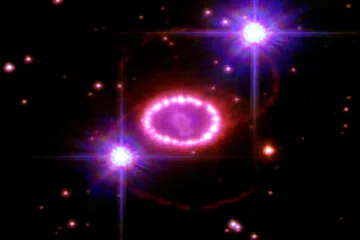
Whether initiated by gravitational collapse or thermonuclear runaway, the resulting energy release is staggering. [9] The force involved in a supernova is so immense that it completely destroys the star, blowing off most of its mass into space at speeds that can reach tens of thousands of kilometers per second. [9] This ejection of material is vital because it seeds the galaxy with elements heavier than iron—such as gold, silver, and uranium—which cannot be formed in standard stellar fusion or even during the core-collapse rebound itself. [1] These heavier elements are synthesized during the high-energy shockwave passage itself, or during the subsequent cooling phase. [1]
The remnants of these explosions seed the next generation of stars and planets. For instance, the iron in your blood, the silicon in the rocks around you, and the calcium in your bones were all created within stars and violently distributed by supernovae. [6] The initial burst of light can be so intense that a supernova can momentarily outshine its host galaxy. [6]
Considering the vastness of space, it is interesting to note that our own Milky Way galaxy has not experienced a recorded supernova in roughly four centuries, the last one being Kepler's Supernova in . [4] This highlights that while supernovae are frequent on a galactic scale—occurring perhaps one or two times per century in a galaxy the size of the Milky Way—they are rare local events, meaning the immediate trigger mechanism for a nearby star is usually years or millennia away from fruition. [4] While we wait for the next local event, the mechanism remains the same: reaching an unsustainable internal configuration that forces a catastrophic structural failure, either from gravity overwhelming fusion support or from degeneracy pressure failing to contain runaway fusion. [2][7] This fundamental physical threshold—the point of no return—is the true trigger for every supernova we witness. [1]
Related Questions
#Citations
Supernova - Wikipedia
What Causes a Supernova Explosion?
What Is a Supernova? | NASA Space Place – NASA Science for Kids
Astronomy Chapter 13 Flashcards | Quizlet
(Super)novas - what is actually happening during the explosion?
Supernova explosions - Las Cumbres Observatory
What Causes Supernovae Explosions? - Institute for Advanced Study
First-of-its-kind supernova reveals inner workings of a dying star
How does a supernova completely destroy a star?