What elements are being fused in a supernova?
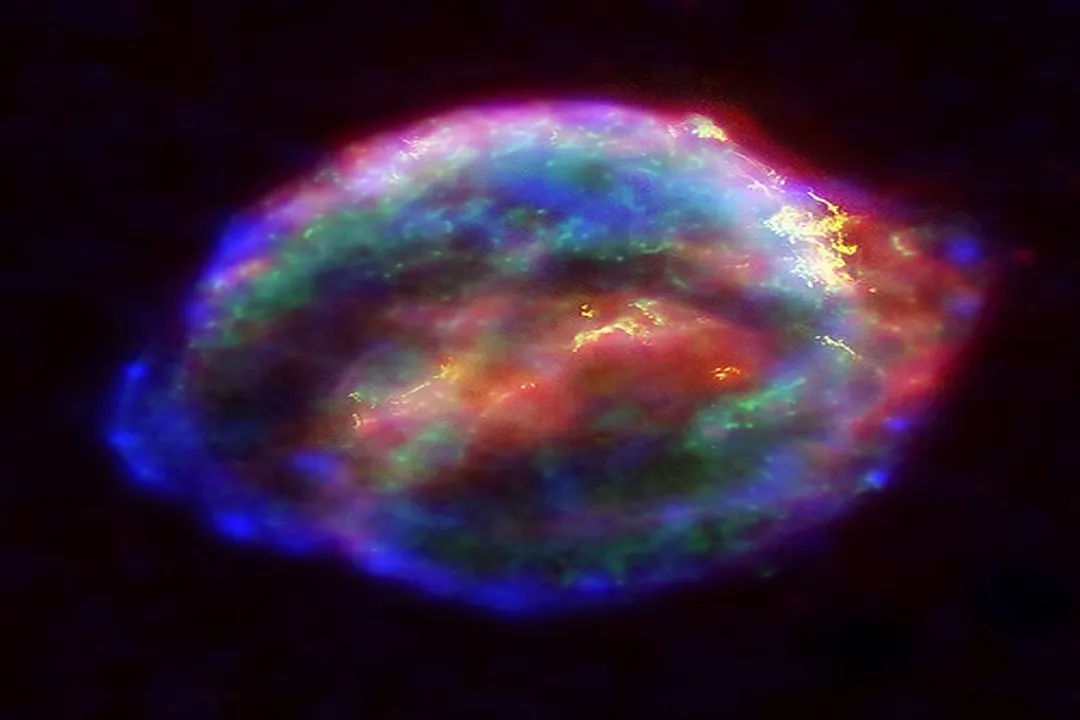
The creation of elements across the cosmos is a dramatic, layered process, with supernovae acting as the universe’s most spectacular foundries. When we ask what elements are being fused in a supernova, the answer requires looking at two distinct, violent phases: the life of the star before its collapse, and the explosion itself. It's less about a single fusion event and more about a chain reaction ending in an unparalleled burst of creation.
# Stellar Life Fusion
For a massive star, the process of element creation is a steady climb up the periodic table, driven by gravity compressing the core and heat overcoming the electrostatic repulsion between nuclei. This pre-collapse fusion builds the star's internal structure layer by layer, much like the stages of a complex, energy-releasing recipe.
The initial fuel is the simplest element, hydrogen (). Under immense pressure, hydrogen fuses into helium (). Once the core hydrogen is depleted, gravity squeezes the core further, raising the temperature until helium can ignite, fusing into carbon () and oxygen (). This continues as the star ages, creating progressively heavier elements in concentric shells surrounding the core.
The sequence continues with the fusion of carbon into neon (), neon into oxygen (), and further up the chain through silicon (). Each successive stage requires higher temperatures and pressures, and each stage burns for a shorter duration than the last. This thermonuclear burning phase is exothermic, meaning it releases the energy required to counteract the crushing force of gravity, keeping the star stable—for a time.
# The Iron Turning Point
The entire sequence of fusion, running from hydrogen all the way up the chain, ultimately terminates at iron (). Iron sits at a unique spot on the nuclear binding energy curve. Fusing elements lighter than iron releases net energy, which supports the star. However, fusing iron—or elements near it—consumes energy rather than releasing it.
This is the cosmic dead end for standard stellar fusion. Once the core is primarily composed of iron, the star loses its primary energy source that was holding up the stellar structure against the weight of its own mass. The core can no longer generate the outward pressure needed to resist the gravitational collapse, which is the immediate precursor to the supernova explosion. This fundamental shift, where the energy balance flips from gain to loss, is the physical mechanism that triggers the catastrophic end of the star's stable life.
# Explosive Nucleosynthesis
The actual supernova event, triggered by the iron core collapsing, is where the most exotic elements are formed. The core implodes incredibly fast, reaching densities greater than that of an atomic nucleus, before rebounding in a shockwave that blasts the star's outer layers into space. It is within this unbelievably dense and energetic environment that elements heavier than iron are forged, a process distinctly different from the standard fusion seen during the star's stable life.
The primary mechanism for creating these heavier elements is called rapid neutron capture, or the r-process. During the explosion, there is a temporary flood of free neutrons. These neutrons are captured by existing iron nuclei and lighter pre-supernova material in extremely rapid succession, often before the newly formed, heavier nuclei have time to undergo radioactive decay.
For every kilogram of iron created over billions of years inside the star, a kilogram of elements like gold, platinum, or uranium might be synthesized in mere seconds within the explosive shockwave. This r-process is believed to be the main source for about half of the elements heavier than iron, including many of the precious metals we find on Earth.
# Elements Forged
While the pre-supernova fusion creates elements up to iron, the supernova itself is responsible for the production of the very heavy elements that make up a significant portion of the periodic table beyond that point.
Here is a simplified view of what is being synthesized in the cataclysmic event, contrasting the steady burn with the flash:
| Process Stage | Elements Created | Primary Mechanism | Energy Balance |
|---|---|---|---|
| Main Sequence/Giant Phases | H He C O Ne Si | Thermonuclear Fusion (Energy Releasing) | Net Energy Gain |
| Iron Core | (Limit of Fusion) | Fusion stops | Net Energy Loss (Trigger Collapse) |
| Supernova Explosion | Elements heavier than (e.g., , , ) | Rapid Neutron Capture (r-process) | Energy Dissipated as Blast |
It is important to note that even before the main explosion, the initial shockwave—as it travels outward through the outer layers of the star—also drives some slower neutron capture (the s-process) in the layers already enriched with elements like barium and strontium, although the r-process dominates the creation of the heaviest species.
# Dispersal and Legacy
The elements fused or forged during the star's lifetime and its death are not simply destroyed; they are dispersed across the galaxy. These ejected materials enrich the interstellar medium, becoming the raw ingredients for the next generation of stars, planets, and, eventually, life. The distribution isn't uniform; elements created through slow pre-collapse fusion (like oxygen and silicon) are spread more widely, whereas the heaviest r-process elements might be more concentrated near the explosion site, depending on the dynamics of the ejecta.
When considering the resulting cosmic composition, a fascinating difference emerges between fusion and capture. The elements up to iron are a direct result of the star converting mass into energy to survive against gravity; they represent the structure the star built. The elements heavier than iron, created in the explosion, are a byproduct of overwhelming physics—a rapid injection of neutrons into existing nuclei when the star's structure fails. This means the very existence of lighter, stable elements like carbon and oxygen is tied to the star's long, stable history, while the heaviest elements are a testament to its final, violent demise. The supernova is thus responsible for both the essential building blocks that form rocky planets and the trace amounts of exotic, heavy metals found within them.
Related Questions
#Citations
Supernova nucleosynthesis - Wikipedia
Supernova explosions - Las Cumbres Observatory
Background: Dispersion of Elements - Imagine the Universe! - NASA
Is it still believed that heavy elements are produced in supernovas?
How many elements are formed in a star before a supernova? - Quora
Fusion of elements inside heavy stars - Astronomy Stack Exchange
Supernovas and the Periodic Table of Elements
The Power and Role of Supernovas in the Universe - Facebook
ESO Supernova Exhibition — How did the first elements form?