What are the five elements of alchemy?
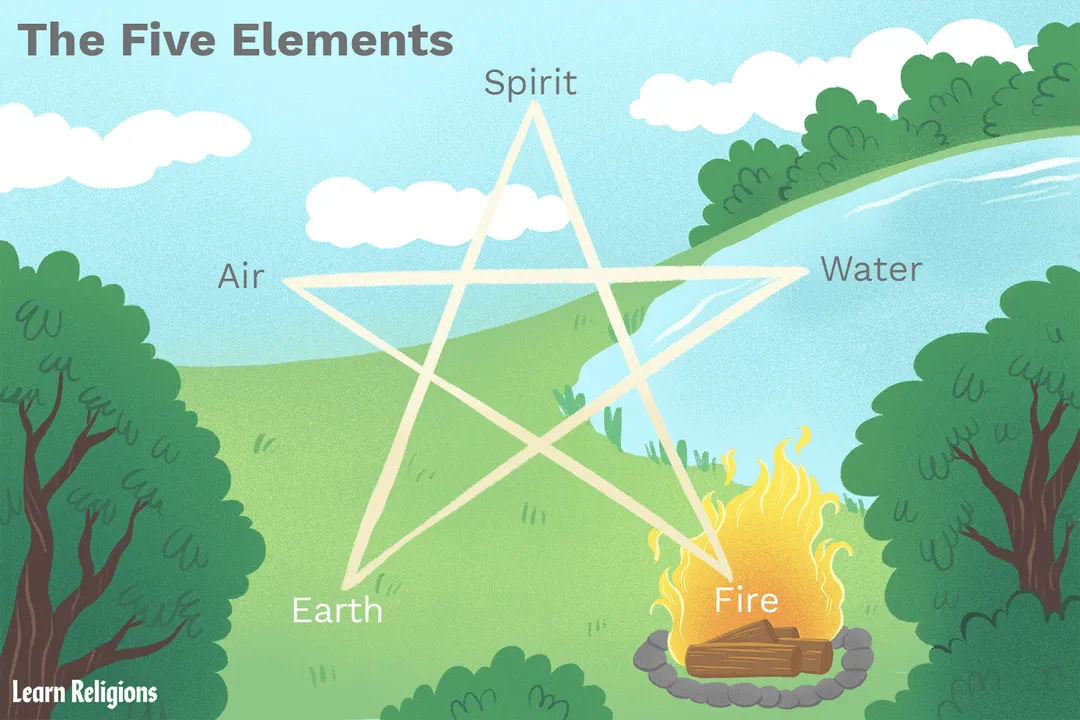
The understanding of elemental composition is foundational to the pursuit of alchemy, representing not just physical matter but also profound philosophical principles that govern change and perfection across various historical and esoteric traditions. While the term "alchemy" often conjures images of transmutation from lead to gold, the real work involved mastering the interplay of fundamental forces, and this mastery began with recognizing the base components of reality itself. Though many associate alchemy with a singular set of components, the concept of "five elements" appears across different schools of thought, necessitating a look at both the dominant Western classical model and its Eastern counterparts to grasp the full scope of this ancient wisdom.
# Classical Foundation
The earliest and most persistent framework in Western alchemy stems directly from ancient Greek natural philosophy, which posited that all matter was composed of four primary ingredients. These four classical elements—Fire, Water, Air, and Earth—were seen as the physical building blocks of the observable world. Alchemists believed that by understanding the nature and relationship of these four, they could effectively manipulate the physical world, attempting to perfect base metals or create the Elixir of Life.
Fire is generally associated with qualities like heat and dryness. It represents energy, action, and passion, the active principle that initiates change. In symbolic representations, Fire is often depicted as an upward-pointing triangle. Water, conversely, is cold and wet, symbolizing fluidity, emotion, and the passive receptivity that allows change to occur. Its symbol is the downward-pointing triangle.
Air is characterized as hot and wet, relating to intellect, communication, and movement, filling the space between the static Earth and the active Fire. Its symbol often involves the upward-pointing triangle with a horizontal line through it. Earth, the final physical component, is cold and dry, representing stability, the material body, and structure. The symbol for Earth is the downward-pointing triangle crossed by a horizontal line. The interactions between these opposing pairs—Fire/Water and Air/Earth—were key to understanding transformation.
# The Fifth Entity
To speak specifically of the five elements in the context of Western alchemy or related philosophy, one must introduce the fifth component that unites and informs the other four: Aether, often called Spirit or Quintessence. This concept is crucial because, while the four elements can transmute into one another (e.g., Water can boil into Air, or freeze into Earth), Aether is often considered the perfect, unchanging substance from which the others derive or to which they return upon purification.
Aether is sometimes described as the celestial element, the stuff of the heavens, distinct from the terrestrial elements confined to the sublunary sphere. In an alchemical sense, achieving the Magnum Opus—the Great Work—often involved not just balancing the four physical elements within a substance, but extracting or fixing the Quintessence within them. If the four elements represent the physical spectrum of existence, Aether represents the spiritual or life-force aspect. For a complete philosophical model, the inclusion of this fifth substance—the unifying principle—is necessary to account for life and consciousness beyond mere physical chemistry. Some modern conceptualizations, even within speculative world-building, explore systems where the elements are six-fold or more, but the classical five almost always hinges on this Spirit/Aether addition.

# Correspondences and Qualities
The power of the elemental system lay in its application. Alchemists and other philosophers (like those working with Ayurveda or Chinese medicine, which utilize their own five-element systems) did not just see Fire as literal flame; they mapped these qualities onto everything. Understanding these correspondences allowed practitioners to predict behavior and guide reactions, whether in the laboratory or in metaphysical contemplation.
| Element | Primary Qualities | Association (General) | Alchemical Symbol |
|---|---|---|---|
| Fire | Hot, Dry | Action, Energy, Masculine | Upward Triangle |
| Water | Cold, Wet | Receptivity, Emotion, Feminine | Downward Triangle |
| Air | Hot, Wet | Intellect, Motion, Communication | Upward Triangle with Bar |
| Earth | Cold, Dry | Stability, Matter, Form | Downward Triangle with Bar |
| Aether/Spirit | Quintessential | Life Force, Perfection, Unity | Circle (Often) |
This mapping suggests that for any substance or process to be considered "complete," it must demonstrate characteristics relating to all these states. For instance, in a physical mixture, an excess of Earth might make it too inert, requiring the addition of active Fire or fluid Water to restore kinetic potential. When we look at elemental alchemy as a psychological practice, the concept becomes even richer; a person struggling with inertia might need to cultivate internal Fire (passion/willpower) to break free from the dense state of Earth (stagnation).
# Divergent Elemental Models
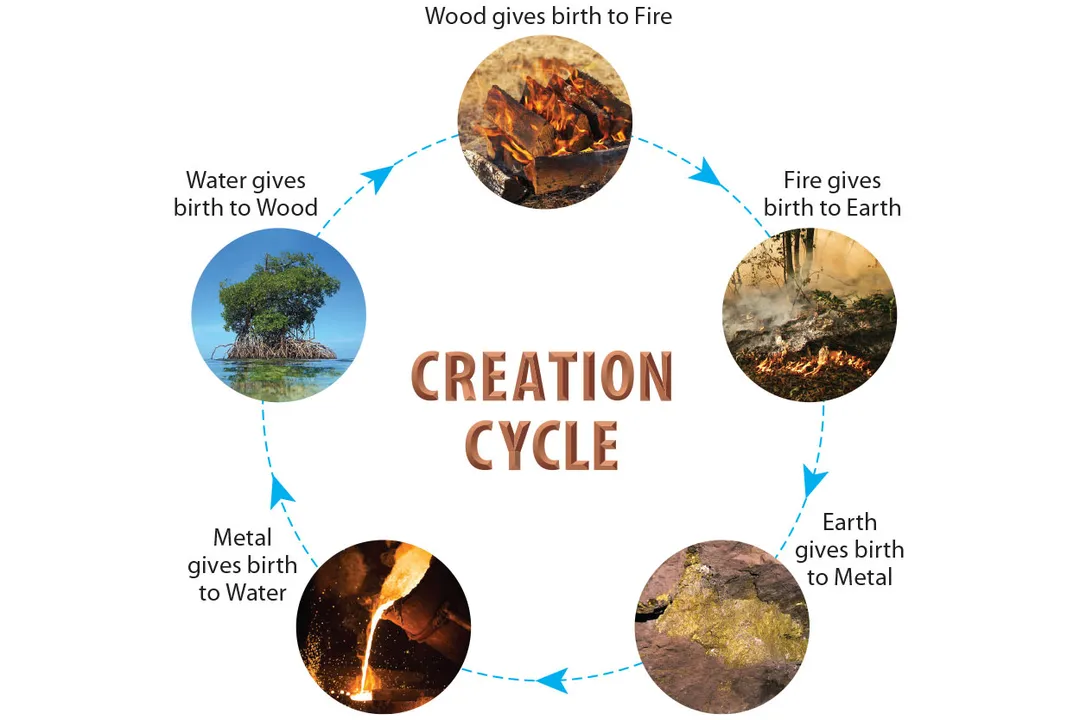
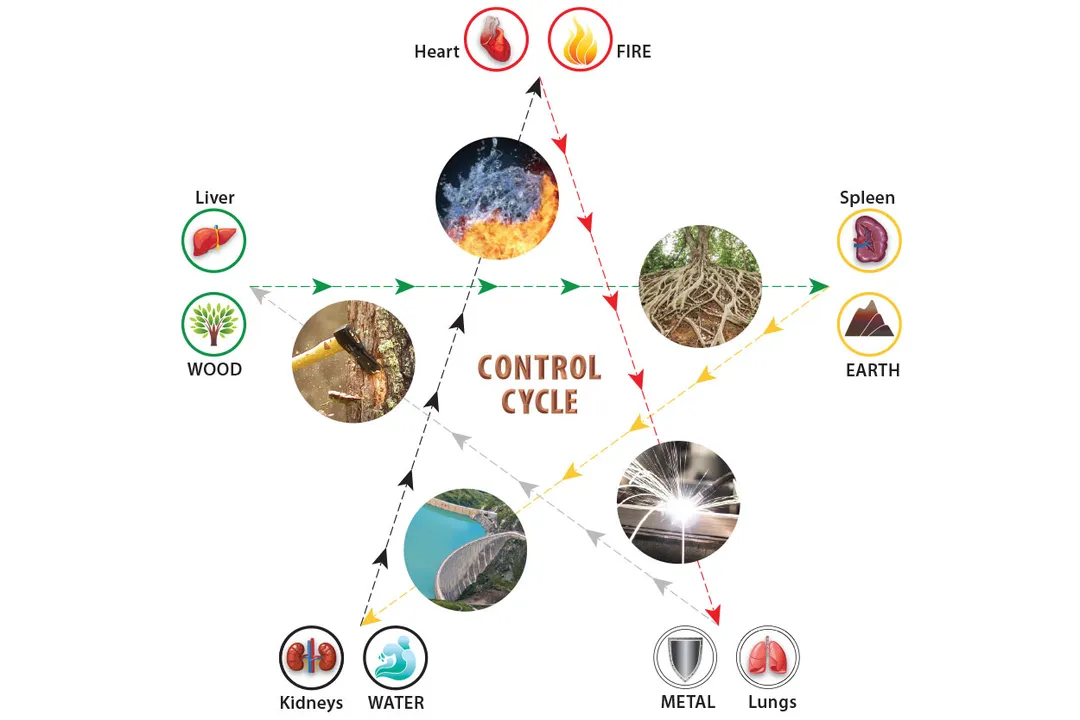
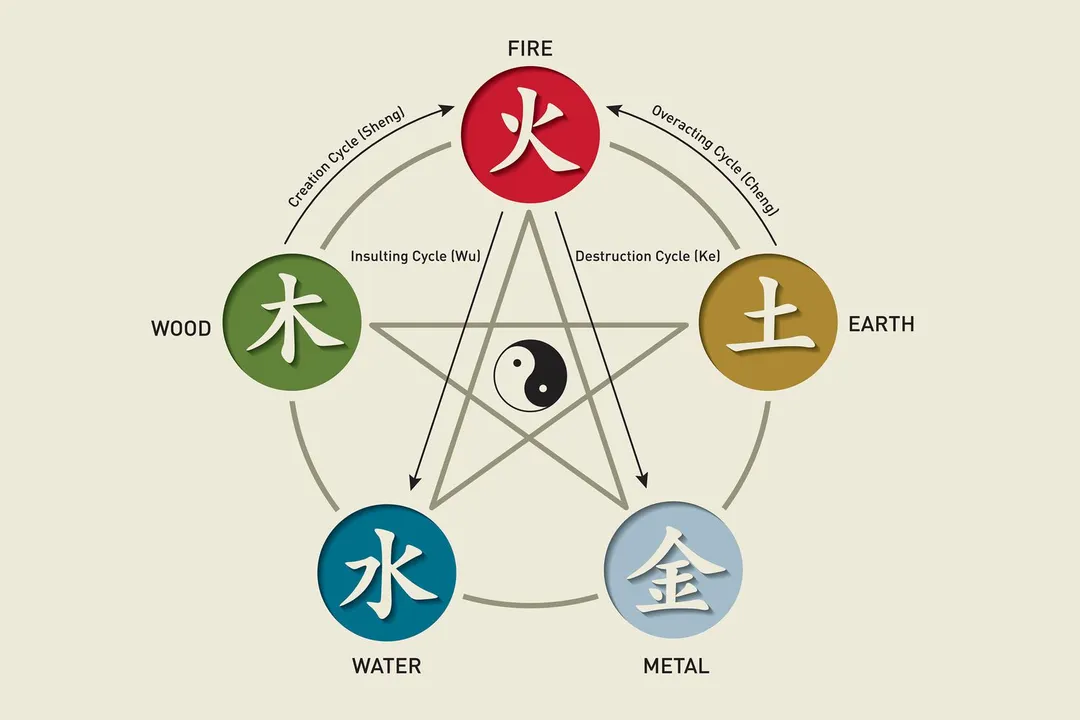
It is important to acknowledge that the "five elements" is a universal concept, not a proprietary one belonging solely to Western Hermeticism. To truly understand the alchemical pursuit of transformation, one must recognize systems that also employ five components, even if their constituents differ significantly. The Chinese system, for example, features Wood, Fire, Earth, Metal, and Water. These elements interact through generative and destructive cycles, forming the basis for traditional Chinese medicine and philosophy.
Similarly, Ayurveda utilizes the five Mahabhutas (Great Elements), which often align closely with the classical Greek/Western model but frame them slightly differently in relation to the body, often incorporating Space or Ether alongside Earth, Water, Fire, and Air. The Ayurvedic perspective emphasizes how these elements manifest in the doshas (Vata, Pitta, Kapha), offering a clinical approach to maintaining the elemental balance necessary for health. While the alchemist focused on achieving physical perfection externally or philosophically, Ayurvedic practitioners sought internal, biological perfection through managing these same universal forces. The key difference lies in the material—Western alchemy often seeking a universal solvent or metal perfection, while Eastern systems focused on balancing the person using the elements as a descriptive language.
This comparative view highlights a crucial point: regardless of the specific five items chosen, the underlying principle is the same: reality is finite, composed of a set number of fundamental, interacting qualities, and perfection (the goal of alchemy) is achieved through their precise calibration.
# Elemental Transformation Checklist
While many historical texts detail esoteric recipes, a simplified, functional approach to these five elements reveals them as a practical checklist for any major transformation project, physical or otherwise. Think of it less as mixing chemicals and more as ensuring all necessary conditions are met for a desired outcome, like producing that philosophical gold or achieving personal enlightenment.
- Define the Earth (Structure): What is the raw material or the fixed, undeniable basis of the work? This is the structure, the discipline, the inert starting point. Without a firm Earth, the energy (Fire) dissipates uselessly, and the flow (Water) has no container.
- Introduce Water (Dissolution): The structure must be broken down or dissolved. This involves dissolution, purification through washing, or confronting the emotional/receptive aspects of the problem. Nothing new can form until the old form is sufficiently taken apart.
- Apply Air (Separation/Movement): Once dissolved, the components must be separated, analyzed, and allowed to circulate. This is the stage of intellect, communication, and separating the useful from the useless residue. It prevents stagnation that leads to putrefaction.
- Ignite Fire (Coagulation/Fixation): The purified components must be subjected to transformative energy—heat, willpower, or active intention—to drive the reaction forward and fix the new form. This is where the energy is concentrated to bind the purified parts into a new, more perfect state.
- Attain Aether (Perfection): The successful combination and cycling of the first four stages ideally results in the manifestation of the fifth—the Quintessence. This is the imprinted quality, the soul of the resulting work, whether it is a perfected metal or a moment of profound personal clarity.
This sequence illustrates an original insight into the mechanics of the process: the elements are not just things, they are actions required for completion. A project fails when one element is missing, not just when one is too strong. If you skip Air (analysis), your Fire (effort) will only cook impurities deeper into the Earth (the base material).
# Balancing the Alchemical Self
Moving away from the laboratory crucible and into the philosophical application—a common aim for many esoteric students of alchemy—the five elements serve as a gauge for personal equilibrium. The pursuit of perfection was often an internal one, aiming for spiritual balance rather than just material wealth.
Consider how one might actively engineer personal balance using this map. If an individual finds themselves overwhelmed by details and unable to initiate action, they are heavily dominated by Earth (rigidity, inertia) and perhaps Water (over-sensitivity). The intervention would be to consciously cultivate Fire (courage, decisiveness) and ensure sufficient Air (clear thinking, communication) to move the heavy Earth out of the way. The goal isn't to eliminate Earth, which provides necessary structure, but to ensure the other elements can move it when required.
This operational view provides another practical takeaway: viewing the elemental system as a constant feedback loop. Modern life, with its rapid shifts in focus, often pushes us toward extremes—either the dry, hot intensity of constant digital Fire (work pressure) or the cold, wet stagnation of Earth/Water (procrastination/emotional overwhelm). True mastery, mirroring the alchemist's search for the Stone, is maintaining the relationship between the forces, recognizing that the element you need most right now is the one you are currently lacking or suppressing. The Aether, in this personal context, is the sense of alignment or purpose that surfaces when the four mundane forces are finally cooperating rather than warring internally. The ability to consciously shift one’s own dominant elemental expression based on the needs of the present moment is perhaps the most accessible form of elemental mastery available to anyone today.
Related Questions
#Citations
Classical element - Wikipedia
The 5 Elemental Symbols: Fire, Water, Air, Earth, and Spirit
An Intro To The Five Elements
Fire, Earth, Air, Water, Ether and Brane. : r/magicbuilding - Reddit
Five Elements Theory - Dragon Herbs
Understanding the Five Elements | Alchemy Learning Center
What Are the 5 Traditional Elements? - ThoughtCo
The Five Element Formulas - Desert Alchemy
Elemental Alchemy: The Five Elements in Ayurveda & Aromatherapy