What are five uses for a telescope?
The simple act of pointing an instrument toward the heavens immediately transforms a familiar night sky into a vista of unimaginable depth and complexity. A telescope, at its most basic, is a device designed to gather light and magnify the image of distant objects, which fundamentally changes what we perceive as possible to view from our own backyard. [8] While many associate them solely with professional observatories or astronauts looking back at Earth, the modern telescope serves a surprising array of purposes, catering to everyone from casual backyard enthusiasts to the most advanced scientific teams. Understanding these varied applications reveals that the instrument is far more than just a fancy magnifying glass; it is a tool for discovery, education, and even terrestrial appreciation.
# Solar Views
Perhaps the most accessible and immediately rewarding use for a new telescope owner is turning the instrument toward our own cosmic neighborhood: the Moon and the planets. [2][7] The Moon is always a spectacular first target, even through modest equipment. Telescopes allow you to see features like craters, mountains, and maria (the dark plains) with striking clarity, revealing textures and shadows invisible to the naked eye. [3][7] Examining the Moon near its terminator—the line separating day and night—maximizes the shadows, enhancing the three-dimensional appearance of the lunar surface. [2]
When observing the planets, the experience shifts from surface detail to atmospheric study and planetary dynamics. Jupiter, for instance, is famous for revealing its four largest moons (the Galilean moons) even in small telescopes, appearing like a tiny, ordered solar system. [3][7] With slightly larger apertures, you might begin to discern the planet's cloud bands and, if luck and steady air permit, perhaps even the Great Red Spot. [2]
Venus, often frustratingly featureless due to its thick cloud cover, can still be observed in its phases, much like our Moon, providing an excellent demonstration of orbital mechanics in action. [7] Mars offers glimpses of its polar ice caps when it is closest to Earth, though seeing surface detail consistently requires excellent atmospheric conditions and high magnification. [2] Saturn remains the crown jewel for many amateur astronomers, as even a relatively small telescope can present the awe-inspiring sight of its rings separated from the main globe. [3] Observing these worlds offers a direct, personal connection to the scale and structure of our solar system, far surpassing what a simple photograph can convey. It is worthwhile to remember, however, that the crispness of these planetary views is heavily dependent on "seeing"—the stability of the Earth's atmosphere; that shimmering or boiling effect you sometimes see means the air currents are blurring the fine details, even if the telescope optics are perfect. [9]
# Deep Space

Moving beyond our Sun's family leads to the realm of deep-sky objects (DSOs), which require the telescope's primary strength: light-gathering power. [8][9] While the naked eye sees only pinpricks of light, a telescope collects that faint, ancient light from distant galaxies, nebulae, and star clusters, allowing these ethereal structures to become visible. [2]
Galaxies are perhaps the most profound deep-sky targets. The Andromeda Galaxy (M31), our nearest major galactic neighbor, can appear as a faint, elongated smudge in small scopes, but a larger aperture reveals more of its central core structure. [3][7] Viewing a galaxy that contains hundreds of billions of stars, light that has traveled millions of years to reach your eyepiece, provides a tangible sense of cosmic scale. [6]
Nebulae, often called "star nurseries," present a different visual spectacle. The Orion Nebula (M42), visible to the naked eye as a fuzzy patch in Orion's sword, transforms in a telescope into a swirling cloud of gas and dust, often showing hints of its characteristic greenish hue, especially near the bright Trapezium stars at its heart. [2][7] Another popular target is the Ring Nebula (M57) in Lyra, which appears as a ghostly smoke ring. [3] These targets demand darker skies, as the light pollution severely washes out the faint, diffuse glow of these massive clouds of interstellar material.
# Star Fields
While the grand structures of galaxies are captivating, another essential use of the telescope is the appreciation of stars themselves, moving beyond simple points of light to reveal subtle relationships and stunning color contrasts. [6] This is where the telescope excels at separating what appears as one bright star into its constituent components, a process called resolving.
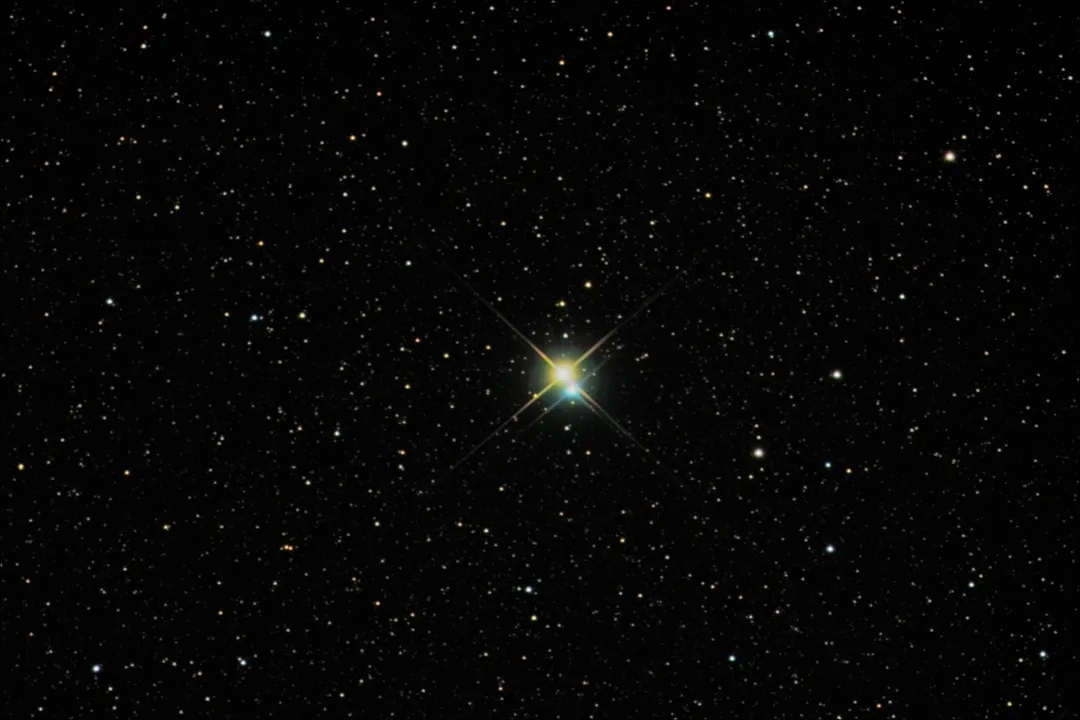
One of the finest examples is the study of double stars or binary systems. These are pairs of stars that appear close together in the sky. While some are optical illusions, many are physically bound, orbiting a common center of gravity. [2] A famous target is Albireo in the constellation Cygnus. To the unaided eye, it appears as a single yellow-white star; through a telescope, it famously splits into a brilliant golden-yellow primary star paired with a fainter, stunning blue companion. [3][7] This contrast is often cited by observers as one of the most beautiful sights in the night sky. [5]
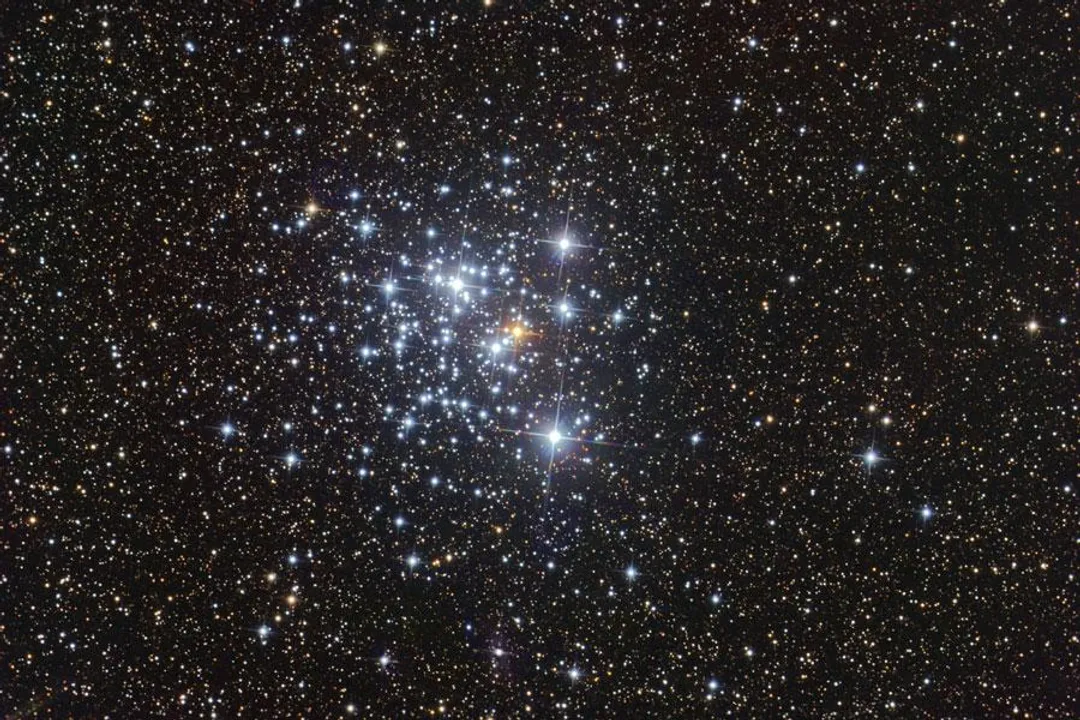
Furthermore, telescopes are perfect for revealing star clusters. Open clusters, like the Pleiades (M45), appear far more densely packed, with dozens of brilliant blue-white stars scattered across a small patch of sky, giving them their "jewel box" nickname. [2][7] Globular clusters, such as M13 in Hercules, look like dense, three-dimensional balls of light packed tightly together. In a good scope, the edges of these clusters begin to dissolve into individual, resolving stars, illustrating how stars are gravitationally bound in spherical structures containing hundreds of thousands of older stars. [3]
# Science Instrument
The use of telescopes extends far beyond recreational stargazing; they are indispensable tools for fundamental scientific advancement, both on Earth and in space. [4][10] Professional astronomy relies on these instruments to collect data essential for understanding the universe, ranging from measuring the distances to nearby stars to mapping the composition of the most distant quasars. [4][10]
Ground-based observatories, such as those operated by the European Southern Observatory (ESO), use massive mirrors—sometimes many meters across—not just to see brighter objects, but to gather enough light from extremely faint, distant sources to conduct detailed spectroscopic analysis. [10] This analysis allows scientists to determine the chemical makeup, temperature, velocity, and gravitational influence of celestial bodies. [10]
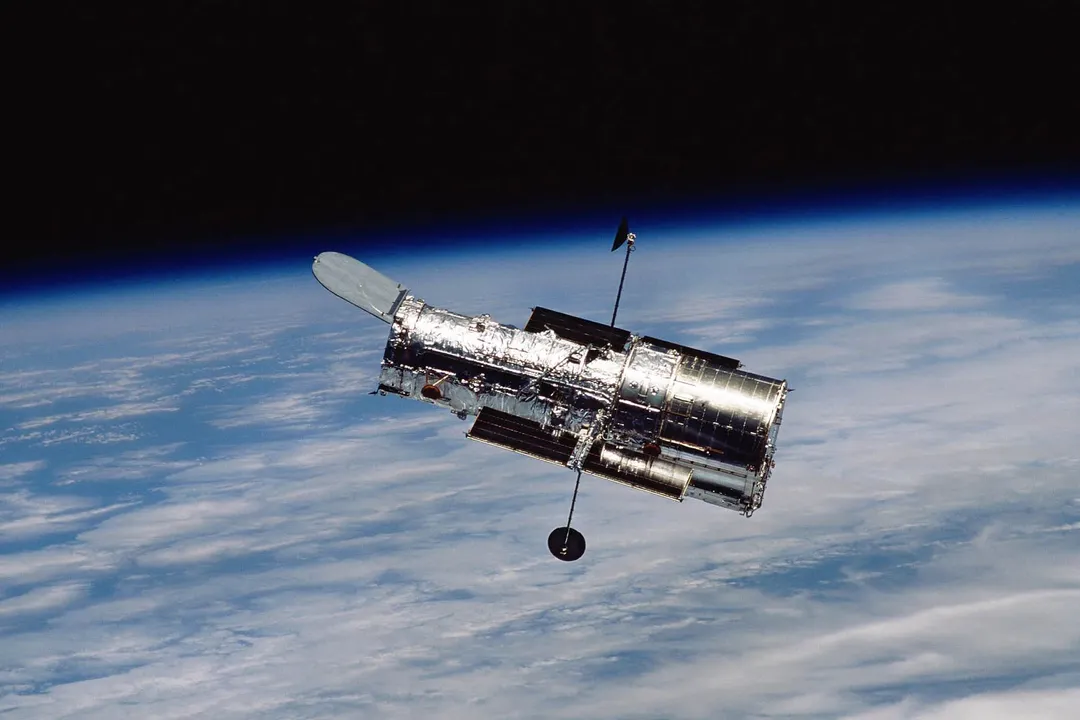
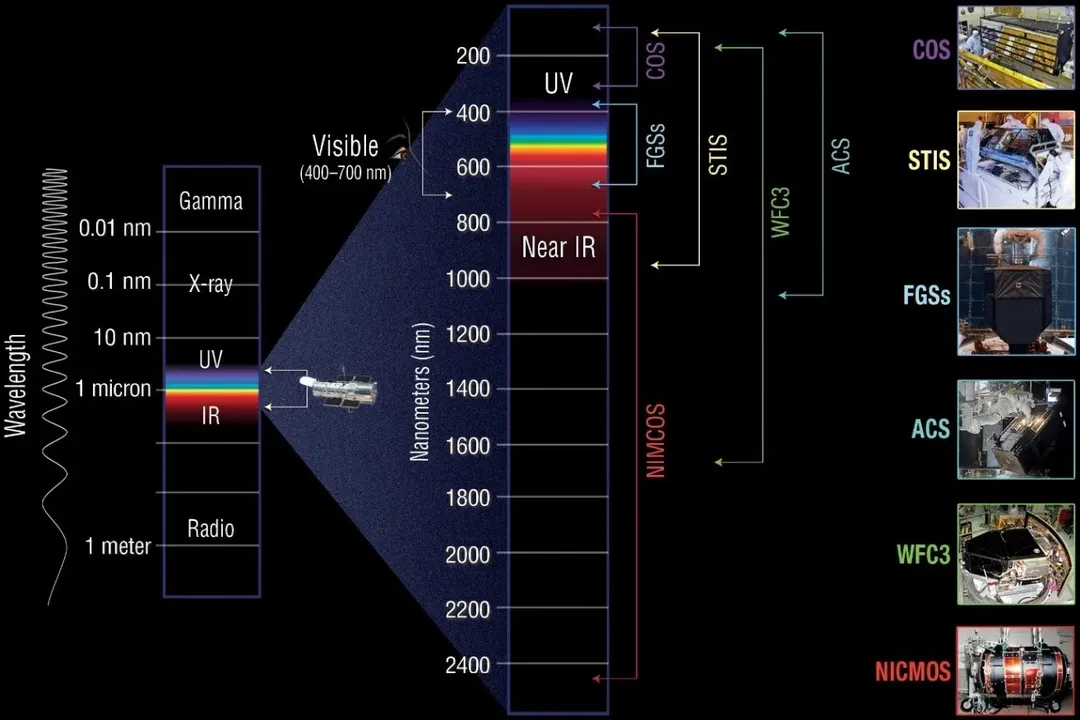
Telescopes placed in orbit, like the venerable Hubble Space Telescope (HST), serve a distinct, critical function: escaping the distortion caused by Earth's atmosphere. [4] The atmosphere absorbs or distorts much of the ultraviolet, infrared, and X-ray light, making observations in those wavelengths impossible from the ground. [4] By placing instruments above this atmospheric veil, scientists can capture pristine data across the entire electromagnetic spectrum, leading to groundbreaking discoveries about dark energy, the expansion rate of the universe, and planet formation. [4] While modern ground-based telescopes employ adaptive optics to correct for some atmospheric blurring, space telescopes remain the only way to achieve truly uninterrupted, wide-spectrum views of phenomena obscured by our planet's air envelope.
# Earthly Views
While the primary association is celestial, the fundamental optical principles that make a telescope effective for astronomy—gathering light and magnifying distant objects—also make it highly valuable for terrestrial observation. [8][6] This use often requires a different type of instrument setup, sometimes involving diagonal correctors to produce an upright image, which are unnecessary for looking at stars that are effectively points of light with no fixed "up" or "down". [7]
For terrestrial use, telescopes function as high-powered spotting scopes. [6] They are favored by birdwatchers, wildlife photographers, and even long-range surveillance or surveying teams. A powerful spotting scope allows an observer to study migratory birds on a distant lake or examine geological features on a faraway mountain slope without disturbing the subject. [6] The added light-gathering capability, which is so useful for faint nebulae, also translates into better performance during low-light conditions, such as dawn or dusk, which are prime times for wildlife observation. [2] It is important for terrestrial observers to choose telescopes designed for this purpose; while an astronomical reflector might theoretically work, refractors or spotting scopes with specialized terrestrial eyepieces are preferred because they provide the necessary upright, correct image orientation and a wider field of view suitable for scanning the horizon rather than the zenith. [7] This practical, everyday application proves the telescope’s utility far beyond the realm of cosmic contemplation.
#Videos
What SHOULD YOU SEE through a TELESCOPE? - YouTube
Related Questions
#Citations
What SHOULD YOU SEE through a TELESCOPE? - YouTube
What can you see with a telescope? - Levenhuk
The 10 Best Things to See With a Telescope | High Point Scientific
Why Have a Telescope in Space? - NASA Science
What's so interesting about looking through a telescope? - Reddit
For what purpose is a telescope used? - Quora
Try These 12 Things with Your New Telescope - Celestron
Telescope - Wikipedia
Most important feature of a telescope - Astronomy Stack Exchange
Technology for Telescopes | ESO - Eso.org