What was the impact of the telescope?
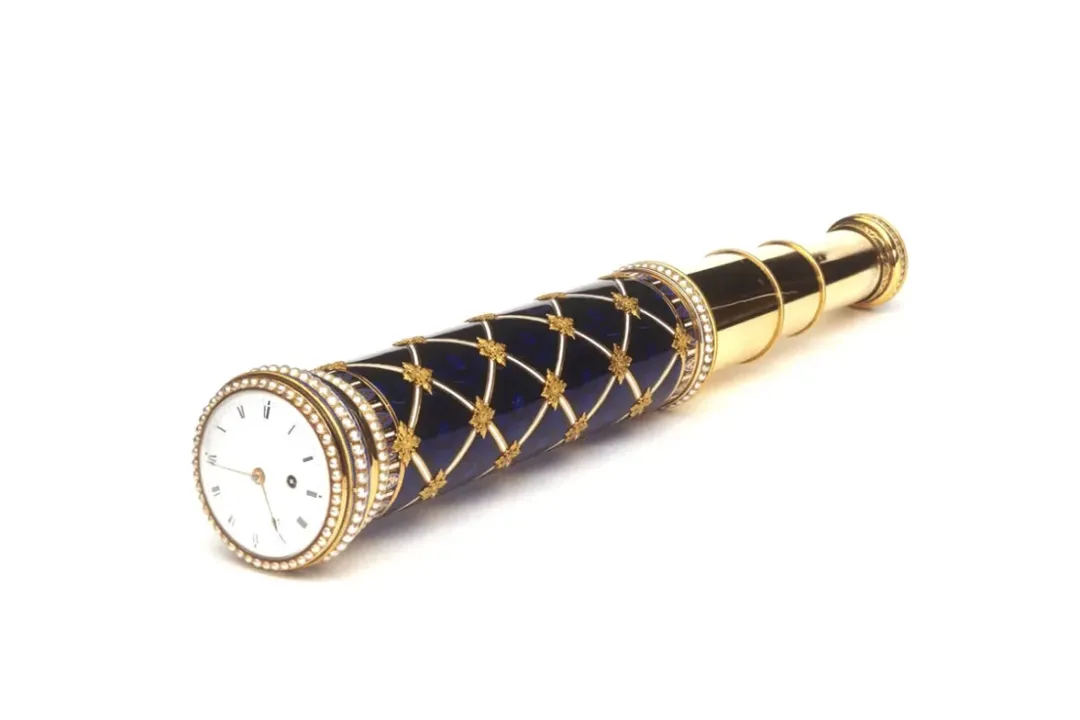
The arrival of the telescope, a seemingly simple arrangement of lenses, fundamentally reshaped humanity's perception of its place in the universe, triggering a cascade of scientific and philosophical upheaval that defines the modern age. Before this instrument appeared in the early seventeenth century, celestial knowledge relied heavily on ancient texts and philosophical reasoning, often placing Earth immovably at the center of all creation. The instrument did more than just bring distant objects closer; it provided the first truly objective view of the heavens, forcing thinkers to abandon established models based on faith in ancient authority in favor of direct, verifiable evidence.
# Initial Optics
The telescope did not spring fully formed into the hands of an astronomer; its origins were rooted in practical craftsmanship in the Netherlands around 1608. Spectacle makers, concerned with crafting lenses for vision correction, found that combining convex and concave lenses in a tube produced magnification. While credit for the initial patent application is often given to Hans Lippershey, other spectacle makers were also producing similar devices around the same time. Initially, these devices were viewed as novelties or tools for terrestrial advantage—for military reconnaissance or for maritime navigation—rather than instruments of profound scientific inquiry. The earliest reported magnification was often quite modest, perhaps only around three times.
# Galileo's Refinement
The true revolution began when the device reached Galileo Galilei in 1609. Galileo didn't invent the concept, but he rapidly understood its potential and significantly improved the design, crafting his own instruments that achieved magnifications of twenty times or more. He turned this improved sight skyward, and what he saw immediately contradicted the prevailing Aristotelian and Ptolemaic systems.
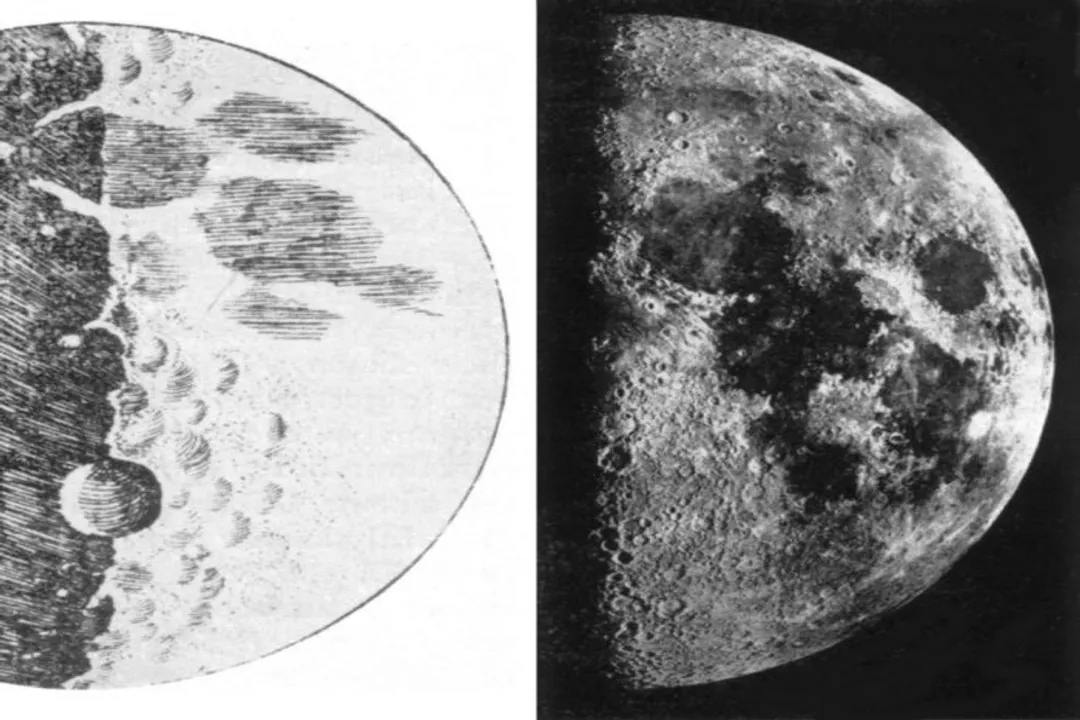
His discoveries were immediate and startling. The Moon, long considered a perfect, smooth sphere as dictated by philosophical expectations, was revealed to be rugged, marked by mountains and valleys, much like Earth. This demonstrated that the heavens were not composed of an entirely different, ethereal substance but shared characteristics with our own world. Perhaps more dramatically, he observed four bright points of light orbiting Jupiter—the first moons ever seen orbiting another planet. This proved definitively that not everything in the heavens revolved around the Earth.
The final, devastating blow to the old cosmology came from observing Venus. Galileo saw that Venus exhibited a complete set of phases, similar to the Moon. This observation was only geometrically possible if Venus orbited the Sun, passing between the Earth and the Sun, a prediction of the Copernican model. These empirical observations, recorded in his 1610 publication Sidereus Nuncius (Starry Messenger), offered direct, visual proof supporting an idea that had previously been relegated to mathematical abstraction.
# Shifting World
The impact on the established cosmic order was profound, driving what many historians consider the start of the modern scientific worldview. The philosophical implication was that if the structure of the cosmos, held as truth for centuries, could be so easily dismantled by looking through a tube, then all established knowledge—whether derived from ancient authority or pure reason—was subject to immediate testing against physical evidence. The telescope established empirical evidence as the primary arbiter of truth in the natural world.
It is fascinating to consider the speed of this transition. The instrument itself was perfected in a matter of months following its arrival in Italy, leading directly to published scientific findings within a year or two. This swift shift suggests that the cultural and intellectual readiness to accept a non-geocentric universe was already present, lying dormant until the right technology provided the irrefutable visual mandate for change. The telescope acted as a catalyst, turning speculation into established fact with unprecedented velocity for the era.
The changes extended even to our own star. Galileo observed sunspots, further confirming that the Sun itself was not a perfect, unchanging heavenly body, but rather an active world subject to change and imperfection.
# Observation Benchmarks
The initial discoveries set a clear standard for what astronomy was about to become, moving away from abstract modeling toward concrete data collection.
| Target Observed | Pre-Telescope View (Ptolemaic/Aristotelian) | Post-Telescope Finding (Galileo/Successors) | Implication |
|---|---|---|---|
| Moon | Perfect, smooth, ethereal sphere | Covered in mountains, craters, and shadows | Heavens share Earth's imperfect nature |
| Jupiter | All objects orbit Earth | Jupiter orbited by four visible moons | Earth is not the sole center of motion |
| Venus | Predicted only crescent phases | Exhibited full range of phases | Required Venus to orbit the Sun (Heliocentrism) |
| Stars | Fixed points of light | Milky Way resolved into countless individual stars | Immensity and depth of the cosmos revealed |
This transition marks a critical departure in scientific methodology. Rather than building a complex mathematical system (a priori) that described what should be seen, astronomers began building theories based on what they actually observed (a posteriori).
# Expanding Vision
The impact of the telescope did not end with Galileo or with visible light. As instrument-making continued to improve, reflecting advancements in glass production and mechanical stability, the capacity for observation grew exponentially. Early telescopes suffered from aberrations—color fringing and distortion—which required further innovation, such as creating very long focal length refractors or moving toward reflecting designs pioneered by Isaac Newton.
Over the centuries, the definition of "telescope" broadened significantly. If the initial revolution was in seeing farther, the next was in seeing differently. Modern astronomy relies on instruments that gather forms of electromagnetic radiation invisible to the human eye. For instance, the Chandra X-ray Observatory is a highly specialized telescope designed to capture high-energy X-rays, which allows scientists to study phenomena like black holes, supernova remnants, and galaxy clusters that emit little visible light.
Similarly, observatories like the Hubble Space Telescope provided clear views unimpeded by Earth’s turbulent atmosphere, pushing observations into the infrared and ultraviolet spectrums, thereby viewing farther back in time and seeing cooler or hotter celestial objects otherwise obscured. The basic principle remains the same—collecting distant information and focusing it—but the "light" being collected has expanded to encompass the entire electromagnetic spectrum.
The difference between an early 17th-century astronomer using a 30x refractor and a modern astrophysicist analyzing data from the James Webb Space Telescope highlights this evolution. While Galileo was shocked to find that the heavens were imperfect, modern researchers are shocked by the sheer complexity and diversity of the physical processes occurring across the cosmos that the various telescopes reveal.
# Societal Context
It is important to realize that the telescope's impact was not purely academic; it had tangible social and political consequences rooted in challenging established authority. The scientific revolution, sparked in part by these visual proofs, involved a shift in who held epistemic authority—moving it from established religious or classical textual interpretations toward empirical demonstration. When the Church contested Galileo’s findings, the argument was not just about physics; it was about the source of legitimate knowledge itself. The instrument democratized sight, giving individuals the power to verify grand cosmological claims for themselves, even if only those with access to the instrument could replicate the initial proof.
For someone looking to engage with astronomy today, understanding this historical context provides a valuable lens. When we look at images from modern observatories, we are seeing the culmination of this shift. The accessibility of these images, often shared freely by organizations like NASA or the ESA, represents the fulfillment of the promise Galileo began—making the universe observable to many, not just the few who could afford or build the specialized equipment. This open access to complex data, while sometimes overwhelming, underscores the enduring value of direct observation that the telescope first championed centuries ago. The initial resistance to Galileo stemmed from the fear that seeing was believing, and what they saw contradicted the very foundations of their established order.
#Videos
How the Telescope Changed Everything We Know About the Universe
Related Questions
#Citations
Galileo and the Telescope | Modeling the Cosmos | Digital Collections
[PDF] - How Telescopes Changed our Understanding of our Universe
Telescopes | Center for Astrophysics | Harvard & Smithsonian
Q and A of the Day: How Have Telescopes Changed Things?
The Telescope – Science Technology and Society a Student Led ...
How the Telescope Revolutionized Our World and Ignited…
The Telescope – Science, Technology, & Society: A Student-Led ...
The Telescope & the Scientific Revolution
The history of the telescope | Royal Museums Greenwich
How the Telescope Changed Everything We Know About the Universe