What are the largest three telescopes in the world?

The quest to understand the cosmos is inextricably linked to the size of the instruments we use to capture light from the deep. For ground-based astronomy, this often boils down to a race for the largest primary mirror—the light bucket that defines a telescope’s potential. However, the title of "largest" is more complicated than a single diameter measurement; it depends on whether we count the physical area of the mirror, the effective area from a segmented design, or the combined power of an array. Looking strictly at single-instrument, single-mount optical reflecting telescopes that are currently operational, the very top tier is defined by mirrors approaching or exceeding ten meters, with the largest claiming an effective aperture well over eleven. These are the giants that stand as the current vanguard of visible and infrared light astronomy here on Earth.
# The Dual Approach
The current reigning champion, when measuring by equivalent light-gathering ability on a single mount, is the Large Binocular Telescope (LBT), situated atop Mount Graham in Arizona, USA. The LBT’s architecture is unique among the largest; it is not a single massive mirror, but rather two 8.4-meter primary mirrors mounted side-by-side on the same structure. This dual setup grants it an impressive 11.9-meter effective aperture. This design choice represents a fascinating engineering compromise. Instead of tackling the immense structural challenges of forging and supporting a single 12-meter-plus mirror, the LBT combines the light from two separate, more manageable (though still gigantic) mirrors. This allows astronomers to use it as a single aperture, or even as an interferometer to achieve much higher resolution by treating the mirrors as a pair separated by 22.8 meters. The LBT's capability to pool light in this manner means it can capture data with a clarity and depth that pushes the boundaries of what ground-based telescopes can achieve.
# Spain’s Segmented Powerhouse
Just below the LBT in terms of overall light-gathering power is the Gran Telescopio Canarias (GTC), located on the volcanic peak of La Palma in the Canary Islands, Spain. The GTC boasts a primary mirror diameter of 10.4 meters. Unlike the LBT, the GTC achieves this scale using a segmented design, composed of 36 hexagonal segments that function together as one cohesive surface. This segmented mirror approach has become a hallmark of modern ultra-large telescopes because constructing and polishing a single monolithic mirror larger than about 8 meters is extraordinarily difficult and expensive. The GTC, which captured its first light in 2006, is a testament to international cooperation, backed by partners including Spain, Mexico, and the United States. Its position in the dark, stable skies of La Palma makes it ideally suited for peering out to observe the most distant and faint objects in the universe, from the formation of new stars to the relics of the Big Bang.
# The 10-Meter Tier
The next cohort of largest telescopes all cluster around the 10-meter mark in diameter, representing a significant milestone in astronomical engineering. While the GTC sits just above this threshold, telescopes like the Hobby–Eberly Telescope (HET), the Keck twins, and the Southern African Large Telescope (SALT) share this monumental scale.
# A Fixed Viewpoint
The Hobby-Eberly Telescope, located at the McDonald Observatory in Texas, USA, is particularly noteworthy for its atypical mounting system. While most large telescopes sweep the sky by tilting their entire structure, the HET is built with its massive mirror fixed at a 55-degree tilt relative to the horizon. This design, which uses 91 hexagonal segments to form an 11m by 9.8m mirror surface, significantly reduces the complexity and cost associated with large moving structures. Despite this fixed posture, the telescope’s rotating floor mechanism allows it to observe approximately 70 percent of the visible sky—a remarkable feat that includes observing exceptionally distant quasars. It is interesting to note that the HET’s design was inspired by its near-twin in South Africa, SALT, which shares the same foundational concept of a fixed, tilted array.
# The Productive Twins
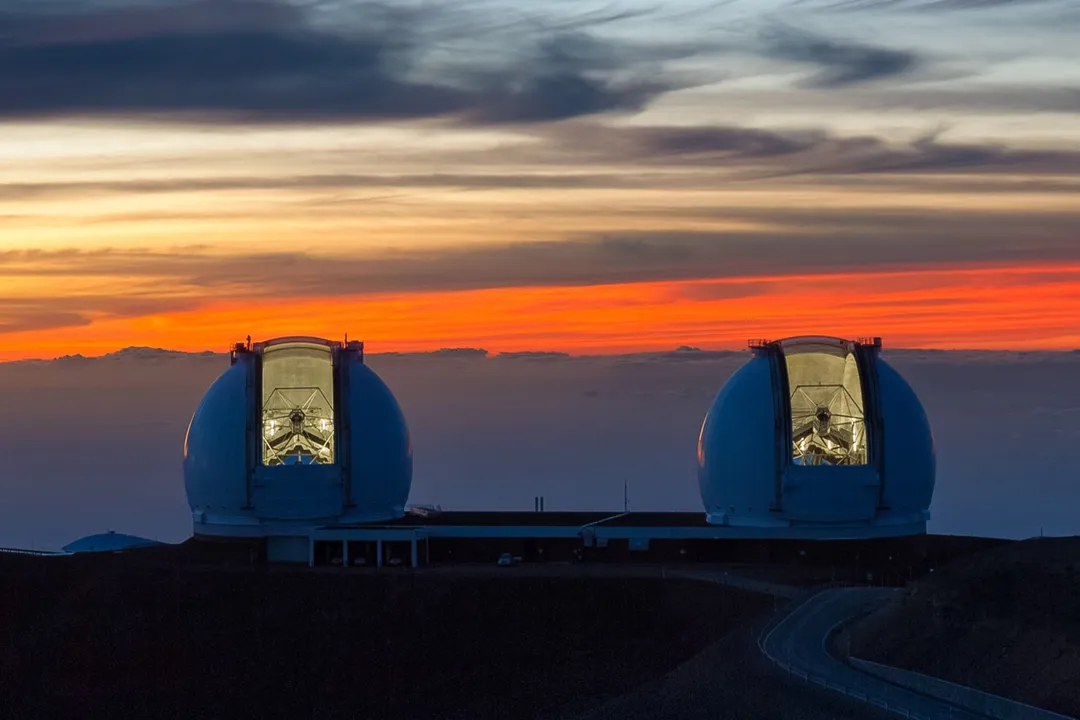
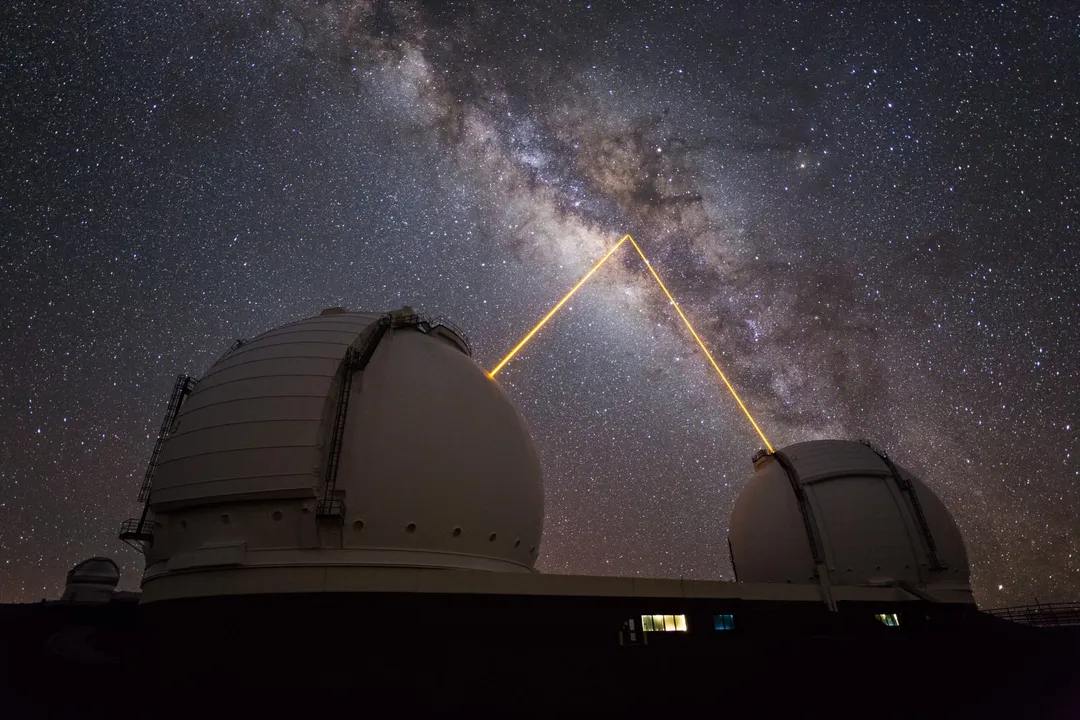
Operating from the high, clear slopes of Maunakea in Hawaii, the W. M. Keck Observatory hosts two identical telescopes, Keck I and Keck II, both boasting 10-meter primary mirrors made from 36 hexagonal segments. While their aperture size places them in the same class as HET, the Keck telescopes are often distinguished by their operational history and scientific output. The Keck twins are widely considered the most scientifically productive optical and infrared ground-based telescopes globally. Their success isn't just about size; it’s about the technology they employ to fight the blurring effects of Earth's atmosphere.
One of the most compelling aspects of the Keck setup is its Adaptive Optics (AO) system. Atmospheric turbulence causes starlight to twinkle, effectively washing out fine detail. Keck scientists developed AO systems that measure this distortion and correct the mirror shape up to 2,000 times per second using deformable mirrors. This real-time correction allows the Keck telescopes, especially in the near-infrared spectrum, to consistently produce images with greater crispness and detail than even the venerable Hubble Space Telescope.
A key difference between the HET/SALT design and the Keck/GTC design lies in how the segments are managed. While HET and SALT use 91 segments for their respective designs, the Keck telescopes use 36 segments each, and this system allows for extraordinary precision; the surface of each segment is polished so smoothly that if scaled to the size of Earth, the imperfections would be only about three feet high. Furthermore, Keck I and II were initially intended to work together as a larger interferometer, though that funding path did not fully materialize, they remain twin workhorses for simultaneous observations.
# Beyond Aperture: Contextualizing Scale
It is vital for the general reader to understand that simply having the largest mirror diameter does not automatically confer the best performance. As the Wikipedia entry points out, factors like location—the dryness and stability of the atmosphere—and specialized technology like active and adaptive optics are equally important. Space telescopes, while unable to match these sheer physical dimensions due to launch constraints, bypass the atmosphere entirely, offering resolution advantages that ground-based systems must constantly fight to overcome.
Consider the light-gathering power leap: The Hale Telescope, a monumental achievement of the mid-20th century, featured a 5.08-meter primary mirror. Its light-collecting area was roughly 20 square meters. By contrast, the LBT’s effective aperture of 11.9 meters translates to an equivalent light-collecting area over 111 square meters. This means that for the same exposure time, the LBT gathers more than five times the light of the Hale, which is a generational leap in capability for observing faint, ancient phenomena. The engineering philosophy has shifted from building the largest single mirror possible to building the largest effective aperture through clever segmentation or dual configuration, something the LBT exemplifies perfectly.

# The Future Arena
While LBT, GTC, and HET represent the pinnacle of current operational optical astronomy, the ground is already being broken on the next tier—the truly Extremely Large Telescopes (ELTs)—which will dwarf the current leaders. The move is toward primary mirrors exceeding 20 and even 30 meters.
The Giant Magellan Telescope (GMT), currently under construction in the Chilean Andes, is slated to become the largest optical telescope in the world upon its expected completion around 2029. The GMT achieves its immense scale not with a single mirror, but with seven monolithic 8.4-meter mirrors arranged hexagonally, providing an effective aperture equivalent to a 24.5-meter mirror. This places its light-gathering power far beyond the current 10-meter class. The Smithsonian Astrophysical Observatory is involved in developing the G-CLEF spectrograph, which, when paired with the GMT, aims to detect Earth-sized planets in the habitable zones of distant stars.
Even larger is the Extremely Large Telescope (ELT), designed by the European Southern Observatory (ESO) and planned for first light around 2027 or 2029, situated in Chile's Atacama Desert. The ELT will feature a staggering 39.3-meter primary mirror. Its light-collecting surface area will be so significant that it will gather 100 million times more light than the unaided human eye, with goals centered on discovering Earth-like worlds and searching for life beyond our solar system. These future instruments underscore a fundamental truth: while today's giants allow us to probe the universe's history, the engineering drive for sheer light-gathering power ensures that tomorrow’s telescopes will ask even deeper questions.
Related Questions
#Citations
List of largest optical reflecting telescopes - Wikipedia
The 10 biggest telescopes on Earth - Space
10 Largest Optical Telescopes in the World - Go-Astronomy.com
Telescopes – W. M. Keck Observatory
The Giant Magellan Telescope | Smithsonian Global
Top Ten: Extreme Telescopes - National Geographic