How did the telescope affect society?
The arrival of the telescope was not merely an incremental improvement in vision; it was a cultural detonation that fundamentally altered humanity’s perception of itself and its place in the universe. Before this simple instrument, the cosmos was a realm governed by perfect celestial spheres, unchanging and eternally distant, existing as an ethereal blueprint upon which terrestrial life played out its drama. [8] The immediate impact, following its initial appearance around 1608, was a rapid destabilization of this worldview, transforming what had been a matter of faith and ancient texts into a field of observable, testable fact. [5][6]
# Optical Beginnings
The invention itself is somewhat murky, often attributed to spectacle makers in the Netherlands, with Hans Lippershey and Jacob Metius frequently mentioned in early patents around . [1] While the initial focus was likely military or terrestrial, it was the subsequent application by Galileo Galilei that truly ignited the revolution. [1][6] Galileo did not invent the telescope, but he significantly improved its magnification and, critically, aimed it skyward, documenting what he saw with meticulous detail. [6]
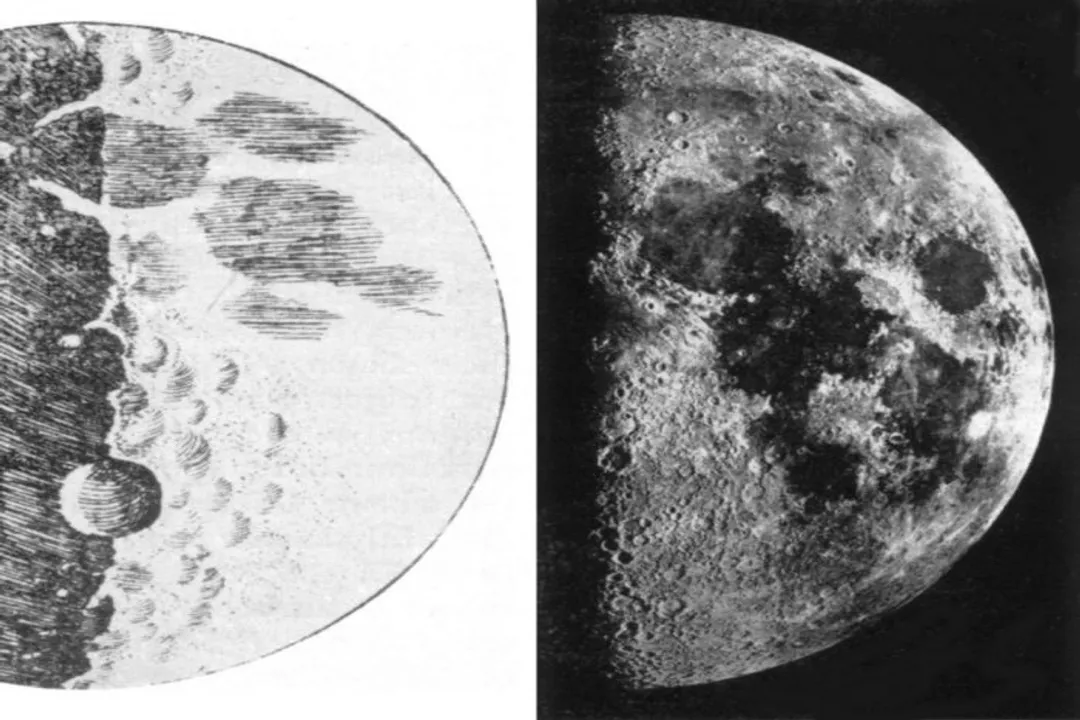
Galileo’s early instruments had magnifications around three times, but he quickly advanced them to around times power. [1] This leap in capability revealed a heavens far more complex and flawed than classical understanding allowed. For instance, observing the Moon, he saw mountains and valleys—features suggesting a world akin to Earth, contradicting the Aristotelian notion of perfect, crystalline celestial bodies. [6][8] This observation alone chipped away at the fundamental philosophical division between the corruptible Earth and the immutable heavens. [5]
# Cosmic Proof

The most devastating blow to the established cosmology came from the observation of Jupiter. Galileo discovered four celestial bodies orbiting it: the Medicean Stars, now known as the Galilean moons. [1][6] This offered a tangible, miniature model of the solar system demonstrating that not everything revolved around the Earth. [5][6] If Jupiter had moons circling it, the Earth could not be the sole center of all motion. [3]
Furthermore, observing the phases of Venus provided what many astronomers considered irrefutable evidence for the Copernican, or heliocentric, model. [6][8] If Venus orbited the Sun, it would exhibit a full range of phases, much like Earth's Moon, which is precisely what Galileo documented. [1][5] Contrast this with the older Ptolemaic system, which predicted only a limited set of crescent phases for Venus. [6] These direct observations created a profound disconnect between what learned institutions taught and what a person could verify with their own eyes using a comparatively simple optical tube. [4]
The shift was not instantaneous; it required more than just data. Consider the societal inertia: for centuries, theological and philosophical authority derived immense power from being the sole interpreters of the cosmos. [5] The telescope, in essence, provided a secondary, accessible source of truth. The true societal impact wasn't just the discovery of Jupiter's moons, but the necessary, slow cultural process of accepting that empirical data, gathered by an individual using a new tool, could overturn deeply entrenched doctrines of the Church and ancient authorities like Aristotle. [4][8] This established a new precedent: observation and measurement held a specific, powerful place in determining reality, a concept that would feed directly into the scientific method.
# Authority Undermined
The ability to see contradicted what people were told to believe, leading to significant friction that extended well beyond astronomy. [8] When the prevailing scientific and religious consensus—the geocentric model—was visibly disproven through empirical evidence, it created a crisis of epistemological authority. [4][5] If established scholars were fundamentally wrong about the structure of the heavens, what else were they wrong about?
This crisis touched every facet of structured thought. While the initial focus was on cosmology, the underlying effect was a shift in trust from inherited, ancient wisdom toward direct, empirical investigation. [8] This feeling of intellectual liberation, driven by the technology, encouraged questioning in other areas, setting the stage for the broader Enlightenment period. [4] In a way, the telescope served as a physical manifestation of the emerging scientific method, demanding reproducible results over received wisdom. The technology did the heavy lifting, but the societal shift came from the willingness to accept what the technology revealed.
For those on the fringes of intellectual life, this instrument democratized vision. While Galileo’s original, high-quality instruments were expensive and controlled, the principle was established: one did not need divine revelation or esoteric knowledge to understand the universe; one needed the correct lens. [1] This early parallel to modern citizen science—where anyone with access to a good pair of binoculars or a small telescope can replicate foundational observations—began the slow process of pulling celestial knowledge out of the cloister and into the public sphere.
# Evolution Of Sight
The initial impact stemmed from the small refractor telescope, but the societal effect continued as the technology itself improved. As astronomers sought fainter, more distant objects, the limitations of early lens-based refractors became apparent—chief among them chromatic aberration, where colors separate, causing fuzzy images. [2]
This limitation spurred the next major technological leap: the development of the reflecting telescope. Isaac Newton, among others, recognized that using mirrors instead of lenses could eliminate this chromatic distortion. [2] By the late and early centuries, reflectors offered sharper views, pushing the boundaries of what could be resolved in the night sky. [1][2]
The progression of telescope technology is itself a societal story of continuous refinement driven by curiosity:
| Telescope Type | Key Innovation | Primary Societal Impact Catalyst |
|---|---|---|
| Refractor (Early) | Magnification to | Direct observation challenging geocentrism [6] |
| Reflector (Newtonian) | Use of mirrors to reduce color distortion | Allowed for sharper resolution of deep-sky objects [2] |
| Large Aperture Ground Telescopes | Increasing mirror size | Mapping of the galaxy; discovery of other galaxies [2] |
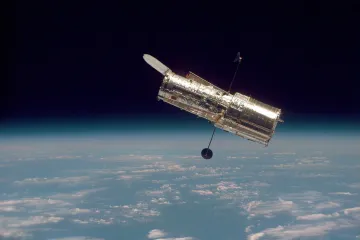
| Space-Based Observatories | Removal from atmospheric distortion | Access to previously invisible light spectrums (UV, X-ray) [7] |
This technological arms race didn't just benefit pure astronomy. The need for increasingly precise mirrors and mounts drove advances in glassmaking, optics grinding, and mechanical engineering—skills that had broader industrial applications. [2] The drive to see farther outward spurred precision mechanics here on Earth.

# New Skies
The influence of the telescope evolved as its reach extended past the solar system. Early reflectors allowed astronomers to map the structure of the Milky Way, revealing it as a vast collection of stars rather than a diffuse cloud. [2] Later, in the century, larger telescopes provided the evidence that "spiral nebulae" were, in fact, separate galaxies, massively expanding the perceived size of the universe. [2][10] Edwin Hubble's work, for instance, showed that the universe was not static but expanding, a discovery built upon decades of increasingly powerful optics. [10]
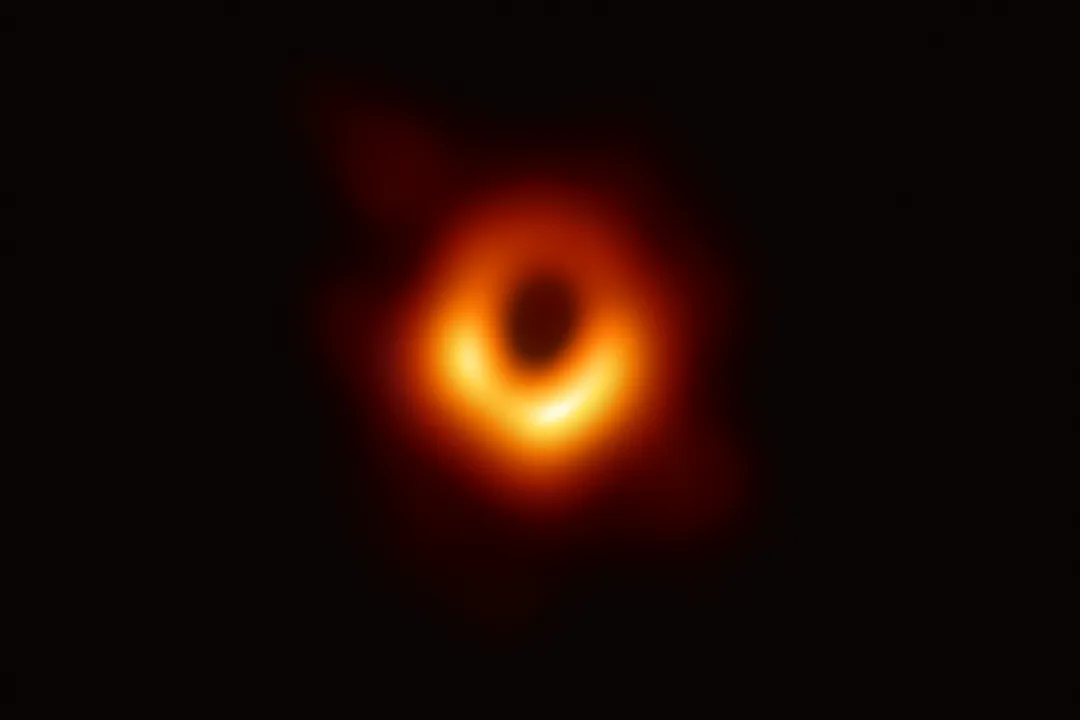
The impact accelerated dramatically when technology allowed us to look beyond visible light. Telescopes are no longer just looking for things that shine in the optical spectrum. We now have instruments designed to capture X-rays, infrared, radio waves, and gamma rays. [7] For example, the Chandra X-ray Observatory detects high-energy radiation from extreme cosmic events like colliding galaxies or matter spiraling into black holes—phenomena completely invisible to Galileo’s simple refractor. [7]
This multi-wavelength approach has added entirely new layers of understanding. It demonstrates that the universe is an incredibly dynamic place, full of violent, energetic processes that only the new generations of specialized telescopes can reveal. [10] If the telescope initially showed us a different cosmos, these modern instruments show us a wilder cosmos than ever imagined.
# Cultural Expansion
The effect on the collective human psyche is perhaps the hardest to quantify but the most profound. The telescope forced a transition from a small, Earth-centered universe to a potentially infinite cosmos containing countless stars, likely with countless worlds orbiting them. [3][10] This forced a re-evaluation of human exceptionalism.
The sheer scale revealed by the instrument has a humbling effect. When we look through a modern telescope, whether optical or radio, we are looking back in time, as the light from distant objects takes millions or even billions of years to reach us. [9][10] This direct, visual connection to deep time and vast space provides an immediate, visceral sense of history and scale that written accounts struggle to convey. Seeing the faint smudge of the Andromeda Galaxy, knowing its light began its trip before Homo sapiens dominated the planet, offers a tangible perspective on our own chronology. [3]
This technological tool has also become central to education and public engagement. Public observing nights, planetariums, and amateur astronomy clubs are direct descendants of Galileo’s initial startling revelations. [4] The desire to simply look remains a primary driver. While the professional telescopes are massive, multi-billion-dollar collaborations managed by global agencies like NASA, the public engagement relies on the same fundamental principle: seeing is believing. [2]
The telescope, in its various forms, anchors our relationship with the unknown. It doesn't just provide data for astrophysicists; it provides a shared, tangible goal for humanity—the desire to see what is next, what is farther, and what is happening right now in the most remote corners of existence. [2][9] It moved cosmology from philosophy to observational science, forever changing how we define 'reality' and where 'we' fit within it. The instrument proved that the most radical changes in human understanding often begin not with a new theory, but with a better way to see the old facts.
Related Questions
#Citations
The Telescope – Science, Technology, & Society: A Student-Led ...
Telescopes | Center for Astrophysics | Harvard & Smithsonian
[PDF] - How Telescopes Changed our Understanding of our Universe
How the Telescope Revolutionized Our World and Ignited…
The Telescope – Science Technology and Society a Student Led ...
Galileo and the Telescope | Modeling the Cosmos | Digital Collections
Q and A of the Day: How Have Telescopes Changed Things?
The Telescope & the Scientific Revolution
How the Telescope Changed Our Minds - WIRED
Journey through Time and Space —The Revolutionary Role of ...