How does mass affect stellar lifespan?
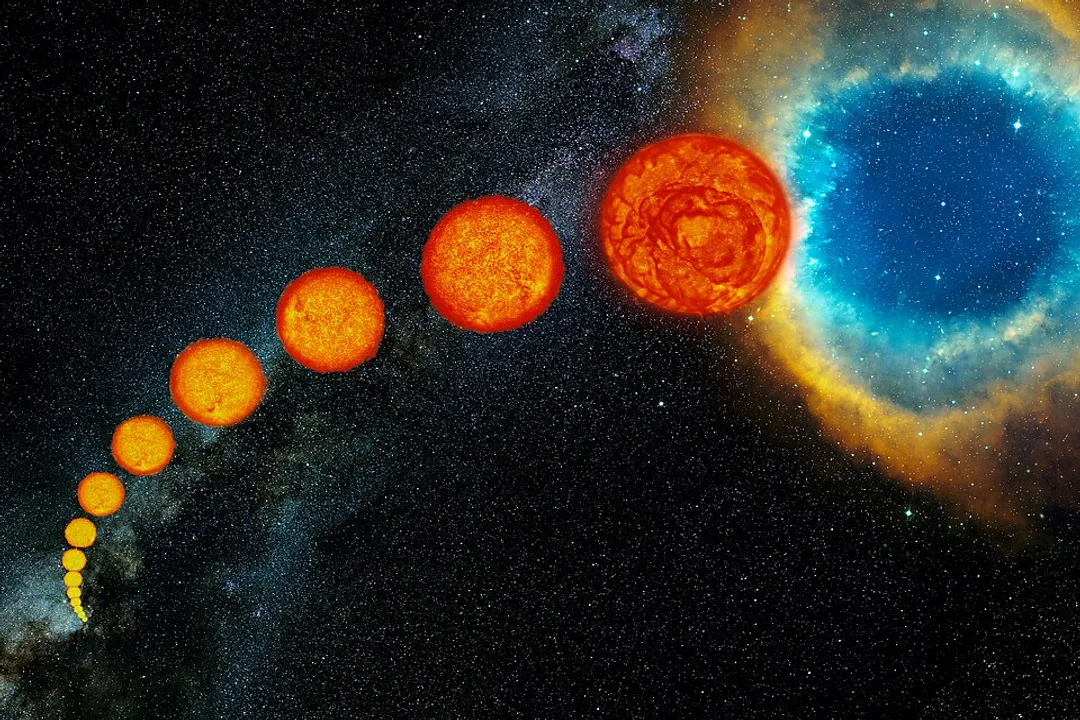
The fundamental question driving the entire life story of a star, from its glowing youth to its dramatic end, boils down to one single property: its initial mass. It is tempting to think that a star containing more fuel—more mass—should naturally last longer. While it is true that more massive stars do have more hydrogen to burn, their existence is dictated by a brutal, non-linear trade-off: the more mass a star possesses, the exponentially shorter its lifespan will be.
# Fuel Burn Rate
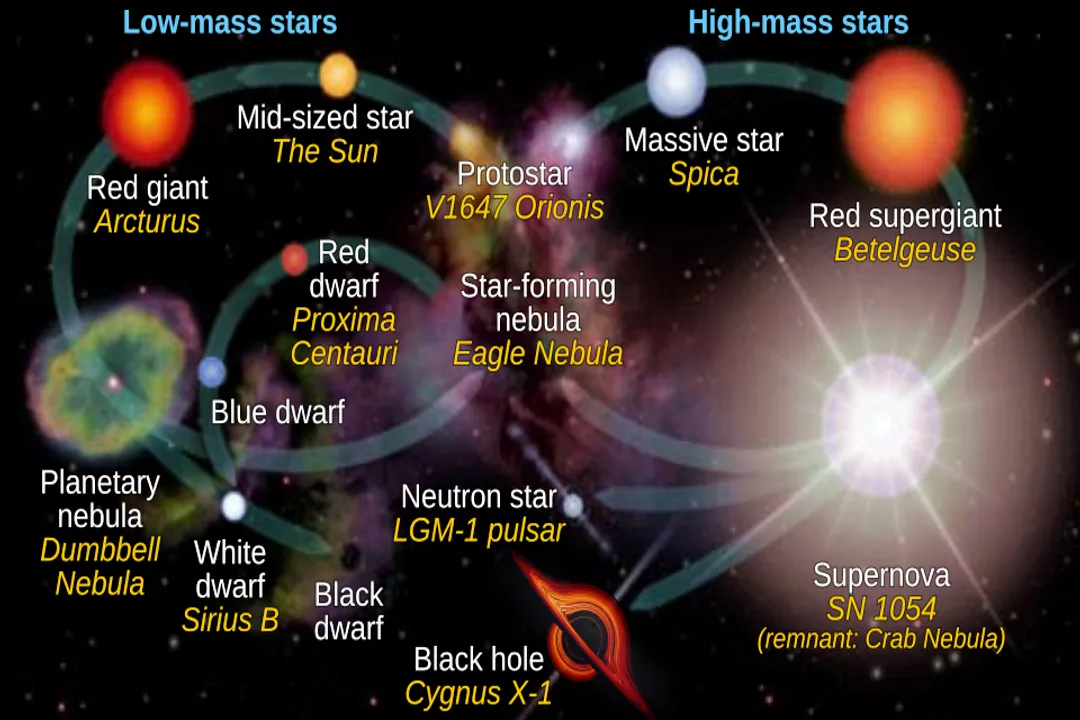
A star maintains stability, a state called hydrostatic equilibrium, through a perfect internal balancing act: the immense inward crush of gravity must be perfectly countered by the outward pressure generated by nuclear fusion in its core. When a star forms with greater mass, the gravitational force compressing its interior is proportionally greater. To resist this stronger squeeze, the core must generate a much higher internal pressure.
This need for greater pressure translates directly into higher core temperatures. In the stellar furnace, temperature is the dial that controls the reaction rate. Higher core temperatures translate directly into a vastly accelerated rate of nuclear fusion, which means the star burns its primary fuel—hydrogen—at a truly prodigious rate.
This relationship between mass and the rate of fuel consumption, or luminosity (), is empirically defined by the Mass-Luminosity Relationship for main-sequence stars. While the exact exponent can vary slightly, a commonly accepted approximation demonstrates this fierce scaling:
For every increase in mass, the luminosity increases by a factor raised to the power of 3.5. A star only slightly more massive than the Sun, therefore, shines much, much brighter, effectively running its engine at a much higher, more destructive RPM.
# The Inverse Lifespan

To estimate the total time a star can sustain itself on the main sequence—fusing hydrogen in its core—we consider the simple ratio of available fuel to the consumption rate:
By substituting the mass-luminosity relation () into this lifespan equation, the relationship becomes clear:
This inverse square-root-of-the-power relationship () is the key to stellar destiny. It means that the increased fuel supply in a heavier star is completely overwhelmed by the explosive increase in its energy output.
To put this into perspective, consider the following scaling, based on this general relationship, which illustrates the non-linear effect of mass on longevity:
| Initial Stellar Mass () | Relative Fuel Mass | Relative Luminosity (Burn Rate) | Approximate Main Sequence Lifetime |
|---|---|---|---|
| $0.1$ (Red Dwarf) | $0.1$ | Trillions of Years | |
| $1.0$ (Sun-like) | $1.0$ | $1.0$ | Billion Years |
| $10$ (Massive Star) | $10$ | Million Years |
A star ten times the mass of our Sun has ten times the fuel, yet it burns that fuel roughly 3,162 times faster, resulting in a lifetime that is over 300 times shorter than the Sun's, not just ten times shorter. This is why the most luminous stars are also the shortest-lived.

# Low Mass Stars
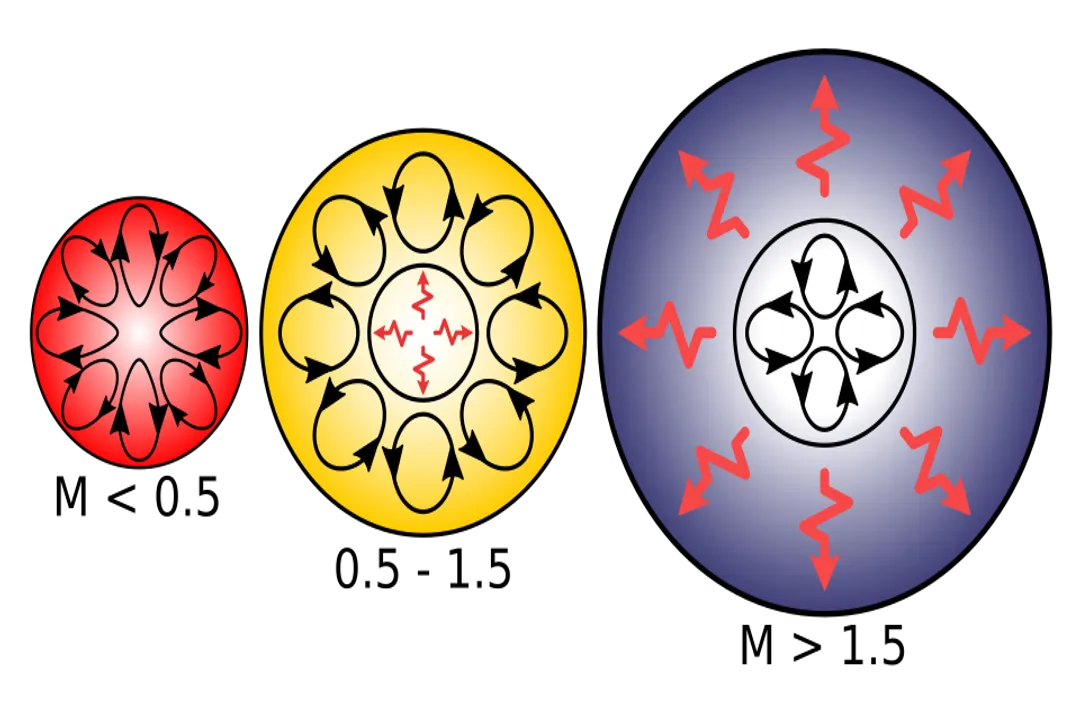
The smallest stars, known as red dwarfs (less than about ), operate on the extreme opposite end of the spectrum. Their low gravity results in relatively cool, dim cores that initiate fusion at an incredibly slow pace.
Astrophysical models suggest that these diminutive stars can remain on the main sequence for timescales that stagger human comprehension—potentially six to twelve trillion years or even longer. This means that the very first red dwarfs born in the universe are still shining today, having never approached the end of their main sequence phase. Furthermore, due to their fully convective interiors, they are thought to utilize nearly all of their hydrogen fuel, unlike larger stars. Their ultimate fate, theoretically, will be a very slow fade into a low-mass white dwarf after these immense timescales have passed.
# Mid-Range Stars
Stars comparable in mass to our Sun—classified as G-type dwarfs—occupy the middle ground. The Sun itself is currently about $4.6$ billion years into its predicted 10-billion-year main sequence life.
Once the hydrogen in the core is exhausted, the balance tips. Gravity contracts the core, heating the surrounding hydrogen layer until shell fusion begins. This powers the star to expand dramatically, cooling its surface and turning it into a red giant. For stars around , the inert helium core eventually gets hot enough (around $100$ million Kelvin) to ignite helium fusion into carbon, leading to a brief period of further activity before it sheds its outer layers as a planetary nebula. The remnant left behind is a dense, Earth-sized object called a white dwarf, which slowly cools over eons.
# Massive Star Fate
The lives of stars exceeding roughly are spectacular but incredibly brief, often lasting only a few tens of millions of years. These O-type or massive B-type stars burn so fiercely they may never fully settle into the peaceful Red Giant phase, instead becoming blue supergiants or rapidly evolving off the main sequence due to intense stellar winds caused by radiation pressure.
Because their cores are so hot and dense from the start, they bypass the slow helium flash seen in Sun-like stars and rapidly proceed through successive stages of fusion, creating an onion-like layering of heavier elements: hydrogen fusion in a shell around a helium-fusing shell, which surrounds a carbon-fusing core, and so on. This process continues until the core is primarily made of iron. Iron is a cosmic dead-end; fusing iron consumes energy rather than releasing it. When the energy source vanishes, the core collapses catastrophically in less than a second.
The resulting implosion rebounds off the hyper-dense core, triggering a supernova explosion. The mass of the collapsed core determines the final remnant: if it is between about $1.4$ and , it compresses into a neutron star—an object so dense a matchbox full of its material would weigh as much as a large mountain. If the remnant core mass exceeds this threshold (the Tolman–Oppenheimer–Volkoff limit), gravity wins entirely, and the core collapses into a black hole. It is these violent supernova events that forge nearly all elements heavier than iron, seeding the interstellar medium for the next generation of stars.
The concept of stellar lifetime is not just about how long a star shines, but what it leaves behind. This final outcome is strictly predetermined by the mass it held when it first condensed out of the nebula. While a low-mass star offers the potential for nearly infinite quiet longevity, a high-mass star trades that potential for a brief, brilliant existence that seeds the galaxy with the ingredients for planets and life—including us.
The inherent speed in the massive stars’ existence creates a fascinating paradox in astronomical observation. We see fewer massive stars than low-mass stars, not because they were never formed, but because their main sequence phase is so short relative to the age of the universe that they represent a minuscule fraction of the current stellar population. Conversely, the current stellar population of a galaxy is overwhelmingly populated by low-mass stars that are still plodding along their trillion-year main sequence schedule, making them the stellar "majority" by sheer endurance. This scaling—where mass dictates not just the duration but the observable frequency of a stellar type—is a direct consequence of that lifetime rule.
#Videos
How Does Mass Affect A Star's Longevity? - YouTube
Related Questions
#Citations
Stellar evolution - Wikipedia
How Does Mass Affect A Star's Longevity? - YouTube
The Life Cycles of Stars: How Supernovae Are Formed
star_lifetimes.html - UNLV Physics
The Mass-Luminosity Relationship | ASTRO 801
Stellar Evolution - | The Schools' Observatory
the amount of "fuel" the star has... its mass, and the rate at which it ...
How does a star's mass affect its evolution? - TutorChase