How does temperature affect reaction kinetics?
The simple observation that heating things up makes them happen faster is a bedrock principle in chemistry, touching everything from how quickly we can bake a loaf of bread to how long food stays fresh in the refrigerator. When we delve into chemical reactions, this relationship between temperature and speed is not just a casual correlation; it is a fundamental dependency governed by statistical mechanics and molecular behavior. For any given chemical transformation, raising the temperature nearly always translates to an increased reaction rate. This acceleration is directly related to the energy available to the molecules involved.
# Rate Factors

Chemical kinetics is the study of the rates, or speeds, of chemical reactions and the mechanisms by which they occur. Many factors influence how quickly reactants convert into products, including the concentration of reactants, the presence of catalysts, the surface area for heterogeneous reactions, and the nature of the reactants themselves. However, among these variables, temperature often exerts the most dramatic and predictable influence on the rate constant, . Understanding how temperature changes the rate requires looking at the molecular level to see what energy is required for collisions to succeed.
# Molecular Motion

At the microscopic scale, chemical reactions occur when reactant molecules collide with sufficient energy and in the correct orientation. This concept forms the basis of Collision Theory. Imagine a room full of people, where a successful conversation only happens if two people are close enough (concentration), oriented toward each other, and willing to speak loudly enough (energy). In a chemical sense, temperature is a direct measure of the average kinetic energy of the particles in a substance.
When the temperature of a system increases, the average kinetic energy of the reactant molecules rises. This increase translates into several key effects that boost the reaction rate:
- Increased Collision Frequency: Faster-moving particles will run into each other more often in a given period. While this does increase the number of potential reaction opportunities, the effect on the rate is actually quite minor compared to the next point.
- Increased Collision Energy: This is the dominant factor. A higher average kinetic energy means a larger proportion of the molecules possess energy equal to or greater than the minimum energy required to break existing bonds and form new ones—this minimum energy threshold is known as the activation energy ().
If most molecules have low energy, most collisions will be ineffective "bounces." When the temperature rises, a significantly greater fraction of molecules possess the necessary activation energy, causing a disproportionately large increase in the number of effective collisions that actually lead to product formation.

# Activation Threshold
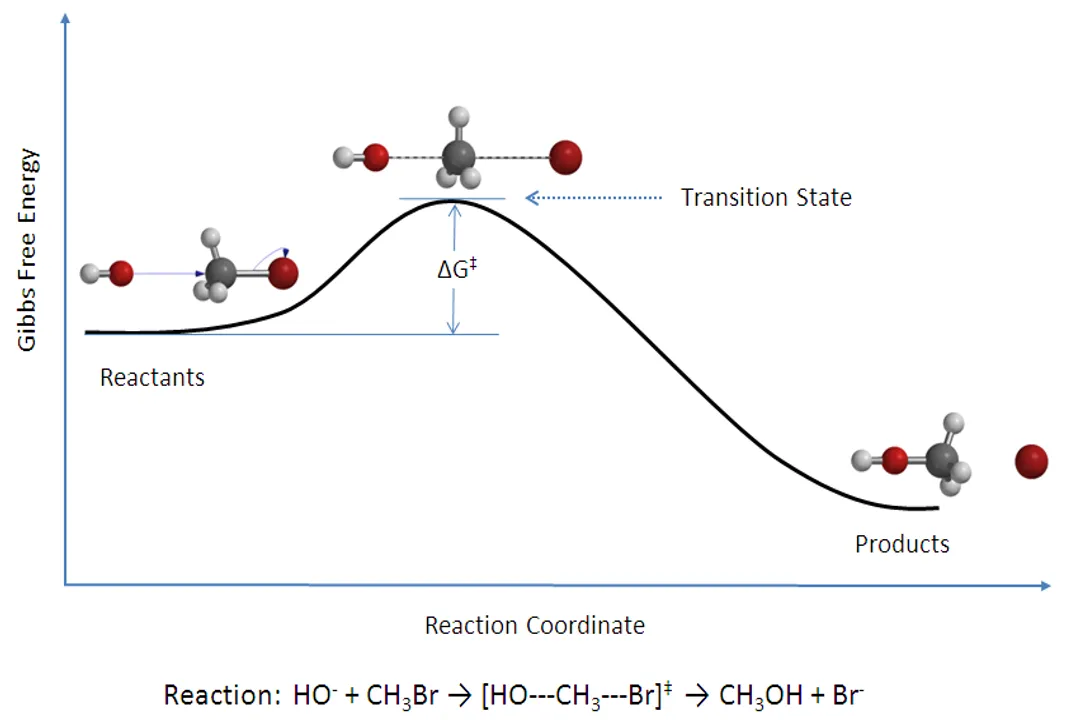
The activation energy () acts as an energy barrier that reactants must overcome to transform into products. Reactions with very high activation energies are naturally slow at room temperature because very few molecules possess that required energy. Temperature provides the thermal energy needed to push more molecules over this barrier.
Consider a simple analogy involving a small hill versus a large mountain. If the activation energy is a small hill, many molecules will have enough energy to roll over it even at low temperatures. If the activation energy is a massive mountain, only a tiny fraction of molecules have the energy to surmount it at low temperatures, making the reaction sluggish. Heating the system is like giving every molecule a slight boost, allowing a much larger percentage of them to clear even the highest mountain.
This distinction between the average energy and the minimum effective energy is crucial. A modest increase in temperature leads to an exponential increase in the fraction of molecules that meet the requirement, which is why the rate increases so rapidly.
# The Mathematical Link
The quantitative relationship describing how the rate constant () depends on absolute temperature () and activation energy () is provided by the Arrhenius Equation:
Where:
- is the rate constant.
- is the pre-exponential factor, often related to the frequency and proper orientation of collisions (the frequency factor).
- is the activation energy (in or ).
- is the universal gas constant ().
- is the absolute temperature (in Kelvin, K).
- is the fraction of molecules possessing sufficient energy for reaction.
This equation beautifully encapsulates the physical reality: the rate constant is exponentially dependent on the inverse of the absolute temperature (). Because of the negative exponent, as increases, the value of the exponent becomes less negative (approaches zero), causing to increase, thus increasing .
# Determining Parameters
Chemists often plot this relationship in its linear form to easily determine and from experimental data collected at various temperatures. By taking the natural logarithm of the Arrhenius equation, we get:
This equation is in the form of a straight line, , where , , the slope () is , and the intercept () is . Plotting against (using Kelvin for temperature) yields a straight line with a negative slope, allowing for precise calculation of the activation energy.
For reactions that proceed through multiple steps, the overall rate is dictated by the step with the highest activation energy—the rate-determining step. Therefore, temperature has the most profound effect on the rate of this slowest, most demanding step.

# Rate Acceleration Rule
A common, though approximate, guideline often taught in introductory contexts is that for many reactions occurring near room temperature, the reaction rate approximately doubles for every rise in temperature. While the exact factor varies widely based on the specific of the reaction, this general trend highlights the extreme sensitivity of kinetics to thermal energy changes. A reaction with a low activation energy might only speed up by 20% for a increase, whereas a reaction with a very high activation energy could triple or quadruple its rate over the same temperature interval.
To illustrate the magnitude of this effect, consider two hypothetical reactions:
| Reaction | Activation Energy () | Rate Doubling Temperature ( for 2x Rate Increase) |
|---|---|---|
| Reaction X (Fast) | Approx. | |
| Reaction Y (Slow) | Approx. |
This table shows that the reaction with the higher energy barrier () is actually more sensitive to temperature changes; it doubles its rate over a smaller temperature shift than the reaction with the lower barrier. This is because the exponential term in the Arrhenius equation is more dramatically affected when the magnitude of the exponent (which is negative) is larger.
A valuable consideration in practical application, which often goes unnoticed in textbook examples, is the difference between homogeneous and heterogeneous reaction systems. While the Arrhenius relationship holds true for both, in heterogeneous systems—like a solid catalyst reacting with liquid reactants—the physical process of diffusion (how fast the liquid molecules can move to the solid surface) can sometimes become the limiting factor at very high temperatures, slightly deviating the observed rate from the purely kinetically predicted Arrhenius behavior.
# Biological Context
Biological systems offer compelling, and often extreme, examples of temperature effects, largely due to the presence of enzymes. Enzymes are biological catalysts that significantly lower the activation energy of specific biochemical reactions, allowing them to proceed rapidly at physiological temperatures (around ).
When the temperature rises slightly above the optimum for a specific enzyme, the reaction rate increases predictably, following the principles described above. However, enzymes are proteins, and proteins have delicate three-dimensional structures essential for their function. If the temperature increases too much—perhaps exceeding or for many human enzymes—the enzyme begins to denature. Denaturation involves the unfolding and subsequent loss of the precise shape required for the active site to bind to its substrate, effectively destroying its catalytic ability.
When denaturation occurs, the rate of the catalyzed reaction plummets, often much faster than the Arrhenius prediction would suggest for an intact catalyst. This explains why high fever is dangerous; it causes a rapid, detrimental shift in the balance of essential bodily reactions. Conversely, refrigeration slows down spoilage not just by decreasing the kinetic energy of the chemical reactants causing decay, but also by slowing down the enzymatic activity of spoilage organisms.

# Storage and Stability
Understanding the temperature dependence of reaction kinetics is vital for material science and safe chemical storage. For materials that degrade over time—such as pharmaceuticals, foods, or complex polymers—the shelf life is intrinsically linked to the rate of unwanted chemical reactions occurring within them.
When chemists test shelf life, they often use accelerated aging studies. By storing samples at elevated temperatures (e.g., or ) and measuring the rate of degradation, they can use the Arrhenius relationship to extrapolate what the rate will be at the intended long-term storage temperature (e.g., room temperature or ). If a degradation reaction has an of , an increase of just in storage temperature could reduce the product's usable life by half, even if the degradation mechanism itself isn't immediately obvious to the user. This highlights why strict temperature control is non-negotiable for sensitive chemicals and medicines.
A useful takeaway for laboratory practice is considering the temperature dependence of both the desired reaction and any undesired side reactions. If you are attempting a synthesis, you might increase the temperature to speed up the main, high- step. However, if the side reactions that lead to impurities have an even higher , that temperature increase could disproportionately favor the formation of unwanted byproducts, leading to a lower yield of the desired product, even if the overall reaction time is shorter. Therefore, the optimum temperature is often a compromise between speed and selectivity.
#Videos
How does temperature affect rate of reaction? - YouTube
Related Questions
#Citations
How Does Temperature Affect The Rate Of A Reaction?
8.5: The Effect of Temperature on Reaction Rates
Lesson 6.4: Temperature and the Rate of a Chemical Reaction
Factors that Affect the Rate of Reactions – Introductory Chemistry
2.4 Temperature and Reaction Rate - Principles of Chemistry
[PDF] Reaction Rates and Temperature; Arrhenius Theory
How does temperature affect rate of reaction? - YouTube
Impact of temperature on the time required for the ... - NIH
Does Temperature Affect Reaction Rates? | Lesson Plan
The Rates of Chemical Reactions