What is an astralabe used for?
The astrolabe, an instrument whose name derives from the Greek for "star taker," represents one of humanity’s earliest and most sophisticated portable analog computers. [1][2] Far more than a simple pointing device, this intricate brass creation allowed scholars, sailors, and astronomers across millennia to solve complex problems related to the time and the positions of celestial bodies. [1][5] Its utility was so wide-ranging that it served functions essential for navigation, religious observance, and general timekeeping from antiquity through the Renaissance. [1][5] To understand the astrolabe is to appreciate a physical manifestation of mathematical and astronomical knowledge captured in metal. [9]
# Instrument Structure

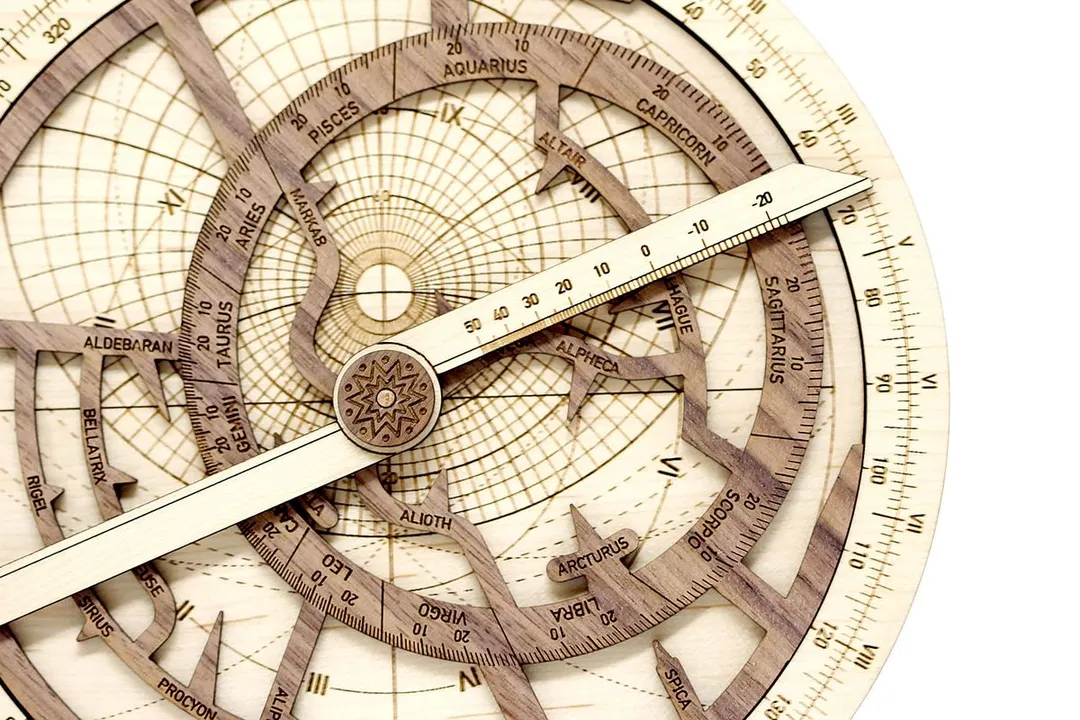
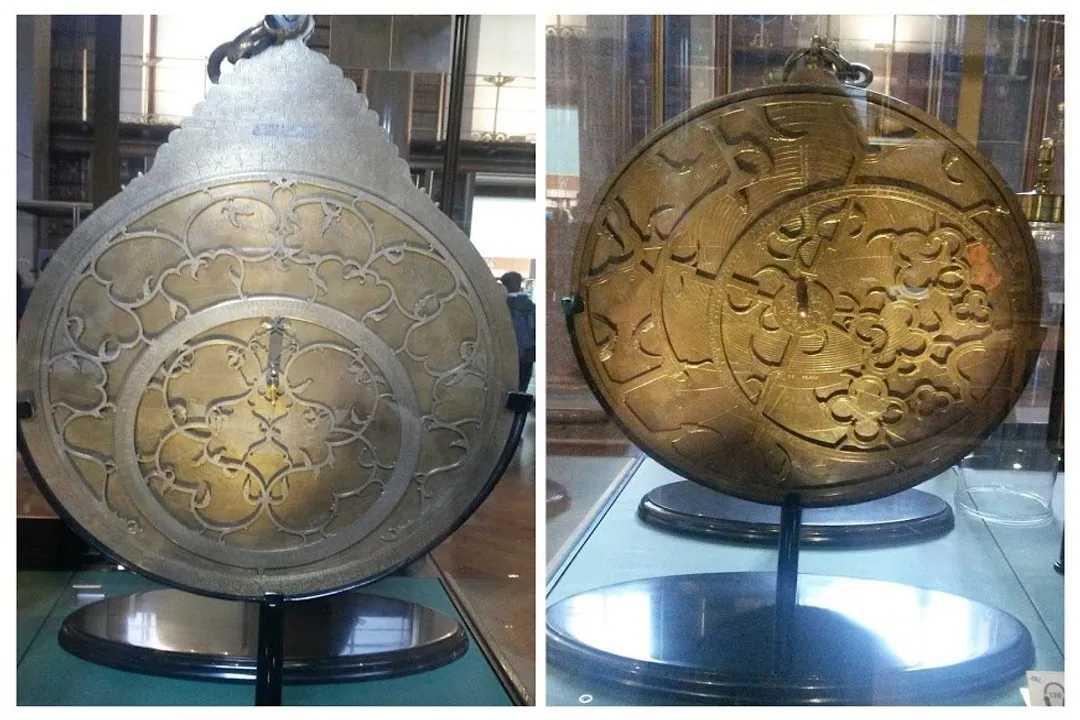
At its physical core, the astrolabe is a complex layering of metal plates, designed to model the heavens onto a flat surface. [2] The entire apparatus is housed within a thick circular frame known as the mater. [1] The mater is essentially the case, often featuring a rim marked with degrees or other angular divisions, and sometimes containing a plumb line or bubble level to ensure the instrument is held perfectly flat during observation. [2]
Inside the mater sits the tympan (or sometimes several interchangeable plates). [1][2] The tympan is engraved with a stereographic projection—a map of the local horizon, altitude circles, and lines of azimuth specific to the latitude where the observer is standing. [2] Because the astrolabe needed to be useful across different geographical locations, one instrument might require several tympans, each calibrated for a specific latitude. [5]
Resting atop the tympan is the rete, which is perhaps the most visually striking component. [1] The rete is a pierced, openwork map representing the celestial sphere, featuring pointers—often shaped like stylized fleurs-de-lis—that mark the locations of important fixed stars. [1][9] This star map rotates around the central pin of the instrument, simulating the daily turning of the night sky relative to the observer's horizon. [2]
Finally, the alidade, a sighting rule that pivots across the back of the mater, completes the primary assembly. [1][5] This rule is used to take sights on the Sun or stars to measure their altitude above the horizon. [2] It is the interaction between these components—the fixed horizon (tympan), the rotating stars (rete), and the sighting device (alidade)—that enables the instrument’s computational power. [2]
# Time Telling
One of the most fundamental uses of the astrolabe was to ascertain the local time, whether it was day or night. [1][5] This capability was critical before the widespread availability of accurate mechanical clocks. [5]
# Daytime Calculation
During the day, the observer would use the alidade on the back of the astrolabe to sight the Sun, measuring its altitude. [5] This measurement, combined with knowing the date (which determined the Sun's declination from the known astronomical tables engraved on the astrolabe’s plates), allowed the user to calculate the hour. The astrolabe could be used to find the time elapsed since sunrise or the time remaining until sunset. [1] It essentially converted an angular measurement (the Sun's altitude) into a temporal measurement (the hour) through projection and rotation of the rete against the marked time scale. [2]
# Nighttime Determination
At night, the process was analogous but involved observing a known star rather than the Sun. [5] By sighting a star whose position was marked on the rete, the user could align the star’s pointer on the rete with its measured altitude on the mater’s scale. By rotating the rete until the current time line on the instrument aligned with the horizon lines on the tympan, the observer could read the current time. [1] The ability to quickly and accurately translate a celestial angle into a terrestrial time value speaks volumes about the precision of medieval craftsmanship; the user needed not just the tool, but a deep intuitive understanding of how to manipulate its moving parts to reflect the immediate reality of the sky above them. [9]
# Celestial Measurement
The ability to determine the altitude of a celestial object is the bedrock upon which most other astrolabe functions are built. [5] Altitude is the angular distance of an object above the horizon, measured in degrees. [1]
To find the altitude, the observer aligns the instrument so it hangs vertically—often by a ring or hook at the top—and levels it using the plumb line or bubble level. [2] They then rotate the alidade until the slit on one side is lined up precisely with the Sun or a star. [5] The degree reading indicated by the alidade’s scale on the mater gives the altitude. [5]
Once the altitude is known, several other astronomical calculations become accessible:
- Latitude: If the altitude of a known star (or the Sun at a known date) is measured precisely, the observer could, conversely, determine their own latitude, provided they had accurate tables recording the object's declination. [5]
- Rising and Setting Times: Knowing the altitude and the date allowed the user to calculate when specific stars would rise or set, information valuable for both planning nighttime observation and for astrological purposes. [1]
- Star Maps: The astrolabe could be used to identify unknown stars by comparing their measured altitude and azimuth to the projections shown on the rete. [4]
# Practical Applications
While its scientific basis lies in spherical astronomy, the astrolabe found many practical applications that touched daily life and professional necessity across different cultures. [1]
# Calculating Heights
A brilliant application of the astrolabe involves basic trigonometry to measure inaccessible heights, such as towers or mountains. [5] This is achieved by using the instrument’s scale to find the angle of elevation to the top of the object. By ensuring the base of the astrolabe is a known distance away from the object (or by using the instrument’s structure to create a right-angled triangle), the height can be calculated using ratios derived from the instrument’s design. [1] This method transforms a difficult measurement task into a straightforward angular reading followed by a calculation, which the astrolabe itself was designed to simplify. [5]
# Religious Orientation
In the Islamic world, where astrolabe development reached a zenith, the instrument gained an essential religious function: determining the Qibla—the direction of the Kaaba in Mecca. [1] By inputting the latitude and longitude of their current location and that of Mecca, skilled users could calculate the precise bearing required, making the astrolabe an indispensable tool for prayer orientation across vast distances. [1]
It is interesting to consider the shift in required expertise between ancient celestial measurement and modern tools. Where an early navigator relied purely on careful sighting, level reading, and precise calibration to find their position, today’s user relies on the automated triangulation of satellites. The astrolabe demanded continuous, active engagement with the mathematics; the error in the final calculation was often a direct reflection of the user’s own reading ability and mathematical speed. [5]
# Historical Context
The roots of the astrolabe trace back to ancient Greece, likely in the Hellenistic period, with theoretical foundations established by figures like Hipparchus. [1] However, the instrument truly flourished and was refined significantly within the Islamic world starting in the early centuries of the Islamic era. [1] Islamic artisans and astronomers added crucial markings, tables, and features, transforming it into the complex tool known today. [9] They standardized its construction and expanded its tables, turning it into a highly accurate scientific instrument for its time. [1]
From the Islamic world, knowledge of the astrolabe was transmitted to Europe, often via Moorish Spain, where it was embraced by medieval scholars. [1] The instrument’s presence in Europe during the Middle Ages marked it as a high-status object, often crafted from expensive materials like brass, signifying both wealth and intellectual attainment. [9] While specialized navigational instruments eventually superseded it for open-sea sailing, the general-purpose astrolabe remained relevant for timekeeping and astronomical study well into the sixteenth century. [5]
# Modern Relevance
Today, the astrolabe is rarely seen in a functional capacity for navigation or timekeeping, having been replaced by electronic devices that offer far greater accuracy and ease of use. [4] Yet, its importance has not diminished; rather, it has shifted from a primary tool of utility to an object of profound historical and intellectual study. [9]
Museums and university collections house surviving medieval and Renaissance astrolabes, preserving them as examples of technological history and exquisite metal craftsmanship. [8][9] Contemporary astronomers and historians often study these artifacts to understand the computational methods and astronomical data available to past civilizations. [6][8] Furthermore, there is a strong interest among modern craftspeople and enthusiasts who build, restore, or even use working replicas for educational demonstrations. [6][8] These reproductions allow modern practitioners to experience firsthand the connection between the observer and the cosmos that defined the experience of using the original instrument. [10] The astrolabe remains a powerful symbol of early scientific inquiry, demonstrating how early thinkers mapped the entire cosmos onto a disk small enough to hold in one's hand. [2]
#Videos
How to use an astrolabe I Curator's Corner S3 Ep1 #CuratorsCorner
Related Questions
#Citations
Astrolabe - Wikipedia
Astrolabes: How do they work? - cabinet
Mariner's Astrolabe - Ages of Exploration
A beginner's guide to the astrolabe | BBC Sky at Night Magazine
Astrolabe | Definition, History, & Facts | Britannica
How to use an astrolabe I Curator's Corner S3 Ep1 #CuratorsCorner
AstroLABe: a lab where technology meets history: Current Projects
What is an astrolabe and its uses? - Facebook
A Medieval Astrolabe | Whipple Museum of the History of Science
Astrolabe, the world's oldest astronomical computer.