What instrument did Galileo use to observe the sky?
The device Galileo Galilei employed to revolutionize our understanding of the cosmos was the telescope. [3][6][8] While he did not invent the concept, his genius lay in adapting and dramatically improving this nascent optical instrument, transforming it from a novelty into a scientific powerhouse. [3][6][7] He referred to his creation as an occhiale or perspicillum, a term denoting an instrument for seeing far away. [2]
# Dutch Precursor
The knowledge that led to Galileo's breakthrough arrived in Padua around $1609$. [3][6] The basic technology—combining a convex objective lens with a concave eyepiece within a tube—was known in the Netherlands, often cited as being invented by spectacle makers like Hans Lippershey or Zacharias Janssen. [6][7] News of this "Dutch spyglass," capable of magnifying objects several times their actual size, reached Galileo quickly. [3][7]
Galileo, already a skilled mathematician and physicist, immediately grasped the profound implications for astronomy. [3][6] He reportedly set about replicating the device almost instantly, working from rumor and sketches rather than seeing an actual model initially. [6] The foundational principle was established, but the execution required serious refinement.
# Optical Design
The initial Dutch instruments offered only about three times magnification. [3] Galileo’s immediate task was to improve this power while maintaining a clear, usable image. [3] His successful construction involved carefully grinding his own lenses. [3][7] The specific configuration that defined the early Galilean telescope used a convex lens placed at the front (the objective) and a concave lens positioned closer to the eye (the eyepiece). [2][5][6]
This specific arrangement, known as a Galilean telescope, had the distinct advantage of producing an upright image. [5] For terrestrial use, this was ideal, as it avoided the inversion that later, more powerful telescopes often produced. [5] However, this design limited the field of view, making astronomical targets appear small, even when magnified. [5] Furthermore, achieving high magnification with this configuration required extremely precise curves on the lenses, a feat of craftsmanship in an era before standardized manufacturing. [6]
It is important to contrast this with the Keplerian telescope, which gained traction later. The Keplerian design used two convex lenses, which provided a wider field of view and allowed for greater magnification potential, but it always inverted the image. [5] Galileo stuck to his upright design for terrestrial observation, but for his most significant astronomical work, the slightly distorted view of the Galilean setup was a necessary compromise to achieve the necessary clarity and magnification to map the heavens. [3][5]
# Power Increase
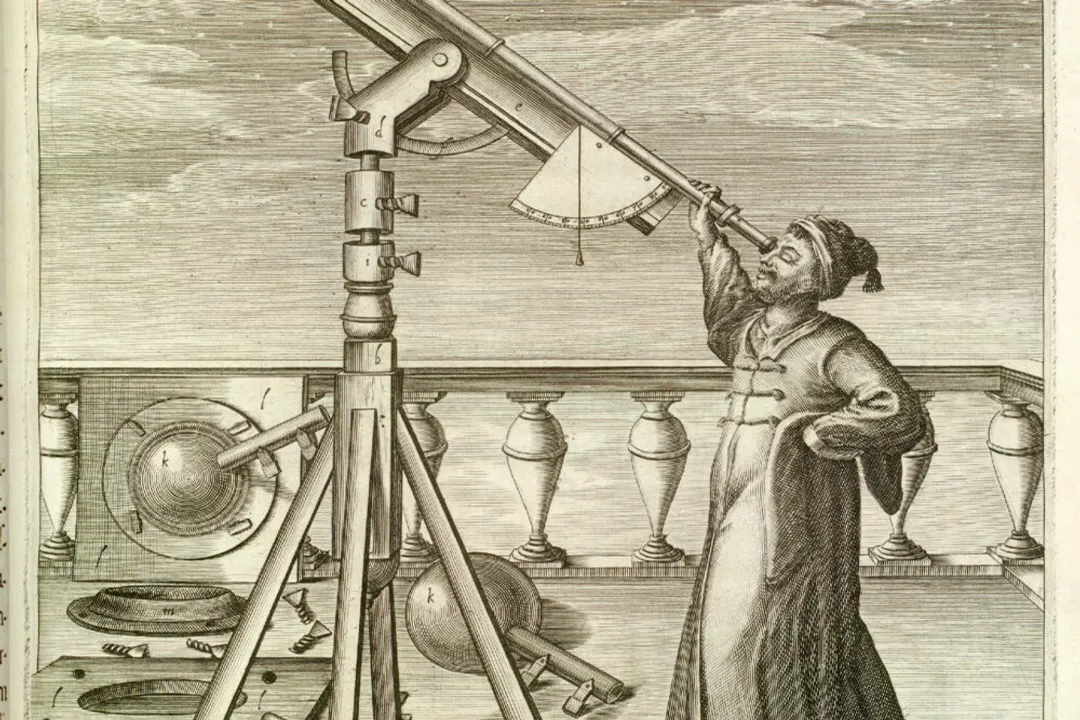
Galileo was relentlessly focused on augmenting the power of his occhiale. [3] Starting with a device that magnified objects three times, he rapidly advanced its capabilities through iterative adjustments to the lenses and tube length. [2][6] Within months, he had created instruments offering eight times magnification, followed by twelve times. [2]
The breakthrough moment for astronomy came when he achieved a magnification of approximately or . [2][3][6] For example, one of his surviving instruments, though perhaps not the absolute most powerful he constructed, is recorded as having magnification and a length around $98$ centimeters. [2] The jump from to fundamentally changed what was visible. To put this technical improvement into perspective, consider the manufacturing challenge: achieving a magnification required lenses ground with an accuracy that demanded immense skill and patience, as any minor imperfection in the glass or the curvature would introduce significant visual distortions, or aberrations, rendering high power unusable. [7] Successfully creating a clear, high-power lens was as much a test of artisanal skill as it was of optical theory. [6]
# Celestial Sightings
Once Galileo possessed telescopes capable of magnifying objects up to thirty times, the familiar night sky was instantly and permanently transformed. [3][6][7] He systematically turned his instrument toward the heavens, recording his observations with meticulous detail in works like Sidereus Nuncius (Starry Messenger) in $1610$. [3][6]
The key discoveries include:
- The Moon's Surface: Instead of a perfect, smooth celestial sphere as held by Aristotelian tradition, Galileo observed mountains, valleys, and craters on the Moon, demonstrating it was a world much like Earth. [3][6]
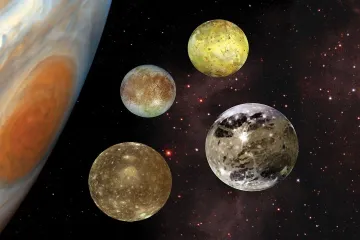
- The Moons of Jupiter: Perhaps his most consequential discovery, he found four bright objects orbiting Jupiter. [3][7] He named them the Medicean Stars in honor of his patron, Cosimo II de' Medici. [6] These moons proved that not everything revolved around the Earth, offering direct visual evidence against the established geocentric model. [3][6]
- The Phases of Venus: Observing Venus go through a full cycle of phases, much like the Moon, provided powerful confirmation that Venus orbited the Sun, a central tenet of the Copernican model. [3][6]
- The Milky Way: What had appeared as a uniform band of light in the sky was resolved by his telescope into countless individual stars, revealing the true depth of the galaxy. [3]
- Sunspots: Although others may have seen blemishes on the Sun, Galileo used his instrument to track their movement across the solar surface, confirming that the Sun, too, was not perfect and that it rotated. [3]
# Revolutionary Scope
Galileo's instrument was not merely an improved spyglass; it was the first true astronomical telescope, the extension of human vision into realms previously accessible only through pure theory or mathematics. [8] The sheer variety and importance of his discoveries, all attributable to this single class of instrument, established the empirical method in astronomy. [6][7]
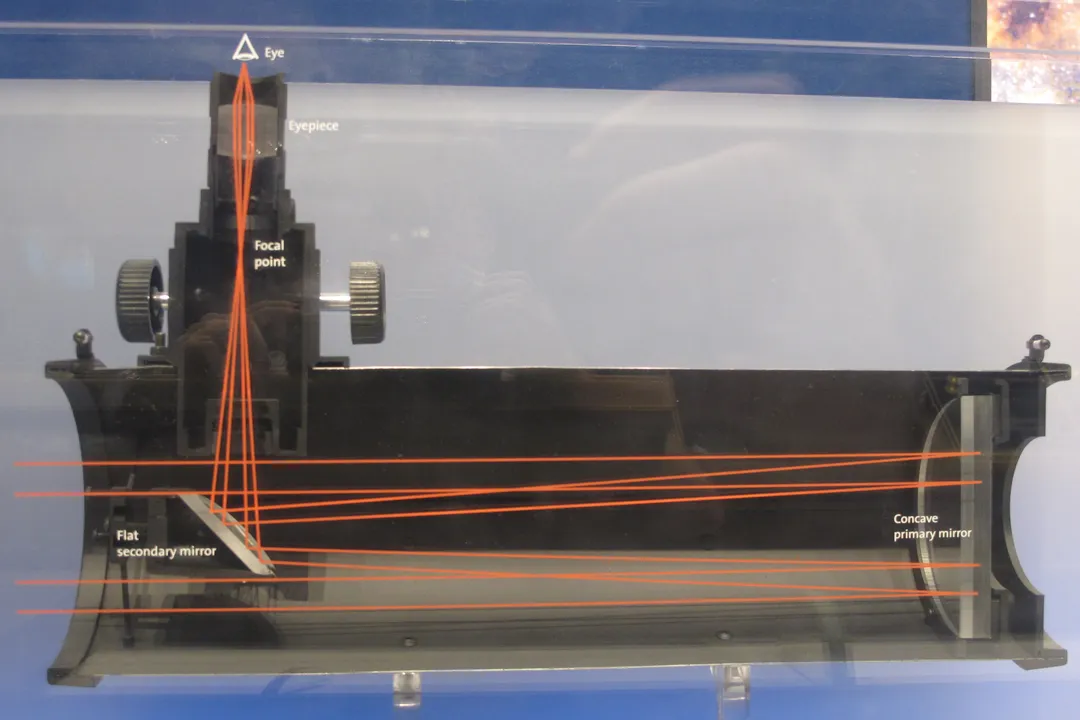
It is fascinating to consider that the earliest surviving telescopes from this period are often quite small. A typical instrument might have been less than a meter long, but the complexity lay entirely within the glass elements, not the overall size. [2] Today, an amateur stargazer can purchase a modest reflector telescope for a few hundred dollars that offers far superior light-gathering and magnification than anything Galileo possessed, yet the intellectual leap he made—from seeing the Moon as a perfect disk to realizing it was a rugged world—remains unparalleled in the history of observational science. [8] His optical tools initiated the shift from classical cosmology to modern astrophysics, all by slightly improving a Dutch toy into a powerful scientific apparatus. [3][6]
Related Questions
#Citations
Galileo Galilei - Wikipedia
Galileo's telescope
Galileo's Instruments of Discovery - Smithsonian Magazine
Galileo First Hears About the Telescope - American Physical Society
Galileo's Telescope | PBS LearningMedia
The First Telescopes (Cosmology - American Institute of Physics
An organ pipe as a telescope - Max-Planck-Gesellschaft
Stargazing with Early Astronomer Galileo Galilei - Sky & Telescope
Extending the Eye - Southern California's gateway to the cosmos!