What was the significance of Galileo's observations of the moon?
The moment Galileo Galilei first turned his newly improved telescope toward the Moon, he wasn't just looking at an object in the night sky; he was peering directly into the foundational assumptions of Western cosmology that had stood largely unquestioned for nearly two millennia. Before his observations, the prevailing philosophical and scientific view, rooted in Aristotelian thought and maintained by the Church, described the heavens as composed of perfect, smooth, unchanging celestial spheres made of a flawless substance called aether. [4] The Moon, being a heavenly body, was expected to be a perfect, smooth orb, similar to a polished mirror. [3] When Galileo began his systematic observations, reportedly starting around November 30, 1609, [2] the significance of what he was about to see would shatter this immaculate cosmic architecture.
# First Viewings

Galileo did not invent the telescope, but he was among the very first to significantly improve its magnification and, crucially, the first to point it systematically and analytically toward the heavens. [8] His initial goal may have been simply to impress Venetian patrons with the improved capabilities of the instrument, but his scientific curiosity quickly took over when he turned the device skyward. [8] The leap from simply seeing distant objects magnified to using the instrument as a precise scientific tool was Galileo’s true innovation. [8]
When directed at the Moon, the views were instantly revolutionary. Instead of the uniformly polished surface described by ancient philosophers, Galileo saw texture, shadow, and, most surprisingly, ruggedness. [3] He meticulously sketched what he saw, documenting the interplay of light and shadow across the lunar surface, noting that the terminator—the line dividing the illuminated day side from the dark night side—was not a smooth curve, as it would be on a perfect sphere, but was instead irregular and jagged. [3]
# Light and Shadow
The quality of the shadows was key to his deduction. On a perfectly smooth sphere, the transition from light to dark would be gradual. However, Galileo observed that the peaks of high features on the Moon were illuminated while the valleys below them remained completely dark. [3] This phenomenon is precisely what occurs on Earth when the sun rises or sets over mountains and plains. This direct visual parallel provided compelling evidence that the Moon possessed topographical features analogous to Earth's own landscape. [3]
To make such fine distinctions with the early optics available required an incredible amount of careful observation and interpretation. A modern observer with a good backyard telescope can see the lunar surface in stunning detail, but Galileo was working with magnifications that might only reach or . [8] To resolve features that look small even today, he had to contend with significant optical aberrations inherent in early lenses. This suggests that the features he perceived—the mountains and valleys—were not just slight irregularities but pronounced topographical contrasts that dominated the view even through his relatively crude instrument. [8] The very act of confirming these imperfections, rather than just suspecting them, was what made his observation so powerful. [9]
# Mountains Revealed
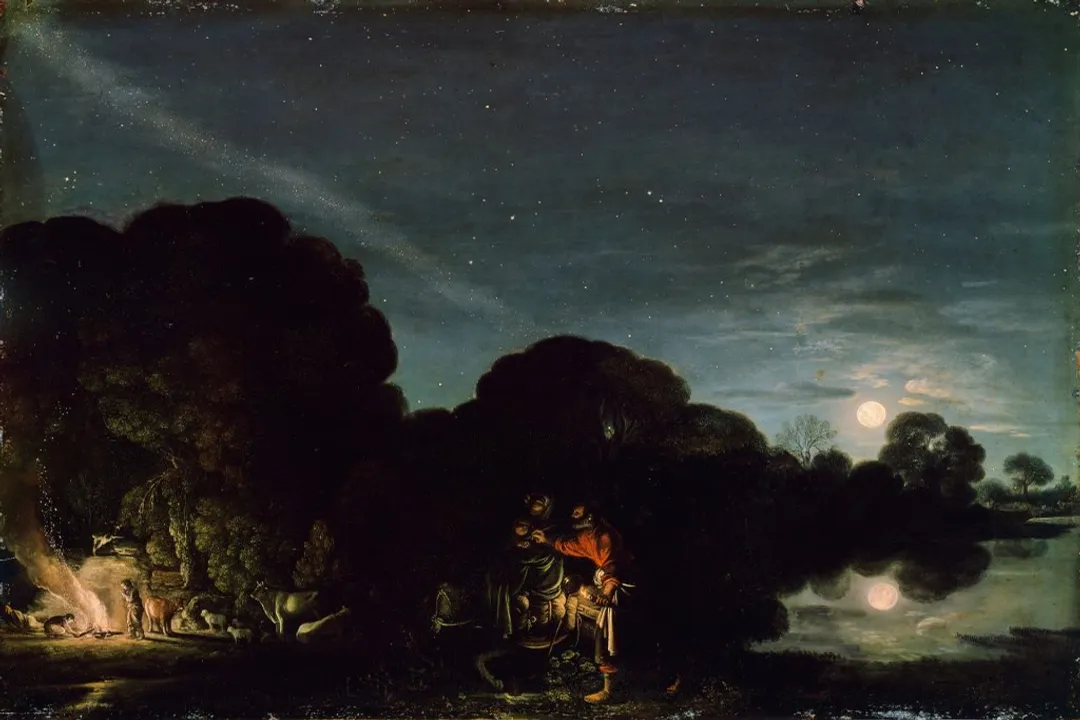
The discovery of mountains on the Moon was perhaps the most direct affront to the established Greek model of cosmology. [4] If the Moon had mountains, it meant it was not a flawless body; it was imperfect, earthly, and therefore dissimilar to the supposedly immutable and perfect celestial realm. [4][3] Galileo’s sketches showed circular formations that strongly resembled terrestrial mountains, leading him to conclude that the Moon was a physical world with its own geology. [3] He deduced the heights of these mountains by measuring the angles at which sunlight first struck their peaks as they emerged from shadow, an early application of trigonometry to astronomical observation. [3]
This insight carried profound philosophical weight. If the Moon was blemished and possessed features like Earth, then the rigid separation between the terrestrial (corruptible) and the celestial (perfect) began to crumble. [5] This was not just a small adjustment to an astronomical chart; it was a fundamental reassessment of what the heavens were made of. [4]
# Strategic Publication
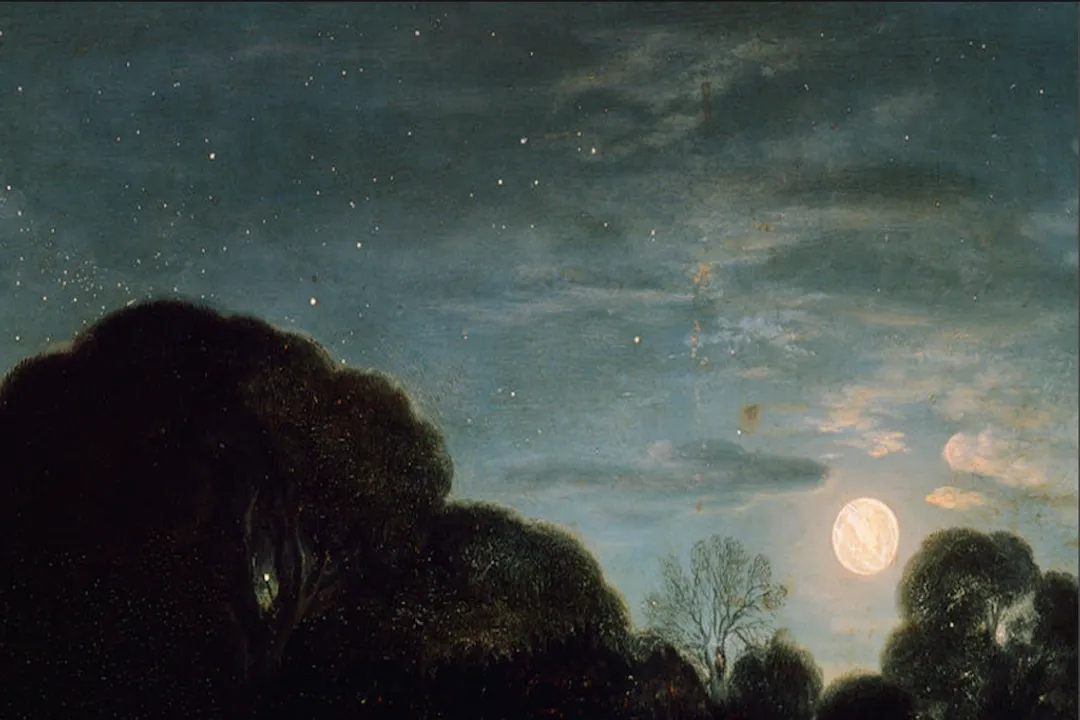
While Galileo made these revolutionary observations starting in late 1609, [2] he did not immediately publish his findings. The actual recording and initial sketching process likely occurred over several weeks or months of dedicated observation. [3] The formal publication of these results came the following year in Sidereus Nuncius (Starry Messenger), published in March 1610. [4]
This interval between discovery and dissemination offers an interesting point of analysis. Given the explosive nature of his claims—that the heavens were not perfect—Galileo likely spent the intervening months solidifying his data, repeating observations to rule out optical illusions, and perhaps even considering the political and religious ramifications. [4] An astute scientist in a highly conservative era would not publish such a radical idea without an ironclad foundation of repeatable evidence. He needed to ensure that when the challenge came, he could present not just an observation, but a demonstrable, repeatable proof that the Moon was materially similar to the Earth, thus laying the groundwork for a unified physical understanding of both Earth and sky. [3] The delay speaks to his understanding of the cultural landscape as much as his scientific rigor.
# Broader Celestial Assault
Galileo's initial success with the Moon quickly paved the way for other shocking discoveries that further dismantled the old cosmos. Once he established that heavenly bodies could have complex, Earth-like surfaces, the precedent was set for finding similar irregularities elsewhere. [1]
# Jupiter's Companions
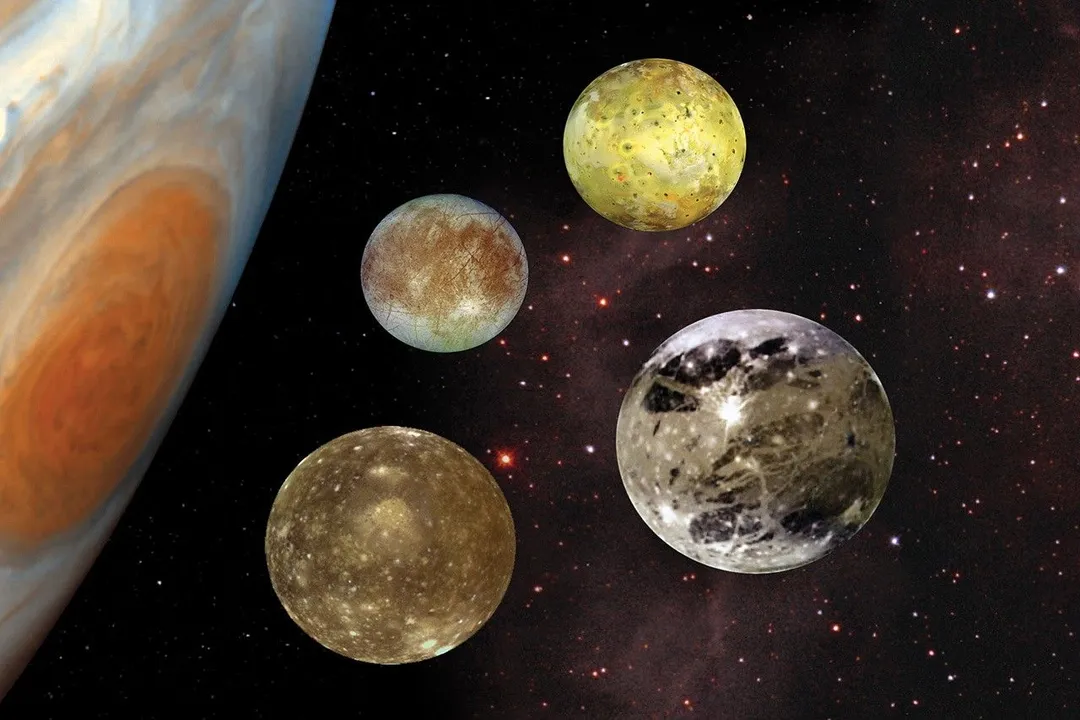
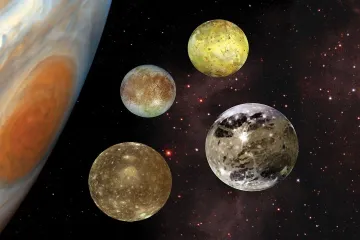
Perhaps even more damaging to the geocentric model than the lunar topography was the discovery of Jupiter's four largest moons: Io, Europa, Ganymede, and Callisto. [6][7] Galileo observed these "stars" orbiting Jupiter, naming them the Medicean Stars, but the crucial point was their motion. [6] Here was a miniature solar system in action, clearly demonstrating that not everything in the heavens revolved around the Earth. [7] If Jupiter could carry its own satellites, it provided a powerful analogue to the idea that the Earth could be moving while still retaining its Moon. [7] This observation, made shortly after his lunar work, built a case that the Ptolemaic system—where Earth was the unmoving center of all motion—was fundamentally flawed. [1]
# Venus and Sunspots
Galileo's later observations of Venus were also critical. He observed that Venus went through a full set of phases, similar to the Moon. [1] In the ancient, Earth-centered (Ptolemaic) model, Venus should only show crescent phases because it always orbits between the Earth and the Sun. The observation of a "full" Venus was only possible if Venus orbited the Sun, placing it on the far side of the Sun relative to Earth at certain points in its orbit. [1] Furthermore, his observations of sunspots—dark blemishes on the Sun—indicated that even the Sun, the supposed perfect luminary, was also subject to change and imperfection, echoing the roughness he first confirmed on the Moon. [1]
# Establishing Empirical Authority
The significance of the Moon observations lies in the shift they catalyzed from reliance on ancient texts and abstract philosophical reasoning to direct, empirical evidence gathered through instrumentation. [8]
The table below summarizes the traditional view versus Galileo’s observation, highlighting the direct contradiction:
| Feature | Aristotelian/Ptolemaic View | Galileo's Observation (via Telescope) | Implication |
|---|---|---|---|
| Lunar Surface | Perfectly smooth, aetheric | Mountains, valleys, craters | Celestial bodies are physical, imperfect, like Earth [3][4] |
| Lunar Motion | Orbited Earth in a perfect circle | Irregular terminator line suggested topography [3] | The heavens are subject to change and structure [5] |
| Celestial Motion | Everything orbits the Earth | Jupiter has orbiting moons [6][7] | Earth is not the center of all motion |
The Moon became the first casualty of the new observational science. It served as the most immediate and accessible piece of evidence. One did not need specialized knowledge of mathematics or complex orbital calculations to see that the Moon was not smooth; the evidence was available simply by looking through his device. [3] This accessibility democratized the revolution in physics; the argument moved from the realm of scholastic debate to something that could be verified by anyone who could look through a telescope. [8]
We can consider the initial visual impact. Imagine the stark difference between the visual experience of the Moon through a human eye—a smooth, pale disc—and the rugged, shadowed landscape revealed by the telescope. For an educated person of the time, steeped in classical perfection, seeing shadowed peaks rising from a lunar plain must have felt less like a scientific discovery and more like a profound, almost sacrilegious, vision of an alien world sitting just a short distance away in the cosmos. [4]
# Lasting Impact
Galileo's work on the Moon inaugurated the era of modern observational astronomy. It established the telescope not as a novelty, but as an essential scientific instrument, the precursor to every major astronomical instrument built since. [8] His success provided the initial, crucial crack in the ancient worldview, opening the door for Kepler’s laws of planetary motion and, eventually, Newton’s universal law of gravitation, which explained why these bodies moved as they did, based on their physical mass, rather than residing on perfect spheres. [1]
The significance wasn't just that the Moon had mountains; it was that observation trumps received authority. By making the heavens subject to physical laws observable on Earth, Galileo essentially relocated the authority for understanding the cosmos from ancient texts and philosophical consensus to the empirical data gathered through instruments. [9] This set the template for the entire Scientific Revolution that followed. The Moon, being the closest and most familiar celestial body, was the perfect, tangible proof that the old maps of the universe were simply wrong.
Related Questions
#Citations
Galileo's Observations of the Moon, Jupiter, Venus and the Sun
Galileo begins observing the moon | November 30, 1609 - History.com
The Galileo Project | Science | Moon
How Galileo Galilei Changed the Moon Forever - Daily Art Magazine
Galileo's Moon Observations and Cosmic Exploration - Facebook
Galileo: Discovering Jupiter's Moons | PBS LearningMedia
Galilean moons - Wikipedia
Galileo's Telescope: Unveiling the Moon's Secrets in 1609 - agnirva
TIL Galileo was the first to confirm the Moon's rough and ... - Reddit