What did Galileo discover about Jupiter and why was this significant?
The moment Galileo Galilei turned his newly improved telescope toward the planet Jupiter in early January of 1610, he began a process that would irrevocably alter humanity’s place in the cosmos. [1][2][4] He was not looking for moons; he was scrutinizing the heavens with a new optical aid, hoping to see details that the naked eye could not discern. [3] What he found, initially appearing as three small, faint stars aligned in a straight line next to the giant planet, quickly proved to be something far more revolutionary than simple background stars. [1][9] Over successive nights of observation, Galileo noticed that these "stars" were not fixed; they moved in relation to Jupiter, sometimes being hidden behind it, sometimes reappearing on the opposite side. [4][7] By January 13th, he had documented a fourth object in the Jovian entourage. [1][5][6]
# Viewing Apparatus
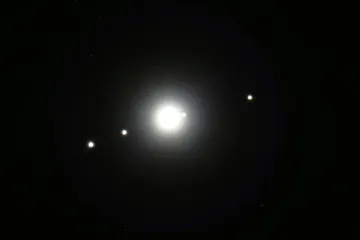
Galileo’s ability to make this discovery hinged entirely on his mastery of optics. While he did not invent the telescope—that credit generally goes to spectacle makers in the Netherlands—Galileo significantly advanced the instrument. [3] He ground his own lenses and constructed instruments capable of magnifying objects up to about 20 times their normal appearance. [3] This technological leap meant that for the first time, astronomers were seeing the sky not as the eye perceived it, but through an artificially extended visual mechanism. [3] The discovery demonstrated that what was previously considered the complete heavens, accessible only through unaided sight, was in fact incomplete when viewed with better technology. [3] Imagine the sheer difficulty in tracking objects that appeared as mere pinpricks of light, shifting their position relative to a much larger, brighter target night after night. The necessary precision in grinding, polishing, and mounting those glass elements to maintain a steady, useful magnification spoke volumes about Galileo’s practical expertise—it was as much an achievement of craftsmanship as it was of observation. [3]
# Four New Worlds
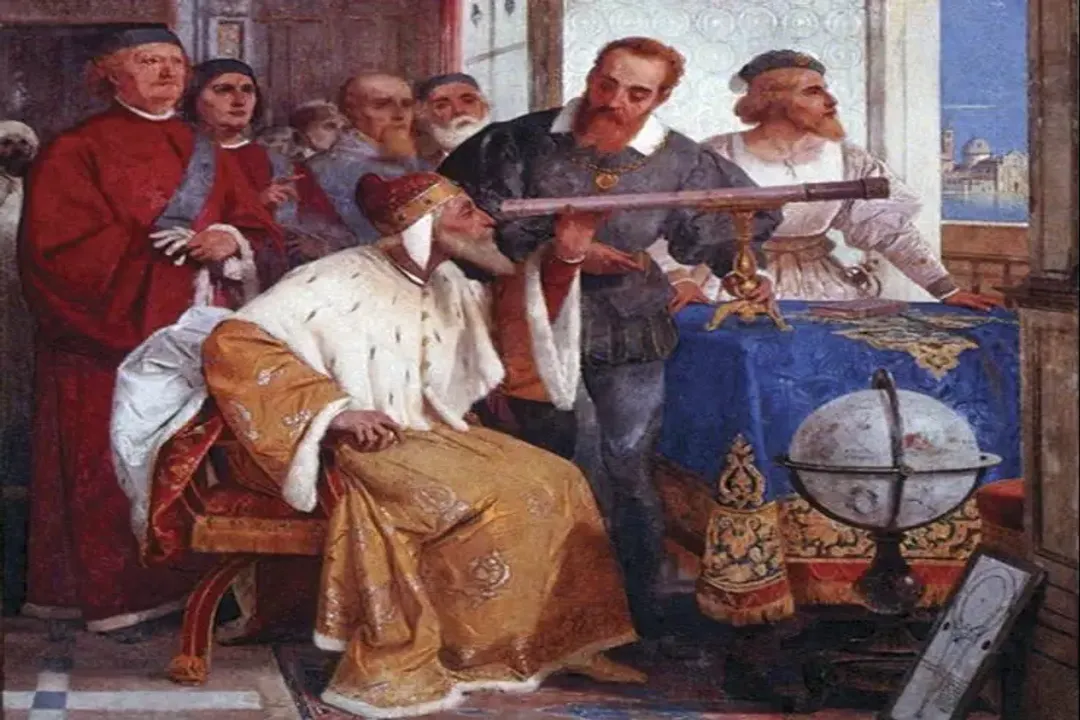
Galileo meticulously recorded his findings in his notebook, charting the positions of the three primary points of light relative to Jupiter over several nights in January 1610. [1][5] He first noted the three companions on January 7th. [9] When he later spotted the fourth, he realized he was observing not just a few unusual stars, but a miniature solar system revolving around Jupiter. [1][5][6] He initially dubbed his new discoveries the "Medicean Stars," dedicating them to his patrons, the powerful Medici family of Florence. [5] This political dedication was a clear attempt to secure patronage and protection for his controversial scientific findings. [5] Today, these four moons—Io, Europa, Ganymede, and Callisto—are universally known as the Galilean moons. [8] Interestingly, the German astronomer Simon Marius also observed these objects around the same time, though Galileo had published his results first. [8]
# Ptolemy Undone
The significance of these moving companions cannot be overstated; they struck at the very foundation of the prevailing cosmological model, the Ptolemaic system. [2][4] For over a thousand years, Western thought, heavily influenced by Aristotelian physics and sanctioned by the Church, maintained a strict geocentric view: the Earth was the stationary center of the universe, and everything—the Moon, the Sun, the five known planets, and the celestial spheres—orbited it. [2][4] Galileo’s observations provided the first truly undeniable, recurring, physical proof that celestial bodies existed which did not orbit the Earth. [1][6] Seeing those four dots reliably circling Jupiter shattered the dogma that Earth held a unique, central position in the heavens. [2][7] While the Sun-centered (heliocentric) model had been mathematically proposed by Copernicus decades earlier, it remained largely theoretical, lacking observable proof of its mechanics in action. [2][4] Jupiter’s orbiting moons provided that observational anchor for the Copernican idea: if Jupiter could carry its own satellites, then perhaps the Earth was simply another planet orbiting the Sun, carrying its own single satellite, the Moon. [7]
# Cosmic Shift
Galileo quickly compiled his findings and observations into a short book published in Venice in March 1610, titled Sidereus Nuncius, or the Starry Messenger. [4][6] This publication was his formal challenge to the established order, bringing his telescopic views—which included observations of the Moon's craters and the phases of Venus—to a wider academic audience. [4] The implications extended far beyond mere astronomy; they reached into philosophy and theology. [7] The controversy was immediate and intense because proving Earth was not the absolute center of creation was interpreted by many as demoting humanity's special status in the divine plan. [7] What Galileo achieved was not just adding four more known objects to the solar system; he provided a practical, visual demonstration that the universe was far more complex and mechanical than the ancient models allowed. [2] By showing that Jupiter behaved like a tiny solar system, he validated a new way of understanding celestial mechanics—one based on empirical observation rather than ancient authority. [4] This single discovery, stemming from Galileo’s meticulous tracking of four faint lights near a gas giant, effectively opened the door for modern astronomy and physics. [2][6]
Related Questions
#Citations
Galileo Discovers Jupiter's Moons - National Geographic Education
410 Years Ago: Galileo Discovers Jupiter's Moons - NASA
Why Did Galileo Need a Telescope to Discover the Moons of Jupiter?
Galileo Discovers the Major Moons of Jupiter | Research Starters
Satellites of Jupiter - The Galileo Project | Science
[PDF] In the Footsteps of Galileo: Observing the Moons of Jupiter
Galilean moons - Wikipedia
On this date: Galileo discovers three major moons of Jupiter