What was Galileo's most significant observation?
The Italian mathematician and philosopher, Galileo Galilei, forever changed humanity’s perception of its place in the universe not with a single pronouncement, but through a series of focused, clear-eyed observations made possible by his telescope. His work catalyzed the shift from reliance on ancient texts to a reliance on empirical evidence, a transition that many see as the true dawn of modern science. While his entire body of work—including his foundational contributions to dynamics—was monumental, the most significant observation was the one that provided the first conclusive empirical refutation of the established Ptolemaic cosmos: the discovery of the phases of Venus.
# Telescope Improvements
Galileo did not invent the concept of the refracting spyglass; the initial devices emerged from Dutch spectacle makers in 1608. However, upon hearing of these instruments, Galileo, already knowledgeable about optics, independently conceived of and rapidly constructed his own versions. Crucially, he didn't stop at replicating them. Within essentially one weekend in his workshop in the summer of 1609, he improved the design, creating instruments with magnifications of eight, and eventually up to thirty times the naked eye view. This improvement transformed the tool from a military or terrestrial novelty into a scientific instrument capable of revealing entirely new celestial truths. His ability to quickly refine the optics set him apart from others who merely possessed the technology.
# Moon Surface
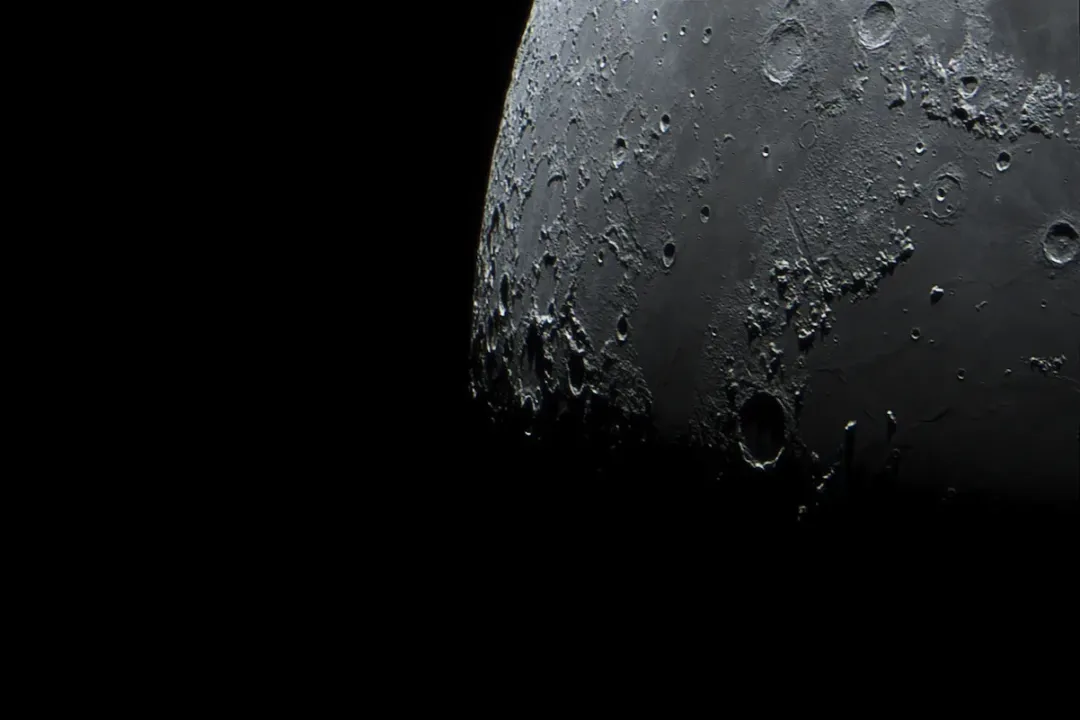
Galileo first turned this refined instrument skyward on November 30, 1609, by observing the Moon. What he saw immediately challenged centuries of received wisdom rooted in Aristotelian thought. The Moon was not the perfect, smooth, ethereal sphere described in classical philosophy, nor was it the flawless "eternal pearl" Dante described. Instead, Galileo documented a surface rough and uneven, covered in mountains and craters whose features were revealed by their shadows. He even sketched topographical charts and estimated the heights of these lunar mountains, showing that the Moon shared characteristics with the Earth itself. This finding proved that the heavens were not made of an unchanging, perfect substance, a concept essential to the traditional worldview.
# Jupiter Moons
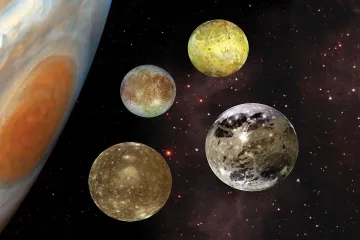
Soon after his lunar studies, in January 1610, Galileo pointed his telescope at Jupiter and spotted four tiny "fixed stars" in a line near it. Through subsequent nights of dedicated observation, he determined these "stars" were moving in complex patterns around the planet—he had discovered the four largest moons of Jupiter. He named them the Medicean Stars, honoring his patron, though they are now known as the Galilean moons.
This observation was an earthquake in cosmology because it demonstrated a system with more than one center of motion in the heavens. The primary argument against the Copernican, Sun-centered system had often been the question of what happened to the Moon if the Earth moved: wouldn't it be left behind?. The Jovian satellites provided a tangible, visible counterexample: if Jupiter could move through space while carrying its own moons, then the Earth could conceivably do the same with the Moon. This was a logical dismantling of a major objection to heliocentrism, validating the possibility of an orbiting Earth without having to invoke the yet-to-be-formulated physics of universal gravitation.
# Venus Phases
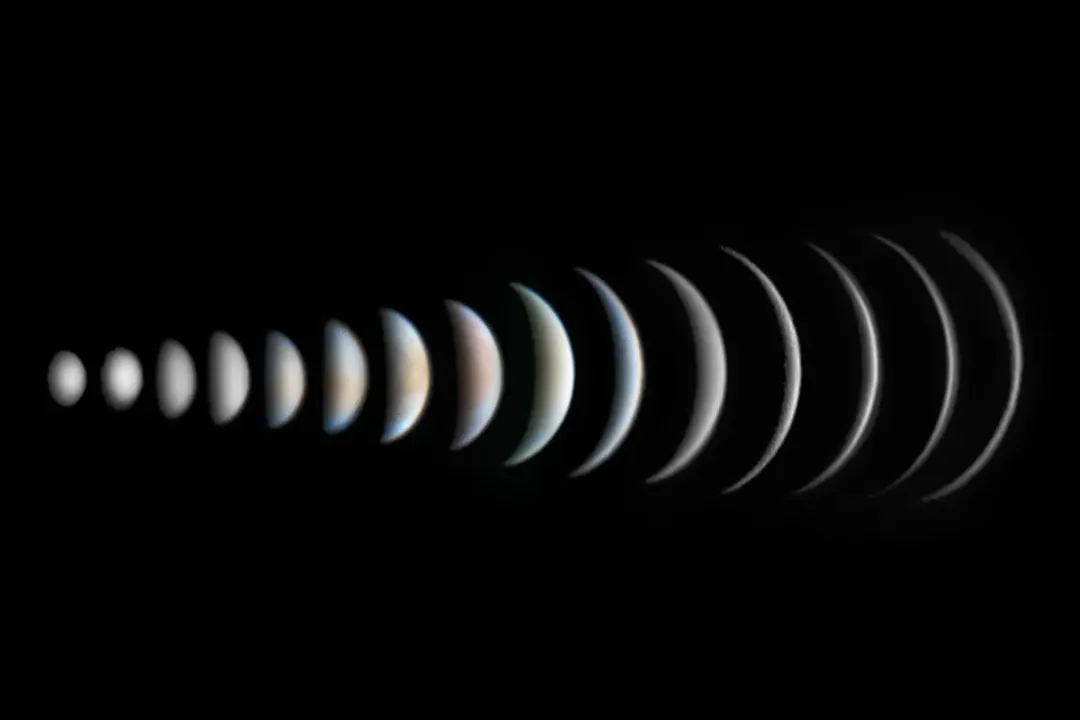
While the Jovian moons showed that the Earth could move, the observation of Venus's phases provided the empirical evidence that the Earth must move—or at least, that the Ptolemaic model was mathematically incapable of describing reality.
Beginning in September 1610, Galileo noted that Venus exhibited a complete cycle of phases, much like our own Moon, shifting from crescent to gibbous and eventually to a 'full' appearance. In the reigning Ptolemaic (Earth-centered) model, the geometry of Venus's orbit—which was confined to the interior of the Sun’s orbit around Earth—made it impossible to see Venus fully illuminated; it should only ever appear as a crescent or a slender crescent/new phase. In contrast, the Copernican model, where Venus orbits the Sun inside Earth’s orbit, perfectly predicted that we would see Venus pass through all its phases as it swung around to the far side of the Sun relative to us.
The phases of Venus, alongside the Jovian moons, delivered a crushing blow to the ancient cosmology. While the Jupiter moons addressed a critique of heliocentrism, the phases of Venus offered direct, geometric confirmation of the relative positions of the inner planets to the Sun. This became the first definitive, direct observational test between the two main world systems, showing that the Ptolemaic universe was not just more complicated, but fundamentally incorrect. It is for this reason, among the pantheon of his great discoveries, that the phases of Venus stand out as the single most significant observation for shifting the scientific consensus away from the geocentric view.
# Sunspots Rotation
Galileo’s inquiring eye also fixed upon the Sun itself, where he independently discovered sunspots. These dark blemishes were another affront to the presumed perfection of the celestial bodies. Furthermore, by tracking the movement of these spots over time, he demonstrated that the Sun was rotating on an axis. This implied that celestial bodies were subject to change and motion, just like Earth, further eroding the ancient division between a corruptible terrestrial realm and a perfect, unchanging heaven. While others, like Christoph Scheiner, also observed and debated the nature of these spots, Galileo’s analysis supported the notion of a dynamic cosmos.
# Empirical Foundation
Taken together, the observations of lunar topography, the satellites of Jupiter, the phases of Venus, and the rotation of the Sun demonstrated an undeniable fact: the universe was far stranger and more complex than anything described by Aristotle or Ptolemy. It was not enough to rely on authority; the physical evidence gathered through the telescope demanded a new philosophy. Galileo himself asserted that the "book of nature was written in the language of mathematics," characterized by geometric figures, thereby shifting natural philosophy from a qualitative account to a mathematical one where experimentation was recognized as a key method for establishing facts.
It is fascinating to contrast Galileo's success with that of his contemporary, the English astronomer Thomas Harriot. Harriot actually made the first recorded telescopic sketches of the Moon about a month before Galileo did in July 1609. Harriot’s map was even more detailed by 1612 or 1613. Yet, it is Galileo who is immortalized for the discovery. The difference lies not just in what was seen, but how it was disseminated. Galileo rapidly published his findings in the widely distributed Sidereus Nuncius (Starry Messenger) in 1610, complete with artfully drawn engravings that convinced the learned community. Galileo grasped that observation alone was not enough; the findings needed to be presented persuasively, using both mathematical reasoning and clear visual evidence, to challenge the entrenched authorities. His systematic publication made his observations the foundation upon which the next generation of thinkers, including Kepler and Newton, would build the new physical description of the universe.
# Physics Context
While the astronomical revelations were the most publicly explosive, Galileo’s work in physics provided the necessary context for a complete overthrow of the old system. He insisted that understanding motion—kinematics—was inseparable from astronomy. His studies on falling bodies led to the law that distance fallen is proportional to the square of the time elapsed (), assuming negligible air resistance. Furthermore, his formulation of inertia—that an object in motion tends to stay in motion unless acted upon by an external force—was a direct abstraction from observation (like rolling balls down inclined planes) that accounted for friction, which had previously obscured the true nature of motion. By unifying the laws of terrestrial motion with the celestial observations, Galileo began the synthesis of physics and astronomy that Newton would complete, making the Earth's motion a problem of physics, not just metaphysics.
In the end, while sunspots showed change and Jupiter’s moons suggested mobile centers, the phases of Venus provided the specific, geometrically necessary proof that the Earth-centered model, which had served as the core of cosmology for over a millennium, simply did not match the observable universe. That single, visually verifiable fact, rapidly published and defended, represented the tipping point for the entire scientific revolution.
#Videos
Galileo's Revolutionary Observation - YouTube
Related Questions
#Citations
Galileo Galilei - Wikipedia
What did Galileo discover? | Royal Museums Greenwich
Galileo's Revolutionary Observation - YouTube
Galileo Galilei - New Mexico Museum of Space History
Galileo and the Telescope | Modeling the Cosmos | Digital Collections
Galileo | Biography, Discoveries, Inventions, & Facts - Britannica
Observations of the Heavens: Galileo – Introduction to Astronomy
How Galileo changed the universe in a single day
Galileo: The Telescope & The Laws of Dynamics