Did Galileo prove that the Sun is the center of the solar system?
The question of whether Galileo proved the Sun is the center of the solar system is complicated, wrapping scientific discovery in layers of historical drama, theological resistance, and the very definition of what constituted "proof" in the early seventeenth century. To be precise, Galileo did not definitively prove the Earth revolved around the Sun in the modern, absolute sense. However, he provided the most compelling, observable evidence to date that shattered the long-standing, Earth-centered view of the cosmos, moving the Copernican theory from mathematical speculation to physical possibility.
# Geocentric View
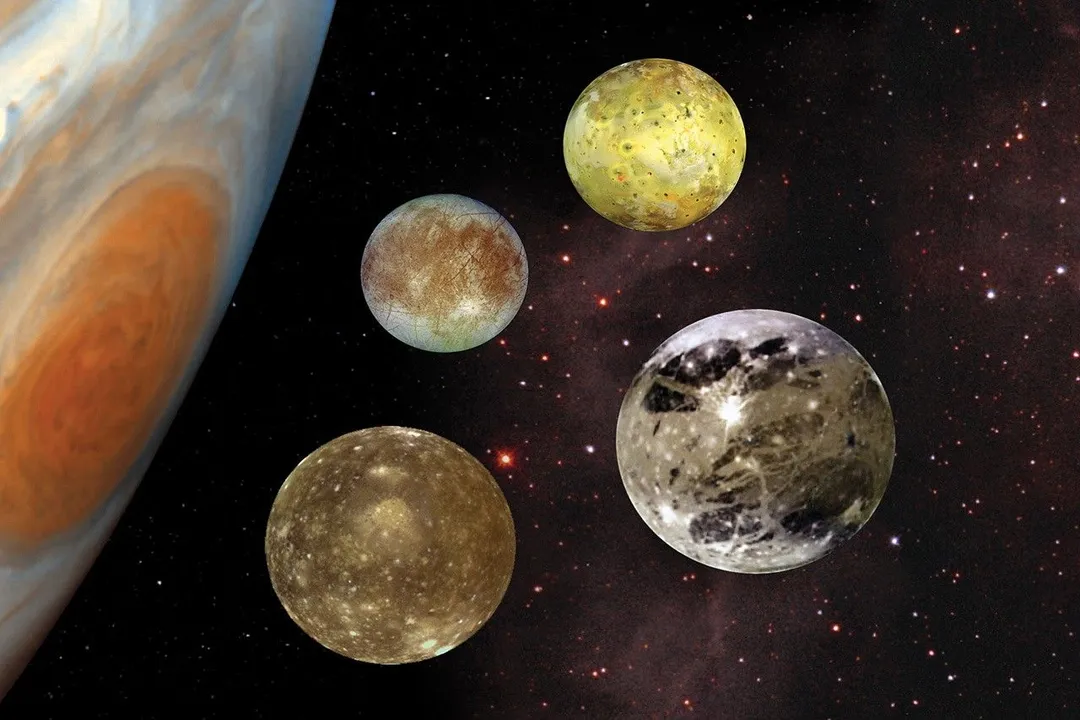
For centuries, the accepted structure of the cosmos, rooted in the work of Ptolemy and Aristotle, placed a stationary Earth at the very center of creation. This geocentric model held that everything visible in the heavens—the Moon, the Sun, and the planets—must circle our world in perfect, unblemished spheres. This worldview was deeply intertwined with the prevailing theological understanding, which suggested that Earth, as God's greatest creation and humanity's stage, should logically occupy the central, unmoving position. Even Copernicus, who proposed the Sun-centered, or heliocentric, system decades before Galileo, published his work only at the request of Pope Clement VII, and even he treated the idea primarily as a mathematical tool to simplify calculations, not necessarily as physical reality.
# Galileo's Lens

What separated Galileo Galilei from predecessors like Copernicus was not theory, but seeing. In 1609, hearing news of a new Dutch invention, Galileo constructed and then significantly improved his own telescope. He was the first person to systematically turn this device toward the heavens, using it to gather hard, quantitative data that contradicted the comfortable perfection demanded by the old system. His initial findings were shocking: the Moon was not a smooth sphere, but rugged, cratered, and rough, much like Earth. He also resolved the Milky Way from a faint cloud into countless individual stars, suggesting a far larger universe than previously imagined. These observations already chipped away at the Aristotelian notion of perfect celestial bodies, but the real revolution came when he turned his lens toward the planets.
# Jupiter Moons
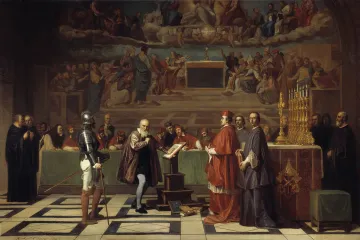
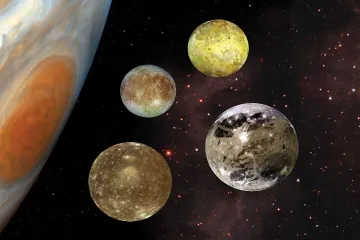
One of Galileo’s most immediately devastating discoveries, published in his Sidereus Nuncius (Starry Messenger) in 1610, involved the planet Jupiter. Through his telescope, he spotted four small "stars" that appeared to dance around the giant planet, sometimes vanishing behind it. Within days, he correctly deduced that these were, in fact, moons orbiting Jupiter, not the Earth. This finding delivered a direct, physical blow to geocentrism. If Jupiter could have its own satellites revolving around it, then the core dogma—that everything in the heavens orbited the Earth—had to be false. This established a critical precedent: other celestial bodies could serve as centers for smaller, local systems. This observation provided a miniature, observable model of a Sun-centered system operating on a smaller scale within the heavens.
# Venus Phases
Equally powerful, though perhaps more inferential, was Galileo’s study of Venus. Like our Moon, Venus goes through a cycle of illumination, displaying phases—crescent, quarter, gibbous, and full. In the strict Ptolemaic model, where Venus orbited the Earth within the Sun’s path, it could never be seen as anything other than a crescent or new phase, because it would always remain situated between the Earth and the Sun from our perspective. Galileo’s telescope revealed that Venus achieved a full range of phases. For Venus to appear "full" or "gibbous," it must swing to the far side of the Sun relative to Earth. This could only happen if Venus was orbiting the Sun, not the Earth. While the moons of Jupiter proved something didn't orbit Earth, the phases of Venus proved that at least one major planet must orbit the Sun. It is interesting to compare the nature of these two discoveries: the Jovian moons provided a direct counter-example to the "Earth-centric" rule, whereas the phases of Venus required a more complex deduction about the geometry of the entire system to make sense.
# Sun Spots
When Galileo focused on the Sun itself, he discovered dark markings—sunspots—which he tracked over time. This observation was twofold in its impact. First, it confirmed that the Sun was not the perfect, unblemished celestial sphere believed in since antiquity, as it displayed blemishes and changes on its surface. Second, by tracking the movement of these spots, Galileo concluded that the Sun itself was rotating on its axis. This implied a dynamic, physical body at the center of motion, rather than a remote, divine, and unchanging lamp.
# Missing Proof
Despite these overwhelming observations, the claim that Galileo proved heliocentrism needs careful qualification based on the standards of the day. The strongest scientific argument remaining against the moving Earth was the lack of observable stellar parallax. If the Earth was orbiting the Sun, as we now know, the apparent position of nearby stars should shift against the backdrop of more distant ones over the course of a year. Since no such shift was visible, many observers felt the Earth must be stationary. Galileo’s supporters argued that the stars were simply too far away for the shift to be measured with the contemporary technology available. Yet, this required an immense conceptual leap regarding the scale of the universe—a leap many contemporaries, including respected astronomers like Tycho Brahe, were unwilling to make. In fact, the Tychonic system, where planets orbit the Sun, but the Sun and stars orbit the Earth, explained the known observations just as well as Copernicus's model did at that observational level. Thus, Galileo’s argument often rested on the elegance and simplicity of the Copernican structure compared to the increasingly convoluted "circles upon circles" (epicycles) required by the older models, rather than irrefutable, final evidence. The true, direct physical confirmation of Earth's motion would wait for Newtonian mechanics in the late seventeenth century, and the precise measurement of stellar parallax in the nineteenth century.
# Inquisition Reaction
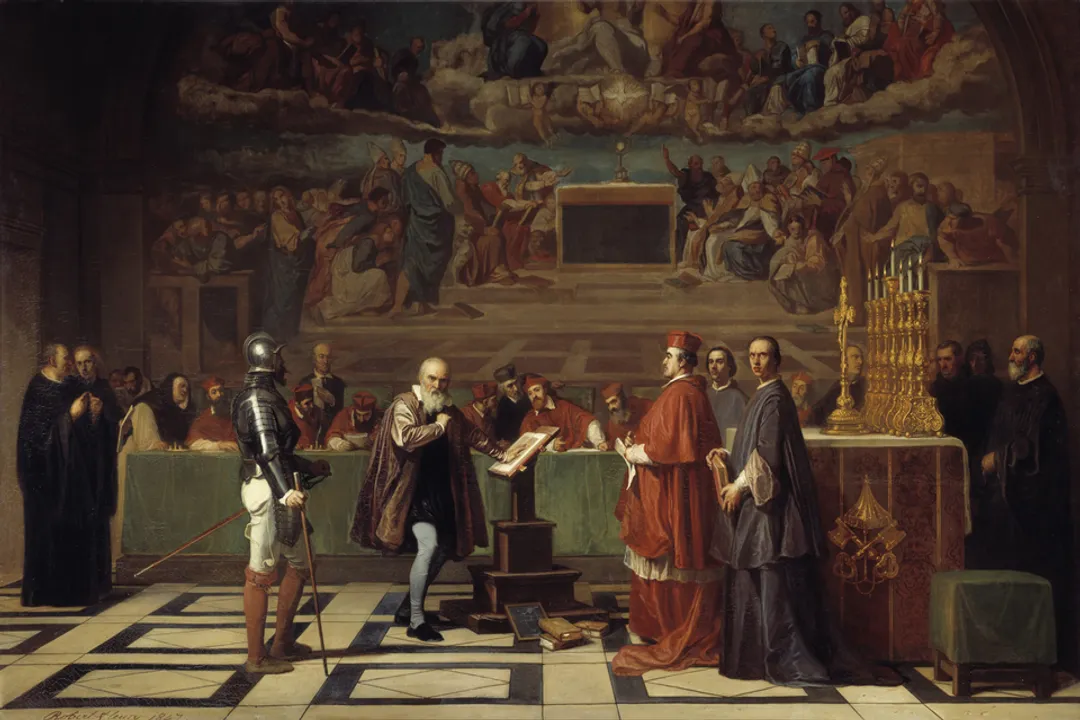
Galileo’s scientific conviction, however strong, immediately collided with institutional authority, leading to the infamous Galileo affair. By championing heliocentrism as truth rather than hypothesis, he stepped outside the boundaries of acceptable scientific discourse into theology. In 1616, the Inquisition declared the moving Earth proposition "erroneous in faith" because it contradicted a literal reading of Scripture, such as the story of Joshua commanding the Sun to stand still. Galileo was explicitly ordered to "abstain completely from teaching or defending this doctrine".
His defiance came in 1632 with the publication of his Dialogue Concerning the Two Chief World Systems. Though written as a dialogue, it overwhelmingly refuted the geocentric position, famously putting the Pope Urban VIII’s own arguments into the mouth of the character Simplicio, who was portrayed as an intellectual fool. This was an unforgivable political misstep. In 1633, Galileo was tried, found "vehemently suspect of heresy," forced to publicly recant his views, and sentenced to house arrest for the remainder of his life. While instruments of torture may have been present in the legal setting as custom dictated, records suggest they were not applied to him; he was treated with relative leniency, given his age, ultimately being held under house arrest rather than in a prison cell.
# Final Verdict
Did Galileo prove the Sun was the center? Scientifically, no, not to the degree that would silence all credible alternatives like the Tychonic system at that moment. He could not demonstrate the absence of stellar parallax, a necessary consequence of an orbiting Earth.
However, Galileo’s contribution was arguably more transformative than mere proof: he provided the necessary empirical foundation that made the heliocentric view intellectually inescapable for future generations. He gave the Copernican vision a physical reality it previously lacked. His discoveries regarding Jupiter’s moons and Venus’s phases offered concrete, observable data that the Earth-centered universe simply could not account for with any degree of simplicity or elegance. For this reason, he is often celebrated as the "father of modern astronomy" and the "father of modern science". He successfully forced the scientific question out of pure theory and into the observable realm, setting the stage for Kepler and Newton to complete the mathematical description of the solar system we accept today.
Related Questions
#Citations
Galileo Challenge
How Galileo Put the Sun at the Centre of the Solar System
Galileo's Observations of the Moon, Jupiter, Venus and ...
Galileo affair
eli5: How did Galileo figure out the Earth revolved around ...
Galileo: Sun-Centered System | PBS LearningMedia
Galileo Galilei
The Galileo Controversy
Copernicus and Galileo: Scientific Questioning