How did Galileo discover the Milky Way?
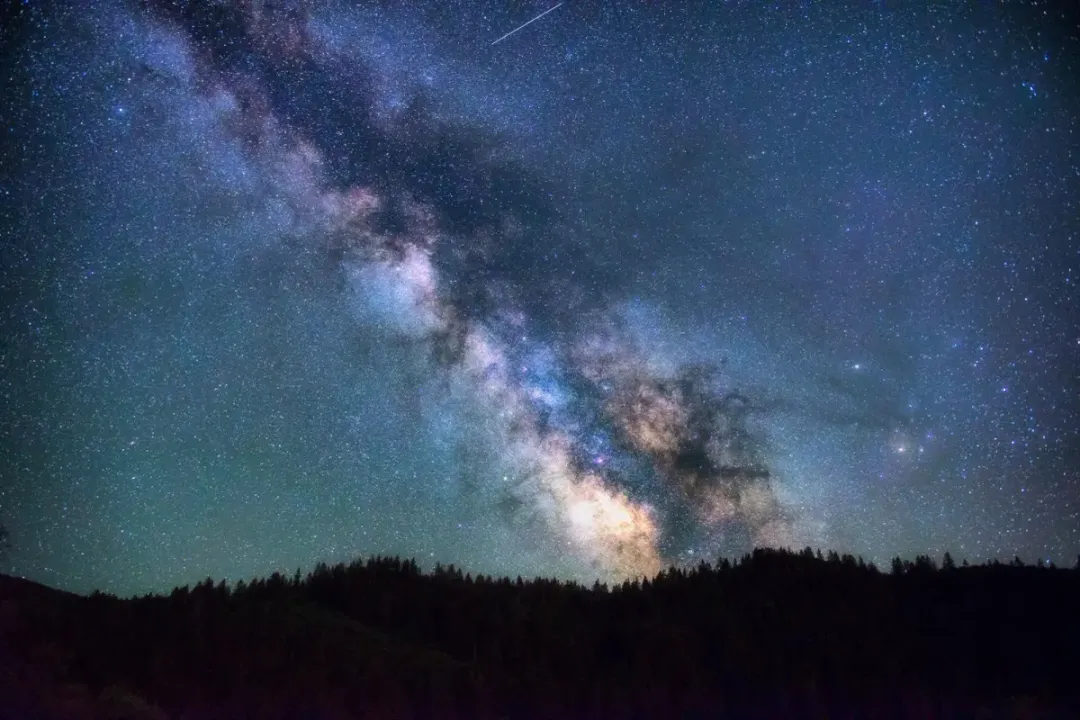
The misty swath of light visible across the night sky, which we now call the Milky Way, held a profound mystery for millennia. To ancient observers, this luminous band was simply a continuous cloud, a feature of the heavens distinct from the sharp, pinprick stars. [1][4][5] Descriptions varied, but the consensus before the 17th century was that it was an intrinsic celestial feature, perhaps a collection of faint lights blended together by distance or atmospheric conditions. [2][9] The real transformation in understanding this feature did not come from a new philosophical argument, but from a revolutionary piece of optical technology: the telescope. [8]
# Ancient Sight
Before Galileo turned his instrument skyward, thinkers had grappled with the nature of the Milky Way. Some, like the Greek philosopher Democritus, speculated it was composed of distant stars, but this remained conjecture, unsubstantiated by direct observation. [7] For the vast majority of scholars and observers, the appearance of a hazy, milky illumination suggested something diffuse, perhaps a fog or an extended nebula inherent to that region of the sky. [2][5] This perception persisted because, even under the clearest conditions, the individual components of that band were too dim or too far away for the unaided human eye to resolve them into separate points of light. [1][4]
# Telescope Power
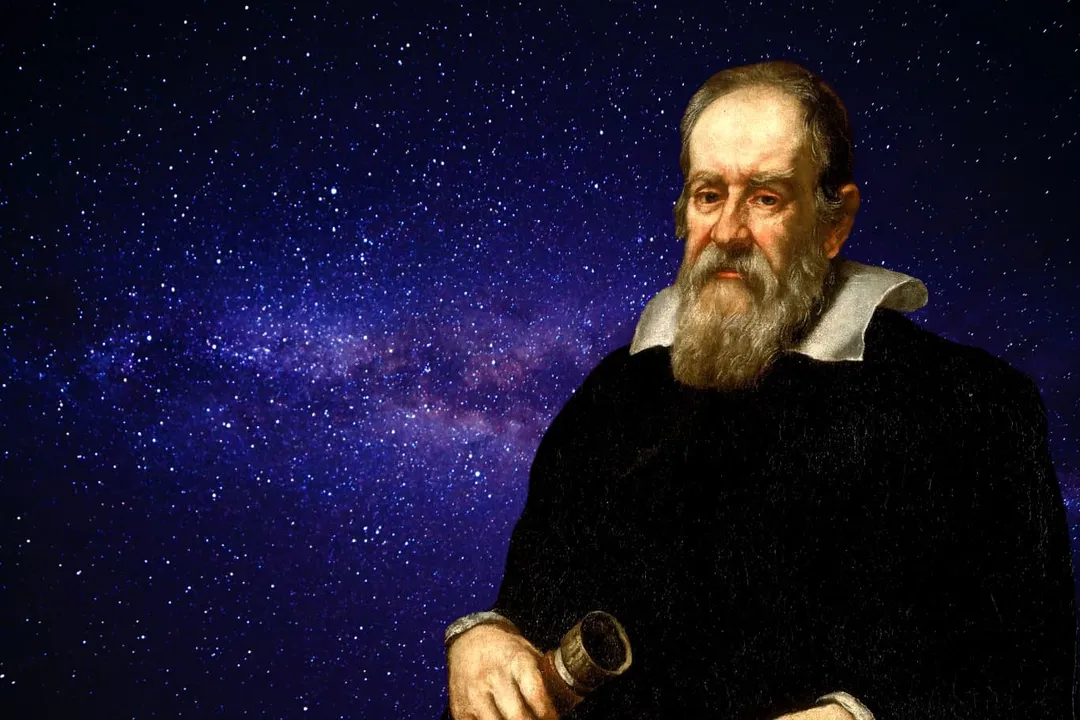
Galileo Galilei, renowned for his astronomical advancements, greatly improved the refracting telescope, making an instrument capable of magnification powerful enough to challenge long-held cosmological beliefs. [8] He wasn't the first to build a telescope, but his skill in grinding lenses produced instruments with an unprecedented clarity and magnification power for his time. [2] It was with one of these refined devices, around 1610, that Galileo turned his attention to the familiar glow of the Milky Way. [1][6]
The shift in observation wrought by the telescope was immediate and jarring. Where the eye perceived seamless milkiness, the telescope revealed structure. [2][4] The sheer clarity offered by his instrument meant that the light was no longer perceived as a continuous substance, but rather as an accumulation of discrete sources. [9] The experience must have been astonishing: the "cloud" dissolved under scrutiny, revealing its true nature as a densely packed stellar field. [4]
# Revealing Stars
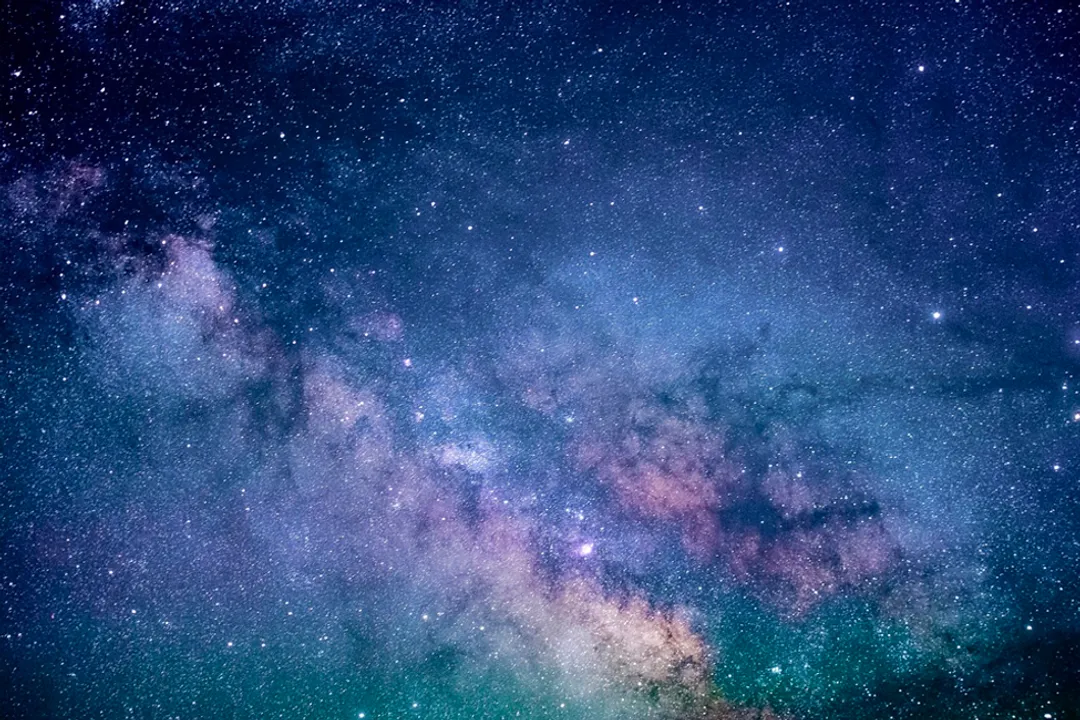
Galileo meticulously recorded his observations, publishing his findings in the seminal pamphlet Sidereus Nuncius (Starry Messenger) in 1610. [1][4][6] This publication detailed his discoveries, including the moons of Jupiter and the rugged surface of the Moon, but his description of the Milky Way was equally earth-shattering for the established cosmology. [1] He stated plainly that the Milky Way was "nothing but a mass of innumerable stars distributed in clusters". [6]
This confirmation was direct visual evidence that objects existed in the heavens at distances far exceeding the capabilities of previous naked-eye astronomy. [5] He proved that the light was not a cloud but rather light from stars that were too faint individually to be registered by human vision without optical aid. [2][5] It is important to note the subtle distinction here: while he proved the composition was stellar, he was not yet discovering the Milky Way as a galaxy in the modern sense—a massive island universe. He saw the ingredients, not the architectural blueprint of the whole structure. [3]
Consider the technological gap this represents. To the naked eye, the brightest star in the Pleiades cluster might appear as a single point, yet Galileo’s instrument could separate them. Applying that same principle to the faint band of the Milky Way meant that what appeared as a faint glow was actually millions of stars so tightly packed along the line of sight that their individual light merged into a perceived haze. [1][4] This forced observers to confront a universe far more populated and vast than previously assumed, immediately expanding the perceived scale of the cosmos by orders of magnitude.
# Structural Implication
Galileo’s discovery fundamentally changed the debate about the structure of the heavens. The revelation that the diffuse light was composed of countless distant suns shifted astronomical focus from what the Milky Way was composed of to how those stars were arranged. [5] It suggested a depth to space that was previously only theoretical.
While Galileo established the stellar nature of the band, the true mapping of our galaxy—understanding that the stars we see are all part of a massive, rotating disk structure, and that this structure is one galaxy among billions—took centuries to develop. [3] Thinkers like William Herschel later attempted to map the distribution of these stars to determine the Sun's location within the structure, though even Herschel’s models were limited by not accounting for interstellar dust obscuring the view. [3] Galileo’s contribution was the critical first step: dismantling the idea of the Milky Way as a simple celestial fog and replacing it with the concept of an immense stellar population. [9]
Galileo’s observation effectively ended the debate over the nature of the light but opened the much larger, more complex question of cosmic geography. [7]
| Observer/Era | View of Milky Way | Supporting Evidence/Tool |
|---|---|---|
| Ancient Greeks | Continuous, hazy cloud or nebula | Naked Eye Observation |
| Pre-Galilean Scholars | Speculated stars, but unproven | Philosophical Argument |
| Galileo Galilei (1610) | Mass of innumerable, discrete stars | Refracting Telescope [1][6] |
| Post-Galilean Era | Stellar disk/island universe (much later) | Advanced Telescopes, Spectroscopy |
One interesting point of comparison is how this discovery contrasted with his other observations. When Galileo pointed his telescope at Jupiter, he saw four distinct points of light orbiting it—the Medicean Stars. [8] Both observations involved resolving something previously seen as singular or diffuse into multiple components. However, the Jupiter moons were close enough to show clear, rapid motion; the stars of the Milky Way were so distant that their individual motions were impossible to detect with the technology of the time, forcing him to accept the resolved points as static, incredibly far-off objects. [4]
# Continuing Inquiry
The success Galileo had in resolving the Milky Way fueled further telescopic examination by him and others. He continued to look at other nebulae and "smudges" in the sky, realizing that many of these unresolved patches were likely collections of stars too remote even for his powerful instrument to separate fully. [2] This realization set the stage for future astronomers to recognize that some faint nebulosity visible through telescopes might represent other, even more distant island universes, a concept that would only be fully proven during the 20th century. [3]
Galileo Galilei was not the first person to theorize about the nature of the Milky Way, but he was undeniably the first person to see its true composition with irrefutable visual evidence. [7] His success hinged entirely on his ability to construct and aim a superior optical instrument toward the sky, making the discovery a landmark achievement in the history of scientific instrumentation as much as in astronomy. [8] This single observational moment, made possible by better glass and a steady hand, permanently altered humanity's conception of its place within the stellar expanse.
Related Questions
#Citations
177. Galileo Galilei, First to See the Milky Way Galaxy
Milky Way - What does your image show
The Milky Way: One of the Many Galaxies | Modeling the Cosmos
14.5: Galileo Galilei, First to See the Milky Way Galaxy
Who Discovered the Milky Way? - Universe Today
GALILEO AND THE STARS
Did Galileo discover the Milky Way Galaxy? - Quora
Galileo Galilei - New Mexico Museum of Space History
Discovery of the Milky Way - Cosmos at Your Doorstep