What did Galileo discover about the Earth's moon?
The world's understanding of the heavens before the early seventeenth century was largely built upon an ancient, elegant system where celestial bodies were considered perfect, unchanging, and fundamentally different from the messy Earth. The Moon, our closest celestial neighbor, was supposed to be a beacon of ethereal smoothness, a flawless orb reflecting light consistently across its face. This long-held view, rooted in Aristotelian philosophy, stood as an untouchable truth for centuries. However, when Galileo Galilei turned his newly improved telescope toward the sky, starting his serious astronomical observations in late 1609, that ancient perfection began to crumble, starting right next door on the lunar surface.
# First Sight

Galileo’s modification of the spyglass into a powerful astronomical instrument provided him with an unprecedented look at worlds beyond Earth. While his later work with Jupiter would capture global attention, his initial scrutiny fell upon the familiar visage of the Moon, beginning around November 30, 1609. What he saw immediately contradicted millennia of received wisdom. The Moon, viewed through his lens, was not the smooth, polished ball depicted in diagrams or imagined by philosophers. Instead, it appeared rugged, mottled, and strikingly... terrestrial.
The evidence he gathered suggested that the Moon was not made of a pristine, incorruptible substance separate from our own world; rather, it possessed topographical features strikingly similar to those found on Earth. This was an early, crucial step in dislodging the strict separation between the celestial and terrestrial realms, a conceptual shift as significant as the visual discovery itself.
# Shadow Study
The primary method Galileo employed to confirm the existence of surface irregularities relied on the universal behavior of light and shadow. He focused his attention on the terminator—the ever-moving line separating the sunlit portion of the Moon from its dark side. When an object has a perfectly smooth, spherical surface, the transition across this line is sharp and predictable. On a smooth sphere, one would expect features to illuminate or darken almost simultaneously as the terminator swept over them.
Galileo observed something different. Near the edge of illumination, points of light—small, bright spots—would appear before the rest of the landscape around them, or conversely, certain indentations would remain dark long after the surrounding plains had brightened. This behavior could only be explained by objects casting shadows of varying lengths. If the surface were flat, the shadows would be nearly nonexistent or uniform. The fact that shadows near the terminator seemed to stretch and shorten dramatically day by day proved, unequivocally, that there were vertical structures protruding from the surface.
It is fascinating to consider why observing shadows near the terminator provided such definitive proof when simply noting the Moon's overall uneven brightness might not have been as convincing to the skeptics of the time. A slight variation in albedo (reflectivity) could be attributed to different mineral compositions or even atmospheric effects, though the Moon has none. The geometry inherent in a shadow's lengthening and shortening—a direct consequence of height relative to the sun's angle—is a mathematical certainty that bypassed philosophical objections and pointed toward physical reality. The changing length of these shadows offered a kind of real-time measurement of elevation change across the lunar surface.

# Lunar Heights
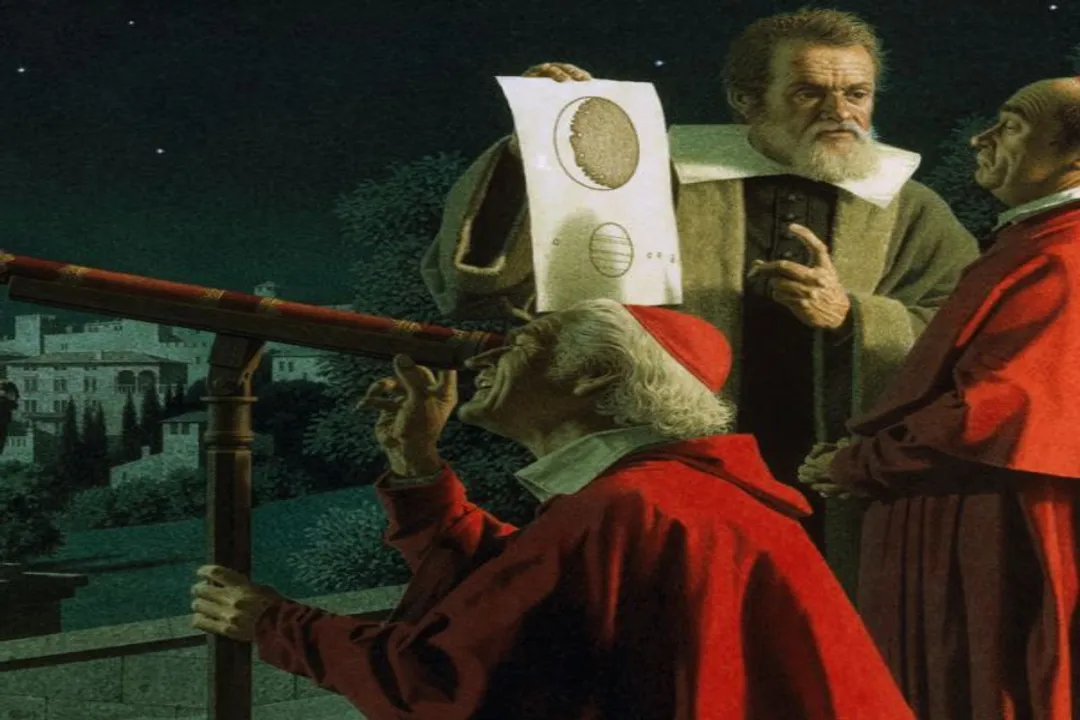
By measuring these changing shadows against the known dimensions of the Moon, Galileo was able to make quantitative estimates regarding these surface features. He concluded that the Moon hosted both mountains and valleys. These were not mere imperfections in the telescope's optics or blemishes on the lens; they were features etched into the lunar body itself.
While the specific measured heights might be subject to the limitations of his early instrument, the presence of mountains and valleys was established fact for Galileo. This discovery overturned the ancient consensus that the Moon was constructed of a perfect fifth element, the aether, which was held to be inherently smooth and unchanging. Galileo showed that, at least concerning its physical structure, the Moon shared the same kind of rugged geology as the Earth, suggesting a physical kinship rather than a divine, separate creation.
# Earthly Texture
The most revolutionary implication of these observations was the comparison drawn between the Moon and the Earth. Galileo did not just state the Moon had mountains; he stated it was like the Earth. This was a profound step toward cosmography—the understanding that different celestial bodies might share common physical characteristics—a concept central to modern planetary science but radical in 1610.
If the Moon possessed mountains and valleys, it suggested geological processes, perhaps even erosion or volcanic activity over vast timescales, similar to those shaping our own world. This blurred the sharp metaphysical line drawn by classical thinkers between the corruptible, changeable Earth and the immutable, perfect heavens. The celestial bodies, it seemed, were made of familiar stuff, governed by familiar physics, even if the details of those governing laws were yet to be fully mapped.
Consider the sheer scope of this comparison in the context of scientific communication then and now. Galileo's initial findings, including those about the Moon, were formally laid out for the world to see in his groundbreaking work, Sidereus Nuncius (Starry Messenger), published in 1610. A reader today can see a new image from the Lunar Reconnaissance Orbiter and have it shared globally in seconds. For Galileo, that information—the revolutionary concept that the Moon was mountainous—traveled from his eye, through his pen, to the printing press, and finally to the learned society of Europe over several months, culminating in the published text in January 1610. This initial physical evidence, though observed in late 1609, represented a vast information lag by modern standards, yet it was enough to trigger an immediate upheaval in astronomical thought.
# Publication Context
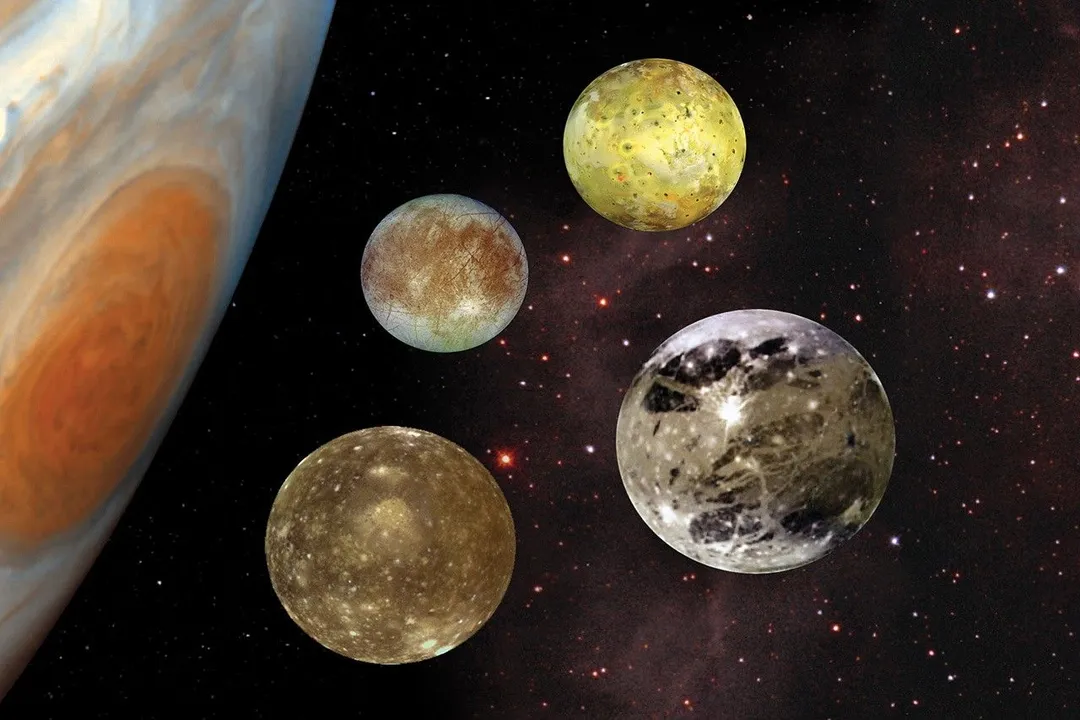
While the discoveries concerning the Moon were groundbreaking evidence for a non-perfect cosmos, they were part of a broader observational program Galileo undertook with his new instrument. By the time he wrote his first letter describing his observations, including the Moon, in January 1610, he had already cataloged the startling 'stars' orbiting Jupiter. The Moon's rough surface served as the first major piece of evidence against old models, confirming the telescope was revealing tangible, physical truths about celestial bodies, which was then dramatically reinforced by the discovery of Jupiter's moons.
The Moon's imperfection, therefore, wasn't an isolated finding; it was the gateway discovery that validated the telescope as a scientific instrument capable of revealing the physical nature of the heavens, paving the way for the acceptance of his more controversial findings about the Jovian satellites.
# Summary of Lunar Features
Galileo's direct contributions regarding the Earth's Moon can be summarized simply, though their impact was anything but simple:
| Discovery Point | Description | Implication |
|---|---|---|
| Surface Texture | Not perfectly smooth, but marked by irregularities. | Challenged the Aristotelian concept of perfect celestial orbs. |
| Physical Relief | Presence of distinct mountains and valleys. | Demonstrated geological similarity between the Moon and Earth. |
| Observational Proof | Shadows near the terminator changed length daily. | Provided verifiable, physical evidence for surface height variations. |
| Publication | Detailed in Sidereus Nuncius in 1610. | Disseminated proof that the heavens were physically complex and changeable. |
Galileo's dedicated look at the Moon with his telescope provided the first concrete, observable data that the heavens were not made of special, flawless stuff. By showing that the closest celestial body shared the rugged, imperfect nature of our own Earth—evidenced by shadows cast by real mountains and valleys—Galileo established a crucial precedent: astronomy was no longer purely theoretical philosophy; it was now an observational science focused on physical worlds.
Related Questions
#Citations
Galileo's Observations of the Moon, Jupiter, Venus and the Sun
Galileo begins observing the moon | November 30, 1609 - History.com
How Galileo Discovered Mountains On The Moon - Forbes
Galileo: Discovering Jupiter's Moons | PBS LearningMedia
Galileo Galilei - Wikipedia
Galileo Discovers Jupiter's Moons - National Geographic Education
Also on this day: 7 January 1610, Galileo Galilei wrote his first letter ...
Why Did Galileo Need a Telescope to Discover the Moons of Jupiter?
The Galileo Project | Science | Moon