Did Galileo prove the Earth rotates around the Sun?
The question of whether Galileo Galilei definitively proved the Earth rotates around the Sun is fascinating because it forces us to define what "proof" meant in the early 17th century versus what it means today. While Galileo provided the most compelling observational evidence to date that made the ancient, Earth-centered model, Ptolemy's system, untenable, the final, irrefutable mathematical demonstration of heliocentrism would require evidence not yet available during his lifetime. [1] His real triumph lay not in delivering the final mathematical proof, but in championing direct observation through the telescope, shifting the foundation of astronomical authority away from ancient texts and toward empirical reality. [6]
# New Sights
When Galileo turned his improved telescope skyward, he began accumulating data that systematically dismantled the prevailing cosmological understanding. [1] For centuries, the accepted view held that the heavens were perfect, unchanging crystalline spheres carrying the Sun, Moon, and known planets around a stationary Earth. [7] Galileo’s observations directly contradicted this perfection.
One of his earliest and most significant findings involved the planet Jupiter. He discovered four celestial bodies orbiting Jupiter, which we now know as the Galilean moons. [1] This observation was profoundly important because it presented a small, working model of a system where not everything revolved around the Earth. [1] If everything in the heavens must orbit our planet, as the established view insisted, then Jupiter’s satellites presented an immediate, visible exception. [1] This observation demonstrated that Earth was not the singular center of all motion in the cosmos. [6]
Another critical piece of evidence came from observing Venus. Galileo noticed that Venus exhibited a full set of phases, much like our Moon, ranging from crescent to full. [1] In the traditional Earth-centered (geocentric) model, Venus would always appear in a crescent phase because its orbital path kept it mostly between the Earth and the Sun, meaning we would rarely see its fully illuminated side. [1] However, in the Copernican Sun-centered (heliocentric) model, Venus orbits the Sun internally, allowing observers on Earth to see it pass through all its phases as it moved around the Sun, just as Galileo witnessed. [1] This phenomenon could not be satisfactorily explained by Ptolemy’s complex system of epicycles, while it was a natural consequence of Copernicus’s arrangement. [1][6]
He also studied the Sun, observing dark blemishes—sunspots—which proved that the Sun itself was not a perfect, unblemished orb of light, another blow to the classical notion of heavenly perfection. [1] Furthermore, by tracking the movement of these spots across the Sun’s surface over time, Galileo inferred that the Sun was, in fact, rotating on its axis. [1] This finding added another dynamic body to the heavens, further eroding the concept of a static, central Earth.
# Explaining Movement
Galileo vigorously argued for the Copernican system, but he needed a mechanism to explain how a moving Earth could be reconciled with everyday experience. [4] For the average person, the most obvious counterargument to a rotating Earth was: if we are moving so fast, why don't we feel it, and why don't objects dropped from a height land far behind us?[9]
Galileo’s scientific explanation centered on inertia. [4] He proposed that everything on Earth—the atmosphere, objects, and people—shares the Earth's motion. [4][9] To illustrate this concept, he often used thought experiments, such as imagining a ship sailing smoothly on calm water. [9] If you drop a ball on a smoothly moving ship, it falls straight down relative to the ship, not backward toward the stern, because the ball, the ship, and the water are all moving together. [4][9] This idea, that objects retain their motion unless acted upon by an external force, laid groundwork for the later formulation of Newton's laws. [4] If the Earth was moving, the air and everything on it moved with it, making the motion undetectable in daily life. [9]
While this explanation addressed the feeling of motion, it did not constitute the definitive observational proof that heliocentrism requires, which is the key distinction in answering the initial question.

# The Unseen Proof
The most powerful, direct evidence that Galileo lacked—and the evidence that would have definitively proved the Earth’s orbit—was stellar parallax. [1] Stellar parallax is the apparent shift in the position of a nearby star against the background of more distant stars as the Earth moves from one side of its orbit around the Sun to the other over the course of a year. [1] If the Earth orbits the Sun, this shift must occur. [7]
In the 17th century, however, the stars appeared to be fixed points of light, showing no discernible shift. [1] This absence of measurable parallax was taken by opponents as strong evidence against the Earth's motion. [1] Galileo, recognizing this obstacle, suggested that the stars must simply be unimaginably far away, making the shift too small for contemporary instruments to detect. [1][7] While this turned out to be true—stellar parallax was finally measured in the 1830s—it left his argument incomplete in the eyes of his contemporaries. [7]
Furthermore, Galileo himself looked for proof in the wrong place: the tides. [5] He advanced the theory that the tides were caused by the sloshing motion of the oceans resulting from the Earth’s rotation and orbital motion. [5] Interestingly, modern science shows that tides are primarily caused by the Moon's gravity, with the Sun playing a secondary role, meaning his attempt to explain tides in support of Copernicus was, in fact, a significant scientific error. [5] Relying on tides, therefore, detracted from the strength of his purely observational arguments regarding Venus and Jupiter.
# Heresy and Science
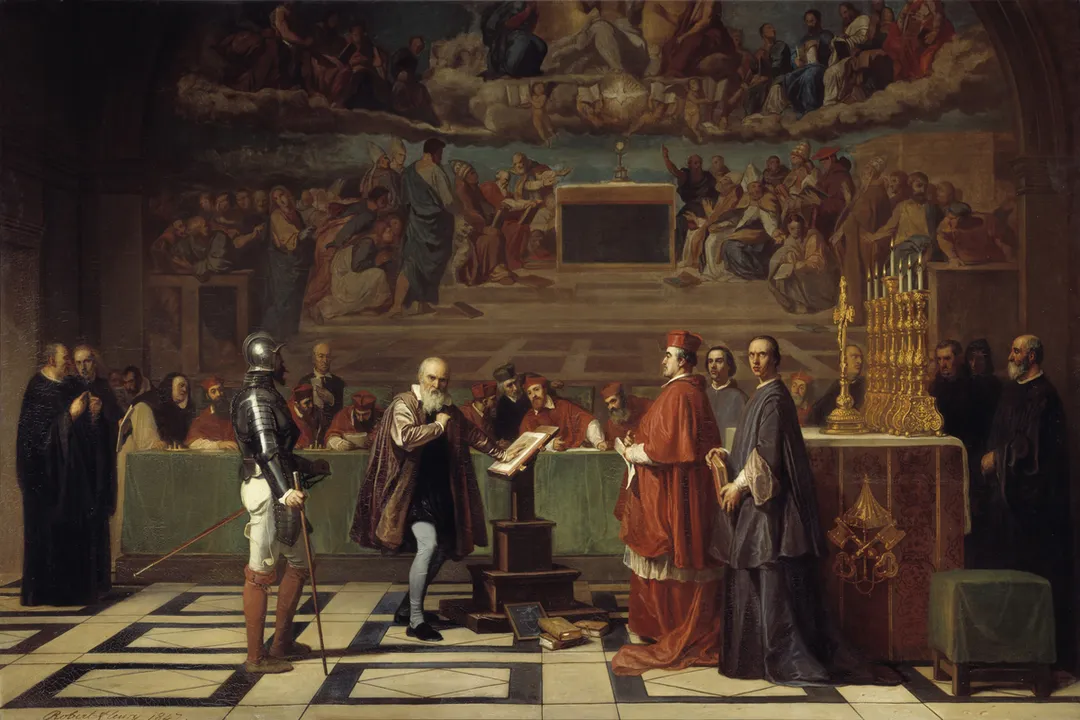
Galileo's enthusiastic promotion of the Copernican system as physical fact, rather than just a mathematical hypothesis, placed him in direct conflict with the Catholic Church. [2][8] In 1616, the Church officially declared the proposition that the Sun is the center of the world and immovable, and that the Earth moves, to be "formally heretical". [7][8] Galileo had previously been warned against holding or defending this view. [2]
His 1632 publication, Dialogue Concerning the Two Chief World Systems, openly compared the Ptolemaic and Copernican models, strongly favoring the latter, leading to his trial by the Inquisition. [2][7] In 1633, Galileo was forced to recant his support for heliocentrism and spent the remainder of his life under house arrest. [2][7][8] This historical episode highlights that in that era, proof was often dictated more by theological or institutional authority than by empirical demonstration. [7] The very act of asserting heliocentrism as physical reality, regardless of the strength of the telescopic data, was seen as defiance. [2]
| Observation/Argument | Heliocentric Implication | Status in Galileo's Time |
|---|---|---|
| Moons of Jupiter | Not everything orbits Earth | Strong observational evidence |
| Phases of Venus | Earth must orbit inside Venus's path | Strong observational evidence |
| Stellar Parallax | Must be observable if Earth moves | Missing/Unobserved |
| Tides | Caused by Earth's physical motion | Incorrectly explained |
| Inertia Principle | Explains why we don't feel movement | Conceptual support |
If we look at the situation purely through the lens of modern falsifiability, Galileo did not prove the Earth orbits the Sun; he merely disproved the Ptolemaic system with overwhelming observational data. [1] He provided the necessary evidence for the model to be taken seriously, but the mechanism of proof was incomplete without the later discovery of stellar aberration and parallax. [7]
However, understanding the context changes the assessment. For the scientific community of the time, the inability of the geocentric model to account for the phases of Venus was a catastrophic failure of explanation, whereas Galileo’s observations provided an elegant, simple alternative. [1][6] The strength of his evidence, derived from applying a new instrument—the telescope—to the heavens, was so persuasive that it initiated the irreversible scientific shift. While he never saw the final nail in the coffin (parallax), his findings were the structural beams upon which the final proof was later built. His work established the necessity of a Sun-centered view, even if the full mathematical demonstration waited for Newton’s synthesis decades later. [6] Galileo armed science with the telescope, showing the world that the universe was far more complex and dynamic than previously imagined, and that nature would only reveal its secrets to those willing to look directly at it.
Related Questions
#Citations
Did Galileo have Proof of the Earth's Movement?
Galileo Challenge - Stanford Solar Center
Galileo affair - Wikipedia
The History of an Idea That Launched the Scientific Revolution
Galileo's Big Mistake | PBS LearningMedia
How Galileo Put the Sun at the Centre of the Solar System | PI News
When did we realize Earth orbits the Sun? - Astronomy Magazine
When Galileo Stood Trial for Defending Science - History.com
What was Galileo's scientific explanation for saying that the Earth ...