What did Galileo use to study the stars?
The initial tools Galileo Galilei employed to study the stars were a direct refinement of existing, relatively simple optical devices, which he transformed into instruments capable of reshaping humanity's view of the cosmos. [2][4] While many people associate Galileo with the invention of the telescope, it is more accurate to say he was the first to systematically modify, build, and turn this novel device skyward with a dedicated scientific purpose. [2][4][7] Before him, the telescope was largely a novelty, sometimes used for terrestrial viewing, but Galileo recognized its profound potential for charting the heavens. [2]
# The Instrument
The device at the heart of Galileo’s astronomical revolution was the telescope. [2][5] This instrument relied on the principle of light refraction through lenses to make distant objects appear closer and brighter. [4] When Galileo first heard about a Dutch invention—a spyglass—he immediately grasped its implications for astronomy. [2][4]
He did not rely on purchasing existing models; instead, he dedicated himself to understanding the optics well enough to create his own versions. [2][4] His initial efforts resulted in devices offering only about three times magnification, but his rapid improvements soon led to instruments far more powerful than any previously available. [2]
# Lens Craft
Galileo’s true expertise lay not just in assembly, but in the painstaking craft of lens-making. [2][4] The quality of the celestial observations was entirely dependent on the precision of the glass components he fashioned. This involved grinding and polishing the glass himself, a highly skilled artisanal task that set his work apart. [2][4]
A key technical detail involves the specific lens arrangement he favored for astronomy. Early spyglasses often used a convex objective lens paired with a concave eyepiece, which resulted in an erect, or upright, image—excellent for looking at ships at sea. [4] However, Galileo found that for observing celestial bodies, an arrangement that produced an inverted image (one turned upside down) offered superior magnification and a wider field of view. [4] This inverted image was acceptable, even preferable, for stargazing since orientation was less critical than clarity and reach. His best instruments could achieve magnifications around 20x or 30x. [2]
To put this optical power in perspective, a modern, good quality pair of binoculars easily offers 10x magnification with a wide field of view. Galileo’s 30x telescope, while a monumental leap for the 17th century, still required immense skill to extract detailed information from the resulting view, especially considering the inherent optical flaws, or aberrations, present in his early lenses. [4]
# Celestial Discoveries
The true measure of Galileo's tools is found in the groundbreaking observations they enabled, which fundamentally challenged the ancient, established models of the universe. [5][7] His telescope was the mechanism through which he gathered the empirical evidence needed to support the Copernican system, moving astronomy from pure geometry to observational science.
# Lunar Surface
One of his earliest targets was the Moon. [5][7] For centuries, the Moon was considered a perfect, smooth celestial sphere, as per Aristotelian philosophy. [5] Galileo’s telescope revealed something entirely different: mountains, valleys, and craters. [5] This observation immediately destroyed the idea that heavenly bodies were fundamentally different from the Earth, suggesting they were physical worlds subject to geological processes. [7]
# Moons of Jupiter
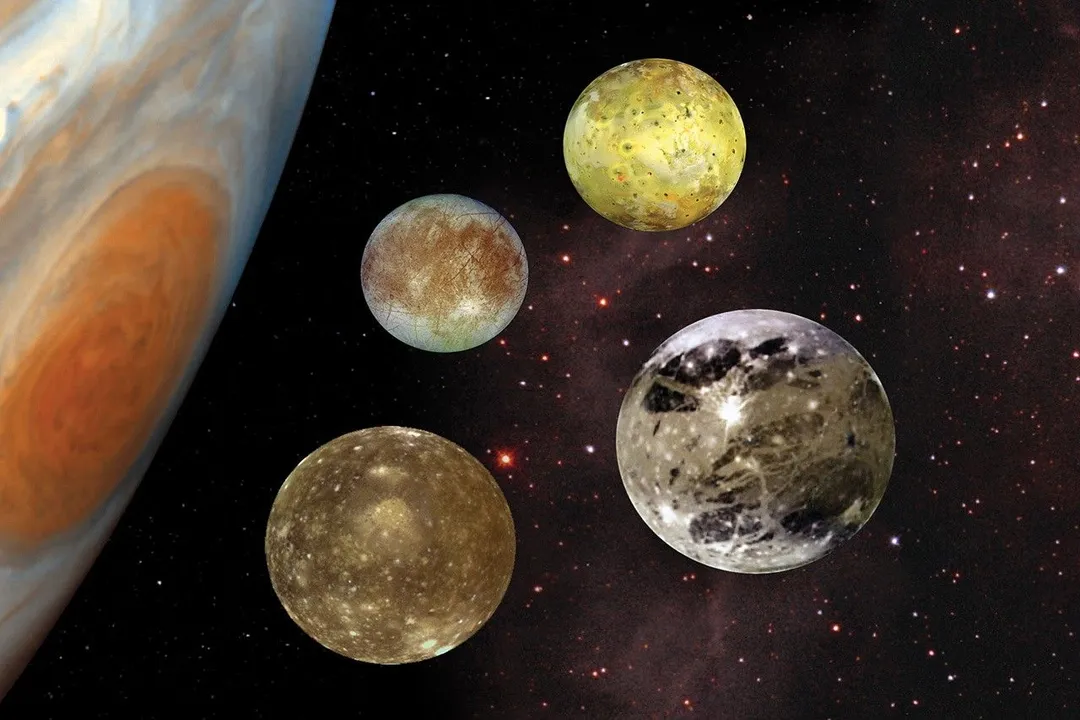
Perhaps the most famous application of his instrument was the discovery of four celestial bodies orbiting Jupiter. [5][7] These were the four largest moons of Jupiter—Io, Europa, Ganymede, and Callisto. [5] Observing these moons repeatedly over several nights showed Galileo that they revolved around Jupiter, not the Earth. [5] This was direct, observable proof that not everything in the heavens orbited our planet, directly contradicting the long-held geocentric model. [2][7]
# Phases of Venus
Galileo also turned his instrument toward Venus. [5] He observed that Venus went through a complete set of phases, much like the Moon. [5] In the old Ptolemaic system, Venus would only ever appear as a crescent because it orbited between the Earth and the Sun. [5] The observation of a full set of phases proved that Venus must orbit the Sun, adding another powerful piece of evidence for the heliocentric view. [5]
He also used his modified optical device to observe sunspots, providing further evidence that the Sun itself was not a perfect, unblemished orb. [5]
# Beyond Measurement
It is essential to note what Galileo did not use, especially when considering modern astronomical practice. While he was a brilliant mathematician and devised ways to calculate the paths and positions of the objects he saw, the telescope itself was primarily an optical amplifier, not a sophisticated measuring device in the modern sense. [6] He wasn't employing spectrometers to analyze chemical composition or high-precision clocks tied to the instrument to measure precise angular separations that required extreme accuracy beyond what a simple tube with lenses could provide. [6]
Galileo’s method was one of repeated, careful visual record-keeping and drawing. He meticulously charted what he saw, often sketching the positions of Jupiter’s moons night after night. [7]
Consider the advancement scale. A modern backyard telescope often has computer tracking and digital sensors capable of measuring angular separation down to fractions of an arcsecond. Galileo was working with an optical tube whose performance was fundamentally limited by the quality of hand-ground glass, relying on his naked eye to interpret the magnified image. [4] His achievement lies less in the raw technology—which was rudimentary—and more in the intellectual leap to apply that technology to fundamental philosophical questions, supported by diligent, almost obsessive, note-taking. [2][7] His visual acuity and understanding of optics allowed him to derive profound physical laws from what, to others, were merely fuzzy points of light and a slightly pitted Moon. The tool was simple, but the interpretation was revolutionary.
Related Questions
#Citations
Galileo Galilei
Galileo and the Telescope | Modeling the Cosmos
Galileo Galilei
The First Telescopes (Cosmology: Tools)
What instrument did Galileo use to measure the stars?
Galileo's Telescope | PBS LearningMedia
Stargazing with Early Astronomer Galileo Galilei
Galileo's Contributions to Astronomy with the Telescope
Galileo's Observations of the Moon, Jupiter, Venus and ...