What are the limitations of using an astronomical refracting telescope?
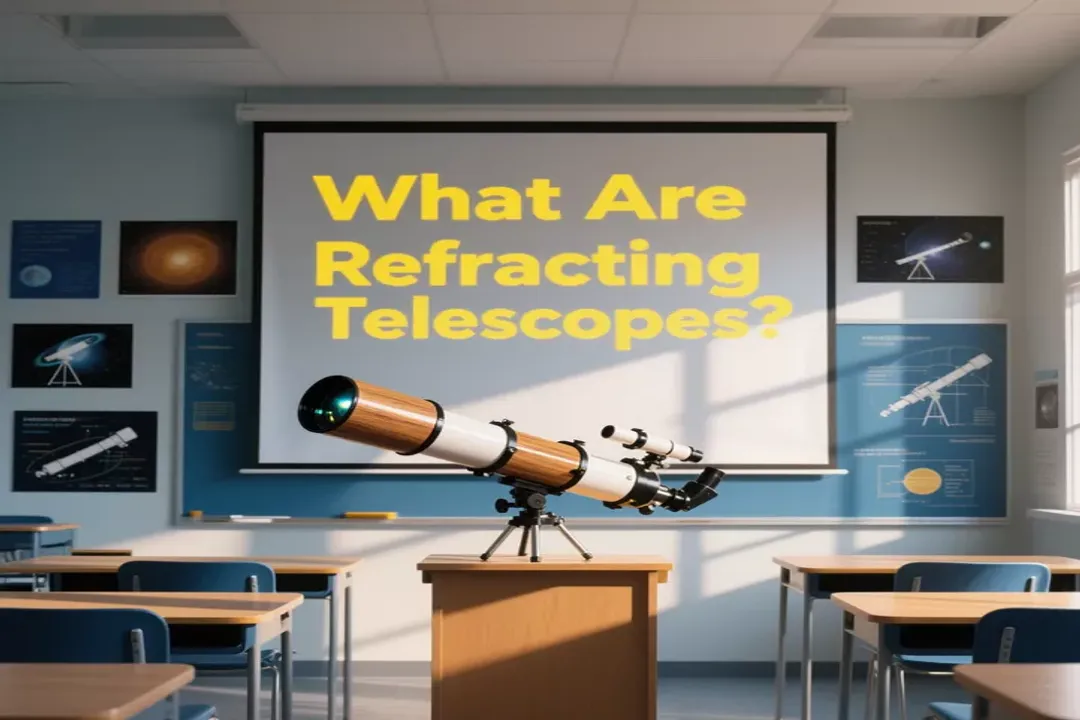
The refracting telescope, the classic design popularized by Galileo, relies on objective lenses to gather and focus light to a single point, creating an image for the observer or a secondary instrument. [5] These instruments are celebrated for providing crisp, high-contrast views, particularly at lower magnifications, because they do not suffer from the central obstruction that plagues most reflector designs, allowing for sharper diffraction patterns. [5] However, this elegant system of bending light through glass comes with fundamental physical and economic limitations that place strict boundaries on their ultimate performance and size compared to their mirror-based counterparts. [3][5]
# Color Fringing
The most frequently cited and fundamental limitation of any refractive optical system using a single lens material is chromatic aberration. [7] This occurs because the glass used in the objective lens refracts (bends) different wavelengths of light—i.e., different colors—by slightly different amounts. [7][9] As a result, blue light focuses at a slightly different point than red light, meaning a perfectly focused image for one color will appear slightly blurred or fringed with color for the others. [7]
For visual astronomy, this manifests as colored halos around bright objects, such as the Moon, Jupiter, or bright stars near the horizon. [9] While astronomers recognized this problem early on, the solution wasn't a simple fix. Early attempts involved using multiple lenses made from different types of glass to cancel out this effect, leading to the development of the achromatic doublet. [5] This design typically pairs a convex crown glass lens with a concave flint glass lens, which helps bring two specific colors (usually red and blue) to a common focus. [7]
Despite the cleverness of the achromatic design, it is not a perfect solution. It only corrects for two colors, leaving a residual aberration known as secondary spectrum, where green/yellow light focuses slightly off the plane of the other two colors. [5][7] To combat this secondary color issue, even more complex lens combinations, like the apochromatic (APO) objective, are employed, requiring three or more lens elements made from specialized, expensive glasses. [9] While an APO refractor offers superb color correction, it significantly increases the complexity, manufacturing time, and, critically, the final cost of the instrument. [5]
# Lens Size Limits

Another defining constraint is the physical boundary on how large the objective lens can be manufactured and supported. [5] Unlike a mirror, which can be supported from the back across its entire surface, a refractor's objective lens is typically supported only around its edge cells. [5]
This edge support method introduces a severe problem: gravity. A large, heavy lens will inevitably sag under its own weight unless the supporting structure is perfectly rigid and precisely engineered to counteract the gravitational pull across the entire optical surface. [5] Even minute distortions caused by sagging destroy the optical quality, rendering the telescope useless for high-magnification or deep-sky imaging. For a primary mirror, only the back surface needs perfect figuring; for a refractor, both the front and back surfaces must maintain perfection relative to each other during use. [9]
This physical reality places a practical ceiling on the aperture available in high-quality refractors. While large reflecting telescopes with apertures of 10 inches, 12 inches, or even larger are common, high-end refractors rarely exceed 6 or 7 inches in aperture for amateur and many professional applications because the challenges associated with supporting a larger, heavier lens become prohibitively difficult and expensive to manage. [5] This physical constraint means that for collecting the maximum amount of light—the primary goal in observing faint, distant objects—reflectors maintain a distinct advantage in achieving large apertures cost-effectively.

# High Expense
The difficulty in manufacturing large, optically perfect lenses directly translates into a significant economic limitation: refractors are substantially more expensive than reflectors of equivalent aperture size. [3][5]
The production process for a high-quality objective lens involves laborious grinding and polishing of both sides of the glass blank to precise curves. [9] Any flaw—a scratch, a bubble, or an inclusion within the glass itself—often renders the entire blank unusable, leading to material waste and increased labor costs. [9] Furthermore, to overcome chromatic aberration, manufacturers must often use specialized, high-dispersion, low-dispersion, or exotic glass types, which are inherently pricier than the standard optical glass used for mirrors. [5]
This cost disparity is perhaps the most immediate practical limitation for many potential buyers. If an amateur astronomer has a fixed budget, say $$3,000$, they will find that this amount buys a significantly larger light-gathering area in a Newtonian or Schmidt-Cassegrain reflector than it will in a high-quality, color-corrected refractor. [6] For instance, that budget might secure a 4-inch APO refractor, but an 8-inch or 10-inch reflector, which gathers four to six times more light, respectively. When the goal is to see the faintest galaxies, this economic trade-off strongly favors the mirror design. [3]
# Aberration Types
While chromatic aberration receives the most attention, refractors are also susceptible to other optical distortions, most notably spherical aberration. [7] Spherical aberration occurs when light rays hitting the outer zones of a spherical lens focus at a different point than rays hitting the center. [7]
Unlike chromatic aberration, which is inherent to using a single refractive element, spherical aberration can be mathematically corrected by shaping the lens surfaces in a non-spherical, or aspheric, profile. [7] However, grinding and polishing a surface into a precise aspheric curve is technically much more demanding than producing a simple spherical curve, further escalating manufacturing difficulty and cost. [7] While some older or very simple refractors might display noticeable spherical issues, most modern, high-quality refractors are designed to be nearly free of this specific defect, often by utilizing lens doublets or triplets that are figured precisely to correct for it. [9]
# Atmospheric Limits
Even if a refractor were flawless in its glass and mounting, its performance when situated on Earth is limited by the atmosphere itself. [4] This limitation is not unique to refractors—reflectors share it—but it affects how one uses the telescope. The Earth's atmosphere causes turbulence, which blurs stellar images into twinkling patterns, a phenomenon commonly called seeing. [4]
This atmospheric distortion limits the practical angular resolution one can achieve, regardless of the telescope's aperture. A large, perfectly figured refractor sitting on the ground cannot resolve details finer than what the local atmospheric conditions allow. [4]
However, the atmosphere also plays a role in light absorption, particularly in the blue and ultraviolet wavelengths. [4] Placing a refracting telescope in space, as done with the Hubble Space Telescope (which uses mirrors, though the principle applies to optics in general), completely removes both the distortion from turbulence and the absorption effects of the atmosphere, allowing the theoretical resolving power of the instrument to be realized fully. [4] While placing a massive objective lens in space presents immense engineering and mass concerns, removing the atmosphere is the only way to eliminate this environmental hurdle completely.
When considering the trade-offs, it is useful to look at aperture ratio versus actual light-gathering power. A refractor, because it has no central obstruction, often achieves a higher contrast for a given aperture than a reflector of the same size, which must incorporate a secondary mirror that blocks a small percentage of incoming light. [5] For a visual observer focused primarily on separating tight double stars or viewing the moon under calm skies, this contrast advantage can be significant. However, the absolute light-gathering capacity, which is proportional to the square of the aperture diameter, remains the dominant factor for faint objects, and the physical size constraints detailed above mean the refractor hits its light-gathering limit much sooner than a reflector budget allows.
Another practical consideration for the user revolves around maintenance and alignment. Refractors are generally considered collimation-free systems; once the lenses are perfectly aligned by the manufacturer, they typically remain aligned due to the fixed mounting of the objective lens. [9] Reflectors, especially those with large, exposed mirrors, often require periodic realignment (collimation) by the user to maintain peak performance. [9] This ease of maintenance is a strong argument in favor of refractors for users who prefer a true "set-it-and-forget-it" instrument, provided they can accept the optical trade-offs associated with the fixed aperture size.
#Videos
What Are Two Disadvantages Of Refracting Telescopes? - YouTube
Ch. 6: Telescopes (10 of 25) What Are the Limitations of ... - YouTube
Related Questions
#Citations
Advantages and Disadvantages of Refracting Telescopes - UBC Math
What Are Two Disadvantages Of Refracting Telescopes? - YouTube
Write two important limitations of a refracting telescope over a ...
What limitation of a refracting telescope could be overcome ... - Quora
The advantages and disadvantages of the different designs at a ...
Need advice to understand pros and cons of a dobsonian vs a ...
Telescopes and their limitations - Mr Toogood Physics
Refracting Telescopes: A Comprehensive Guide - Band Optics