Which is the most common element in the universe?
The single most abundant element in the entire cosmos is hydrogen. It is, by a substantial margin, the universe's reigning champion of chemical elements, making up the vast majority of all ordinary matter we can observe. [2][5][6][10] To truly grasp its dominance, consider that roughly three out of every four atoms in the universe are hydrogen atoms. [5] By mass, it accounts for about 75% of the elemental content in the cosmos, with its nearest competitor trailing far behind. [1][5]
# Cosmic Genesis
The reason for hydrogen's overwhelming prevalence is intrinsically linked to the very beginning of the universe: the Big Bang. [5][6][10] When the universe was extremely young and hot, the initial conditions favored the creation of the simplest possible atomic structures. [5] As the universe cooled just moments after its explosive start, fundamental particles coalesced into the first nuclei, and these nuclei were overwhelmingly just single protons, which form the nucleus of a hydrogen atom. [5][6][10] Hydrogen is, in essence, the primordial building block from which everything else was later constructed. [10]
This initial cosmic recipe was surprisingly simple. The immediate aftermath of the Big Bang resulted in a universe composed almost entirely of hydrogen and helium. [3][5] The formation process was quick and efficient for these light nuclei, requiring very little energy input relative to the subsequent synthesis of heavier elements. [7] Because hydrogen is the simplest element—consisting of just one proton and one electron—it was the first element to form and the easiest to produce in large quantities during that initial period of rapid expansion and cooling. [2][10]
# Helium's Role
Following hydrogen, the second most abundant element is helium. [1][3][5] Like hydrogen, helium formed during the Big Bang nucleosynthesis. [3] While hydrogen dominated, the conditions were also right for some of those initial protons to fuse into helium nuclei (which contain two protons and two neutrons). [3]
When looking at the distribution of matter in space, the ranking remains quite clear: Hydrogen holds the top spot, Helium is second, and everything else—the elements that make up planets, water, and life—comprises only a tiny fraction of the total elemental inventory. [1][5]
To provide some perspective on this imbalance, if we were to list the top few elements by mass percentage, the contrast is stark:
| Rank | Element | Approximate Mass Percentage | Origin |
|---|---|---|---|
| 1 | Hydrogen | Big Bang | |
| 2 | Helium | Big Bang | |
| 3 | Oxygen | Stellar Fusion | |
| 4 | Carbon | Stellar Fusion |
This simple breakdown immediately highlights an interesting point: the two most common elements account for roughly 99% of the universe's ordinary matter. [1][5] The remaining 1% is where all the complexity—the carbon in our bodies, the oxygen we breathe, the iron in our blood—resides. [1][7] The sheer percentage difference means that even if a star creates massive amounts of oxygen, its contribution to the total cosmic elemental budget is minuscule compared to the baseline amount of hydrogen already present. [4]
# Stellar Furnaces
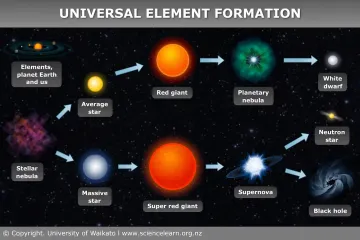
If hydrogen and helium were created in the Big Bang, where did the next most common elements come from? The answer lies within stars themselves. [1][5] Elements heavier than lithium are primarily synthesized through nuclear fusion reactions occurring in the cores of stars, a process known as stellar nucleosynthesis. [1][5][7]
Oxygen often ranks as the third most abundant element overall, and it is the most abundant heavy element. [4][5][7] Its abundance is a testament to the life cycle of massive stars. [7] Stars fuse hydrogen into helium, and once the core hydrogen is depleted, they begin fusing helium, which eventually leads to the creation of carbon and, subsequently, oxygen. [4] When these massive stars reach the end of their lives and explode as supernovae, they scatter these newly forged elements across the galaxy. [1][5]
It is fascinating to consider that the existence of oxygen, vital for terrestrial life, depends entirely on the death of large stars, while hydrogen's existence depends only on the universe's birth. [1][7] This means that the entire chemical complexity we see today is built upon a foundation established in the first few minutes of time, with subsequent generations of stars acting as the necessary, albeit less voluminous, factories for everything else. [9]
# Why Not More Variety?
A natural question arises when considering the small percentage of elements beyond the top two: why is the universe so heavily weighted towards simplicity? Why aren't the intermediate elements, like carbon or nitrogen, as common as oxygen, or why aren't elements like iron or silicon more prevalent than they are?[9]
The answer lies in the efficiency and requirements of the stellar processes themselves. [7] For an element to become common, it must be produced in vast quantities and then efficiently released into the interstellar medium.
- Production Thresholds: Fusing elements together requires specific temperature and pressure conditions found only in stellar cores. [7] For example, creating carbon requires the triple-alpha process, where three helium nuclei fuse, a reaction that requires precise conditions that aren't as readily sustained as the initial hydrogen-to-helium conversions. [7]
- Stellar Lifecycles: Elements like oxygen are produced abundantly in massive stars, but the life cycle of these stars is relatively short compared to the universe's history, and their abundance is contingent on a specific mass range. [4] Less massive stars, which are far more numerous and longer-lived, typically end their lives by gently puffing off their outer layers as planetary nebulae, primarily returning unprocessed hydrogen and helium, or elements like carbon and nitrogen, rather than large amounts of oxygen. [7]
- Iron's End: The production of elements heavier than iron effectively stops the normal fusion process within a star because fusing iron consumes energy rather than releasing it. [7] This generally requires a supernova explosion to create elements beyond iron, making them inherently rarer. [1]
This tiered system of creation results in a distribution curve that heavily favors the lightest elements forged in the Big Bang, with subsequent heavier elements forming a rapidly decreasing ladder of abundance based on how difficult they are to create and how often their host stars die violently enough to spread them around. [9]

# Where We Find Hydrogen
Hydrogen isn't just a historical relic; it is actively shaping the universe today. [6] Because it is the fuel for stars, it is everywhere that stars exist, but also in the vast spaces between them.
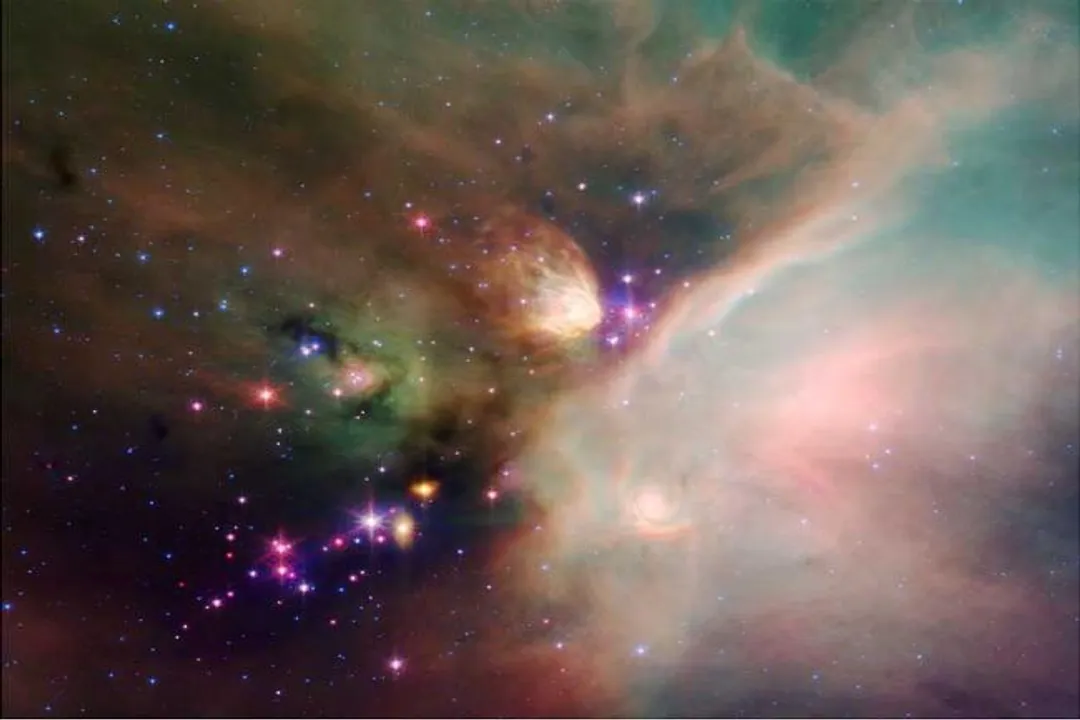
Vast clouds of cold, dense molecular hydrogen exist in the interstellar medium, often referred to as stellar nurseries. [6] These clouds are where gravity begins to win the long battle against outward pressure, causing the gas to collapse inward, eventually igniting the fusion process that creates a new star. [6] Observatories specializing in radio astronomy, such as those involved with the National Radio Astronomy Observatory (NRAO), frequently focus on detecting the specific radio signature of neutral atomic hydrogen to map the structure and dynamics of galaxies. [6] This ubiquitous gas allows astronomers to trace the spiral arms of galaxies and measure how quickly they are rotating, giving us deep insight into galactic dynamics. [6]
Even within a solar system like our own, hydrogen is dominant. For example, the Sun is overwhelmingly composed of hydrogen, which it converts into helium in its core, powering its energy output for billions of years. [5] On Earth, while hydrogen is chemically reactive and often bonded with other elements (like in water, ), it is still incredibly abundant, though its nature as a free element is rare on our planet due to its low mass allowing it to easily escape Earth's gravity. [2][10]
If we consider the element by number of atoms, hydrogen’s dominance is even more pronounced than by mass. Since it is the simplest atom (one proton), it contributes the greatest count of particles to the cosmic inventory, solidifying its place as element number one in nearly every atomic census conducted across space. [2][5] Hydrogen atoms are the baseline unit upon which the entire periodic table is constructed. [10]
Related Questions
#Citations
This Is Where The 10 Most Common Elements In The Universe ...
Hydrogen - Wikipedia
If Helium is the second most abundant element in the universe then ...
The Abundance of Oxygen | Center for Astrophysics
Why Is Hydrogen the Most Common Element in the Universe?
Hydrogen is the most abundant element in the universe. So where ...
Why is oxygen the third most abundant element?
Why are the most common elements in the universe so ... - Quora
Hydrogen – the number 1 element - Science Learning Hub