Why is the universe red?
The light reaching us from the farthest reaches of space carries a distinct signature, one that often makes people ask why the universe appears fundamentally red. This isn't because every star or galaxy is actually glowing with a deep crimson hue, but rather a consequence of the fabric of space itself stretching while that light travels across cosmic distances. This stretching phenomenon is known as redshift, and it is one of the most profound pieces of evidence we have for a dynamic, evolving cosmos. [2][4]
# Light Stretches
Light travels in waves, and the color we perceive depends on the wavelength of that light. Shorter wavelengths appear bluer, while longer wavelengths look redder. [2] When a source of light is moving away from an observer, the light waves get stretched out during their transit. This lengthening of the waves shifts the light toward the red end of the electromagnetic spectrum—hence, the term redshift. [2][4] Conversely, if a celestial object were moving toward us, its light waves would be compressed, resulting in a blueshift. [6]
In the case of galaxies, we observe a predominant redshift, meaning almost everything outside our immediate local group is receding from us. [6] Early astronomers, utilizing spectroscopy, found that the characteristic spectral lines of elements like hydrogen and calcium in distant galaxy light were shifted toward the red end compared to laboratory measurements of the same elements here on Earth. [3] This consistent pattern indicated a universal recessional velocity for these objects. [4]
# Expansion Link
While the stretching of light waves is analogous to the familiar Doppler effect observed with sound waves (like a siren dropping in pitch as it passes), the cause in cosmology is distinctly different for distant objects. [5] For nearby objects, motion through space causes a Doppler shift. However, for very distant galaxies, the primary driver of the redshift is the expansion of space itself. [3][5]
Imagine drawing dots on a rubber band and then stretching the band; the dots move apart not because they are walking across the rubber, but because the medium connecting them is expanding. [4] Cosmological redshift is this stretching effect applied to photons. [5] As space expands, the distance between us and a distant galaxy increases, and in doing so, the wavelength of the photon it emitted is stretched proportionally to the expansion that occurred during its travel time. [4] This mechanism is the cornerstone of the Big Bang model, confirming that the universe is not static but has been expanding for billions of years. [7][9]
The magnitude of this stretching is what tells us about distance and time. The amount of redshift, usually expressed as the redshift parameter , correlates directly with how much the universe has expanded since the light was emitted. [2] A redshift of means the universe has expanded by a factor of two since that light began its journey. [4]
# Seeing Red
It is crucial to understand that while the light shifts toward red, the effect is not uniform across all light. If a galaxy emits a strong signal in the visible blue region, cosmological redshift might push that signal into the infrared part of the spectrum, which is invisible to the naked eye. [3] Therefore, while we describe it as a redshift because that is where the characteristic spectral lines land, the actual light we receive from the very farthest objects is often not visible light at all; it's just redshifted light that has moved out of our visible window. [3]
The observation that virtually all galaxies exhibit redshift implies that observers in any other galaxy would see the same pattern of recession around them, which supports the Cosmological Principle—the idea that the universe is roughly homogeneous and isotropic when viewed on large scales. [5] There is no special central point from which everything is rushing away; every location sees the same outward flow. [5] This eliminates the possibility of observing a blueshift from distant galaxies unless they are gravitationally bound to us and moving toward us relative to the general expansion flow, or if we are looking at objects so close that the local gravitational motion dominates the cosmic expansion. [6]
To provide a clearer picture of how wavelength changes based on distance, consider this conceptual mapping based on the redshift factor :
| Redshift () | Expansion Factor | Wavelength Multiplier | Common Appearance Driver |
|---|---|---|---|
| Galaxies begin looking slightly redder | |||
| Visible light is stretched to the infrared | |||
| Cosmic Microwave Background (CMB) light |
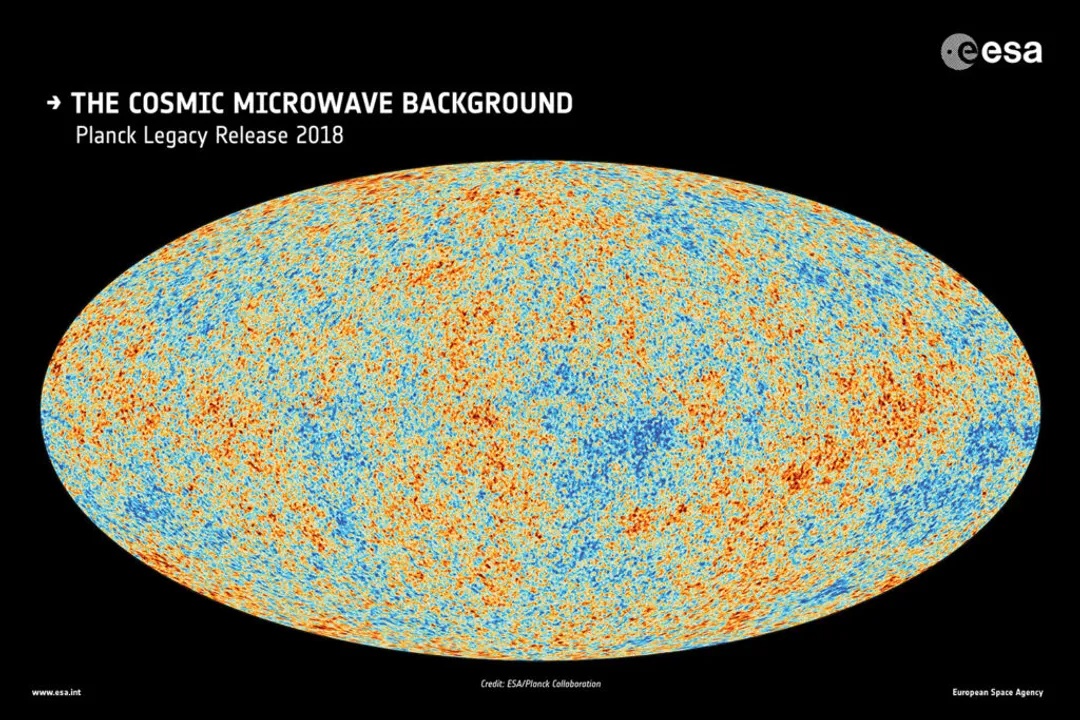
This table illustrates that the redness isn't a steady hue but an accumulation of stretching over time. The most extreme example of this effect is the Cosmic Microwave Background (CMB), the faint glow filling all space. This radiation originated when the universe was only about 380,000 years old, emitting visible light, but the subsequent expansion by a factor of over a thousand has redshifted that light all the way into the microwave band. [4]
# Horizon Depiction
When we look at artistic representations or models of the universe's edge, they are often depicted in shades of red or orange. [1] This visual choice is a direct, simplified metaphor for the dominant cosmological effect observed—the redshift itself. [1] The "edge" in these diagrams usually represents the boundary of our observable universe, or the visual horizon we can see back to, often related to the time before the CMB was released. [1]
Since the light from the furthest objects we can detect is the most heavily redshifted, coloring that boundary red serves as an immediate visual shorthand for "very far away" and "very old" light that has undergone maximum stretching. [1] This depiction contrasts sharply with the idea of a physical barrier or boundary in space; rather, it’s a boundary in time dictated by the finite speed of light and the age of the universe. [9] The concept of looking out into space is fundamentally equivalent to looking back in time, and the red shift quantifies that journey through an expanding medium. [7]
# Cosmic Rulers
The reliability of redshift as a measure for distance is an application of expertise in astrophysics. Knowing that the universe's expansion rate, parameterized by the Hubble Constant (), links distance to redshift allows scientists to build a cosmic distance ladder. [9] For objects far enough away that their motion is dominated by Hubble flow (the expansion of space), we can measure the redshift spectroscopically and immediately calculate the distance with a reasonable degree of accuracy. [7]
This gives researchers an incredibly powerful tool. Instead of relying solely on "standard candles" like Type Ia supernovae—which are complex to calibrate—redshift provides a direct, quantifiable physical measurement based on wave mechanics. [5] It’s almost like having a built-in odometer for space itself. A scientist studying galaxy clusters will measure the value of hundreds of member galaxies, effectively charting the three-dimensional structure and history of that cluster based on how much expansion each photon experienced on its way to the telescope. If one were designing a survey, understanding the relationship between observed spectral shift and distance must be the foundational step for mapping any large-scale structure accurately.
The constant observation of redshift across the cosmos solidifies the conclusion that the universe is expanding, a fact confirmed through techniques like measuring the luminosity and distance of Type Ia supernovae, which demonstrate that the expansion is actually accelerating. [7][9] The redness is not a flaw in the light; it is the message itself—a record of cosmic expansion imprinted on every photon that managed to bridge the vast gulfs of space and time to reach our detectors. [4] It tells us that the universe we see today is merely one stage in a much longer, unfolding drama that began with the Big Bang. [9]
#Videos
Why Is The Universe Expanding? Red-Shift & Doppler Effect ...
Related Questions
#Citations
Why is the edge of the universe often depicted with this orange ...
Redshift - Wikipedia
The red shine you glimpsed through your telescope might actually ...
Redshift - Las Cumbres Observatory
Other explanation for cosmological redshift? - Physics Stack Exchange
Why do we see a red shift for distant galaxies instead of a blue shift?
Why Is The Universe Expanding? Red-Shift & Doppler Effect ...
How do we know the Universe is expanding? - Euclid Consortium