How does the universe expand?

The increase in distance between gravitationally unbound parts of the observable universe over time—that is the core physical description of the expansion of the universe. [3] It is an intrinsic feature of our cosmos, meaning that the very metric of space is changing. This is not the universe moving outward into some pre-existing void, but rather, the space between widely separated objects is continuously being created. [3][10] To grasp this concept, which fundamentally departs from our everyday, local experience, we must first look at how scientists arrived at this revolutionary conclusion.
# Discovery Evidence
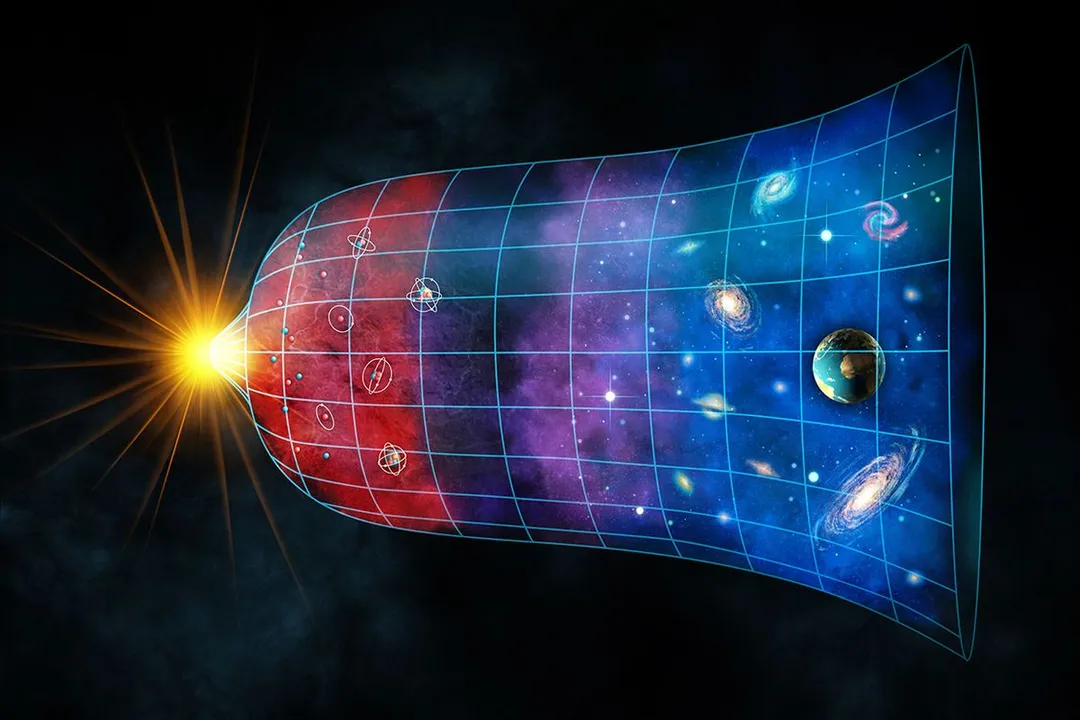
The foundation for understanding our dynamic cosmos was laid in the early decades of the 20th century, combining theoretical groundwork with startling astronomical observation. [3] One of the earliest critical observations came from astronomer Vesto Slipher, who, using a spectrograph, noticed that light from remote galaxies was systematically redshifted. [3][6] Light behaves like a wave, and when a source of light moves away from an observer, the wavelengths stretch out, shifting toward the red end of the spectrum. [4][6][7] This phenomenon is often confused with the familiar Doppler effect for sound, like an ambulance siren changing pitch as it passes, but in cosmology, this stretching is primarily a consequence of the expansion of spacetime itself over the light's travel time. [1][3]
While Slipher noted the recession, it was the work of others that formalized the relationship. In the 1920s, independent theoretical work by Alexander Friedmann and Georges Lemaître, building upon Albert Einstein’s theory of general relativity, suggested that the universe could not be static but must be expanding. [3][6] Einstein’s equations, unlike his initial static assumption, mathematically supported an evolving cosmos. [4] The definitive astronomical proof came shortly after when Edwin Hubble, collaborating with Milton Humason, compared the measured distances to galaxies with their measured redshifts. [3][6] They established a linear relationship: the farther away a galaxy is, the faster it appears to be receding from us. [6][7] This relationship is now formalized as Hubble’s Law (or the Hubble–Lemaître law), where recession velocity is directly proportional to distance, quantified by the Hubble constant (). [3]
Beyond the kinematic evidence of receding galaxies, other observations strongly support the Big Bang model, which necessitates an expansion history. The existence of the Cosmic Microwave Background (CMB) radiation, the faint thermal echo of the universe’s earliest, hottest phase, provides powerful confirmation. [6] Furthermore, the observed ratios of light elements like hydrogen and helium throughout the cosmos align perfectly with calculations based on an initial, rapidly expanding and cooling early universe. [6]
# Space Stretching

The realization that galaxies are moving apart implies that the arena in which they exist—spacetime—is the thing that is actually growing. When cosmologists discuss the expansion, they are referring to the increase in the scale factor (), which dictates the average separation between objects that are not bound together by local forces like gravity. [3][7]
To visualize this, scientists often turn to analogies, though each has its limitations. The most common is the raisin bread model: imagine the dough is space, and the raisins are galaxies. [1][7] As the dough bakes and rises, the raisins themselves do not expand, but the distance between every raisin increases as new dough (space) is created uniformly throughout the loaf. [1][7] Another popular illustration is dots drawn on the surface of an inflating balloon. [6][10] As air is pumped in, the surface area grows, forcing the dots apart. The crucial takeaway from both analogies is that the expansion happens everywhere simultaneously, and there is no central point from which everything is rushing away. [2][10]
However, applying our intuition developed in a world where objects move through fixed space presents confusion, particularly regarding the question: what is the universe expanding into?. [2][8][10] By definition, the universe is everything there is; there can be no "outside" for it to expand into, because "outside" is a spatial concept, and space only exists within the universe. [8][10] The expansion is better understood not as pushing into a pre-existing external volume, but as new space itself coming into existence everywhere at once, increasing the scale factor. [2][10] It is less like an explosion propagating outward and more like a universal metric being steadily stretched. [1] This concept is deeply non-intuitive because we are accustomed to time flowing, where more time has simply elapsed, but we don't typically visualize time as "expanding into non-time". [2] The universe’s increasing volume is similar: space is constantly increasing its own internal separation. [2]
# Binding Effects

While the space between all points in the cosmos is technically increasing, this effect is entirely dominated by other forces on smaller scales, making it unobservable locally. [2][7] The gravitational attraction within solar systems, galaxies, and even galaxy clusters is vastly stronger than the repulsive effect of cosmic expansion. [2][10] Consequently, gravitationally bound structures do not expand along with the universe. [1][2] Our solar system remains intact, the Earth does not expand, and the stars within the Milky Way maintain their relative distances due to their collective gravity. [1]
Even on the scale of galaxy clusters, the local gravitational pull can overcome the general expansion. For instance, the Andromeda galaxy, our nearest large neighbor, is actually moving toward the Milky Way because the mutual gravitational attraction between our two massive structures is greater than the expansion separating us. [2][10] The Hubble flow—the systematic recession due to expansion—is only clearly measurable between structures that are far enough apart that gravity is extremely weak, such as between distant galaxy clusters or superclusters. [2][10]
To put the local effect into perspective, consider the calculated rate. The current expansion rate, using a common measurement, is about . [7][10] A megaparsec is just over three million light-years. The distance to our nearest stellar neighbor, Alpha Centauri (about one parsec away), increases by approximately 7 centimeters every second. [2][10] While mathematically this means new space is being added between us and Alpha Centauri every moment, this minute accumulation is instantly nullified by the galaxy's local motion toward us, which is much faster. [2][10] If we could precisely measure the expansion rate between two objects separated by just one kilometer, the rate of separation is minuscule—on the order of a few nanometers per second. [2] This highlights a fundamental aspect of General Relativity on cosmic scales: the expansion dictates the dynamics only where gravity is too weak to enforce local structure. [2]
# Cosmic Tug
The story of cosmic expansion is not a simple one of relentless stretching; it is a history governed by a cosmic tug-of-war between the initial momentum of the Big Bang, the attractive force of matter (gravity), and a mysterious repulsive pressure. [8]
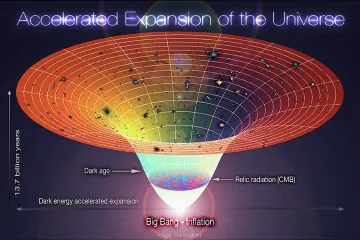
In the universe's earliest moments, an epoch known as inflation saw an incredibly fast, exponential increase in scale, theorized to have occurred within the first fraction of a second after the Big Bang. [3][7] Following this, the expansion decelerated significantly. Initially, this deceleration was driven by the high density of radiation, and later, as the universe cooled, by the density of matter. [3][8] For billions of years, the mutual gravitational attraction of all matter worked to slow the outward rush, leading to the prior expectation that the expansion would eventually stop or reverse into a "Big Crunch". [7][8]
However, observations made in 1998 using distant Type Ia supernovae revealed a profound surprise: the expansion was not slowing down; it was accelerating. [3][4][8][9] This discovery, which earned the 2011 Nobel Prize in Physics, implied the existence of a pervasive, repulsive force overwhelming gravity on the largest scales. [4][7] This unknown driver is what scientists have termed Dark Energy. [4][7]
# Dark Energy
Dark energy is currently the dominant component shaping the universe's fate, making up roughly 68% of its total mass-energy content. [4][9] It behaves like a negative pressure, actively pushing spacetime apart, causing the scale factor to grow exponentially once more, similar to inflation but at a slower, sustained rate. [3][4]
Physicists have several leading hypotheses for what dark energy could be, illustrating the depth of our current ignorance regarding this major cosmic influence. [4][9]
The simplest explanation ties it back to Einstein: the Cosmological Constant (). [3][4] This suggests dark energy is an inherent, ever-present vacuum energy permeating all of space. [4] If this is the case, its energy density remains constant even as space expands, ensuring its repulsive effect grows relative to matter density, which dilutes over time. [3][8] A major hurdle for this theory is the cosmological constant problem: theoretical calculations based on quantum field theory predict a vacuum energy density that is many orders of magnitude (up to times) greater than what is observed, a discrepancy that remains a profound mystery in physics. [4]
A competing idea is Quintessence, proposing dark energy is a dynamic energy fluid or field whose quantity and distribution can change over time and space, contrasting with the constant nature of . [4] Another, less supported idea involves Space Wrinkles, suggesting dark energy might stem from defects in spacetime, like hypothetical cosmic strings formed in the early universe. [4] Finally, a radical alternative suggests that dark energy isn't a physical substance at all, but rather an indication that General Relativity needs modification when applied to the largest cosmic scales. [3][4] Some modifications, like unimodular gravity, could explain the acceleration without invoking a new form of energy. [3]
# Future View
The current dominance of dark energy suggests a future where the scale factor continues to increase exponentially, meaning the expansion accelerates indefinitely. [3][4] If this acceleration continues, the distances between all but the most tightly bound structures will grow so vast that almost all other galaxies will eventually recede beyond our observational horizon, leaving future astronomers seeing a mostly empty local group of galaxies. [8][9] The concept of the cosmological horizon defines the boundary beyond which light can never reach us because the space expanding between us and the source is growing faster than the speed of light itself. [3][7]
The actual measurement of the expansion rate, , is currently subject to what is termed the Hubble Tension. [3] Measurements based on nearby standard candles, like Type Ia supernovae, yield a slightly higher value for (around ) compared to measurements derived from the early universe via the CMB (around ). [3] Resolving this tension is a major goal for new instruments. Projects like the ESA's Euclid mission, launched in 2023, and NASA's upcoming Nancy Grace Roman Space Telescope are designed to create precise 3D maps of billions of galaxies to measure how dark energy has influenced structure and expansion across cosmic time, potentially narrowing the measurement uncertainty or pointing toward a breakdown in the standard Lambda-CDM model. [3][4][9]
Even though gravity dictates that objects within a galaxy cluster won't fly apart in the immediate future, understanding the acceleration caused by dark energy is essential to charting the ultimate destiny of the cosmos. [9] The expansion is a fundamental property of the metric itself, governed by the total energy content of the universe, and while gravity works to cluster things, dark energy seems intent on pulling everything else apart over astronomical timescales. [8] The fact that this vast, repulsive pressure is pushing the universe apart faster and faster, despite our galaxy clusters holding fast, is a strange balance, one where the local environment holds steady against a backdrop of ever-increasing cosmic scale. [2][9] The ongoing effort by observatories to map this expansion history promises to reveal whether dark energy is a fixed property of space or something more dynamic and evolving. [4]
#Videos
The Expansion of the Universe Made Simple - YouTube
Related Questions
#Citations
Expansion of the universe - Wikipedia
How does the expansion of space work? - Reddit
What is Dark Energy? Inside Our Accelerating, Expanding Universe
Ask Ethan #39: Why does light stretch as the Universe expands?
The Expansion of the Universe Made Simple - YouTube
How do we know the Universe is expanding? - Euclid Consortium
Expansion of the Universe - BBC Sky at Night Magazine
What is the universe expanding into? - Astronomy Magazine
Exploring the Mystery of Our Expanding Universe
Our Expanding Universe: Delving into Dark Energy